

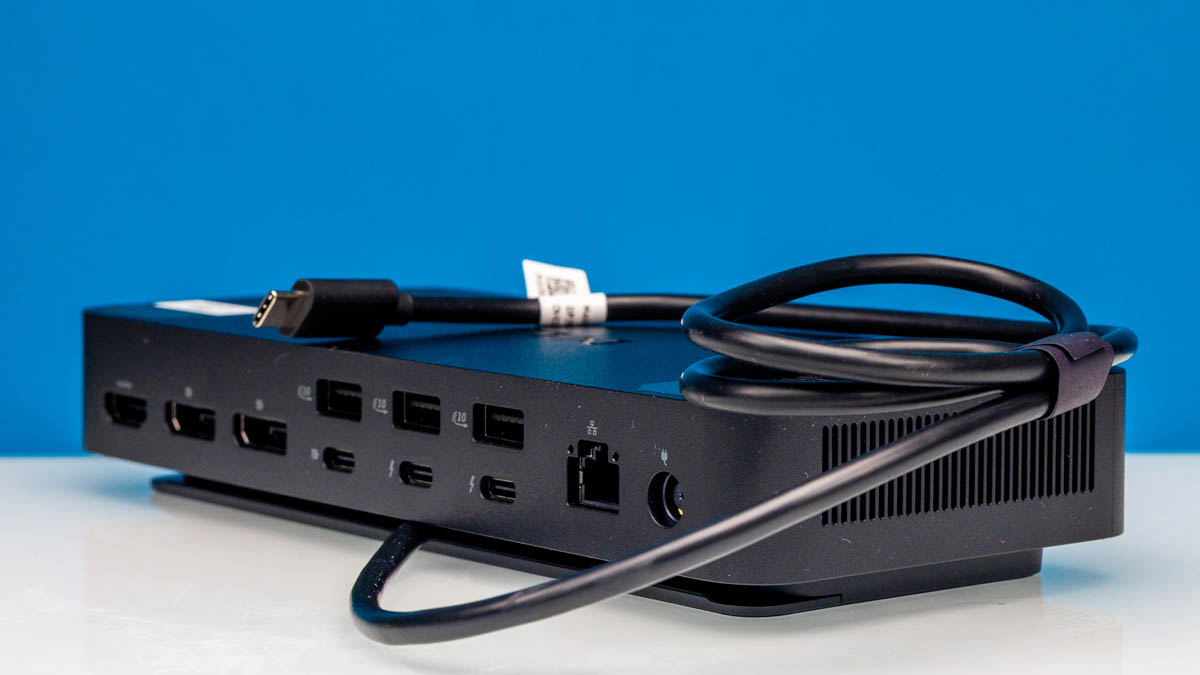
The Dell Pro Thunderbolt 5 Smart Dock is a next-generation dock for adding ports and display outputs to Thunderbolt 5 systems. Recently, we had access to the Dell Pro Thunderbolt 5 Smart Dock. Dell sent this as part of a package to review the Dell Pro Max 18 Plus, and we did not find a lot out there on it, so we figured we would do a quick write-up. This dock actually has a feature which is useful for large notebooks like that Dell Pro Max 18 Plus, so we thought it was worth doing its own piece for it.
Dell Pro Thunderbolt 5 Smart Dock Hardware Overview
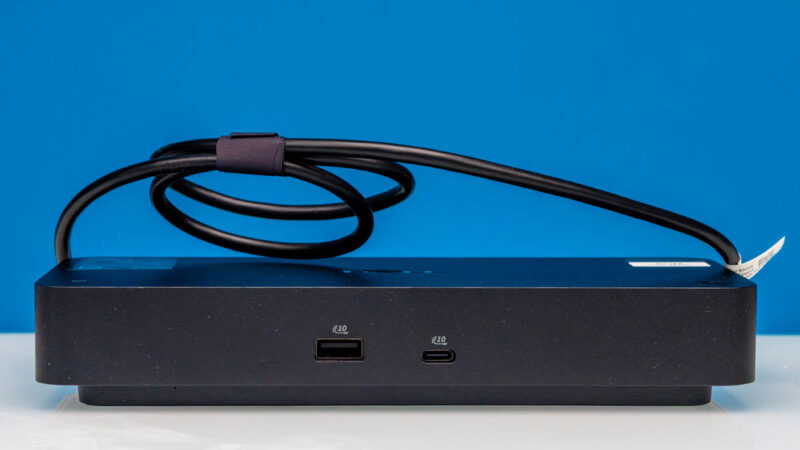
On the front of the dock, we get two USB ports, one Type-A and one Type-C. Dell labels these with a 10, so we know they are 10Gbps ports. If you have been reading STH for some time, you probably know we advocate clearly labeling what USB ports are because the USB folks have made an absolute mess of naming conventions over time.
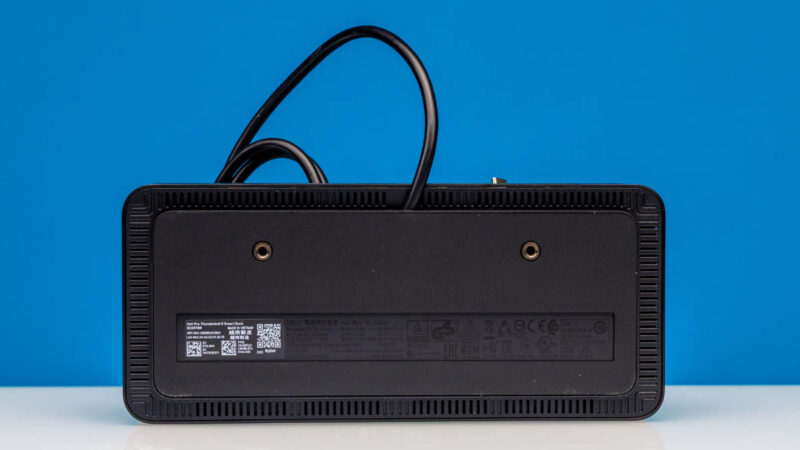
On the bottom, we get a large rubber base and connection information.
On the back we get three more USB Type-A ports with PowerShare (all four have PowerShare.) All of the USB ports are 10Gbps USB 3.2 Gen2. There are two downstream Thunderbolt 5 ports, a power input, and a 2.5GbE port. We will later show this is a Realtek 2.5GbE NIC port.
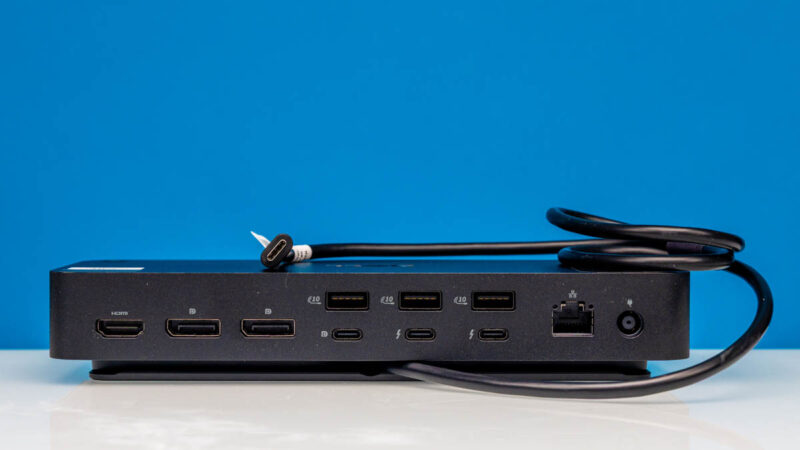
Display outputs are a HDMI 2.1 port and two DisplayPort 2.1 ports. The rear Type-C port is another USB 3.2 Gen2 port but with DisplayPort alt mode.
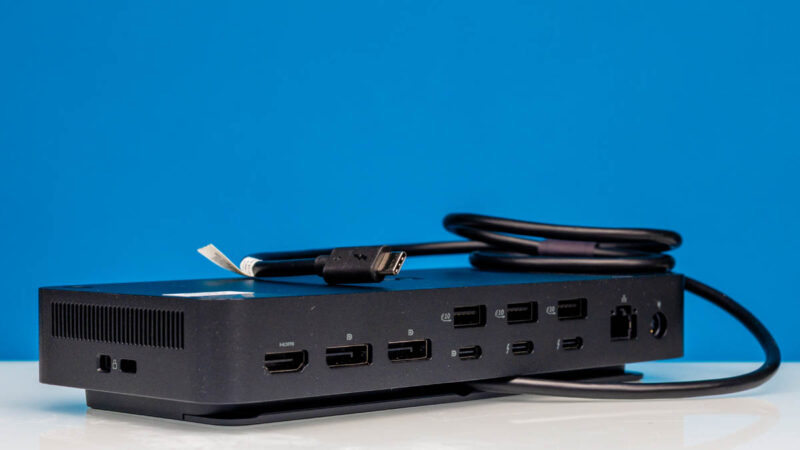
Something you may have noticed by now is that Dell has a Thunderbolt 5 cable that attaches into the bottom of the unit. That limits the cable you are using, but on the plus side you do not have to try buying a Thunderbolt 5 cable that works with the dock.
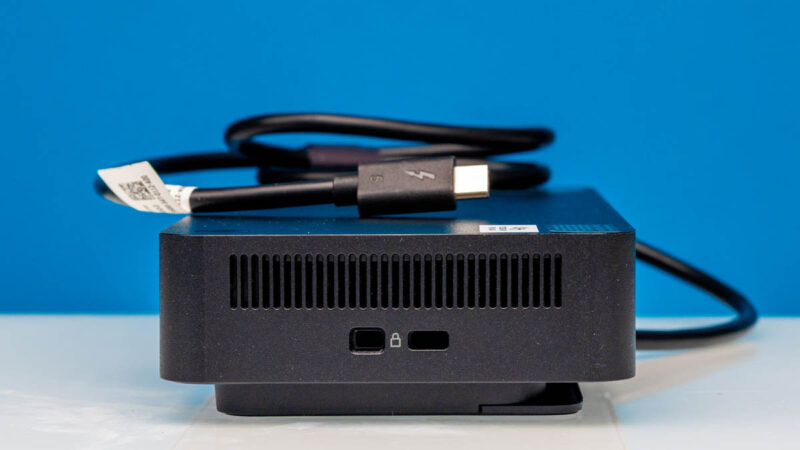
There are also locking points on the side.
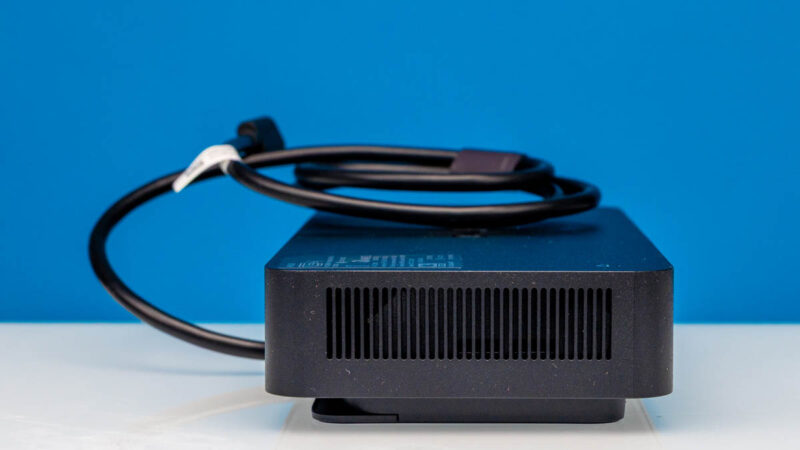
Another side feature is the vents. This Dock has an internal fan. That internal fan is audible but in our 34dba noise floor studio is reading 35-36dba on the sound meter from 1 meter away. The sound is present, but so far it has not been bad for us.
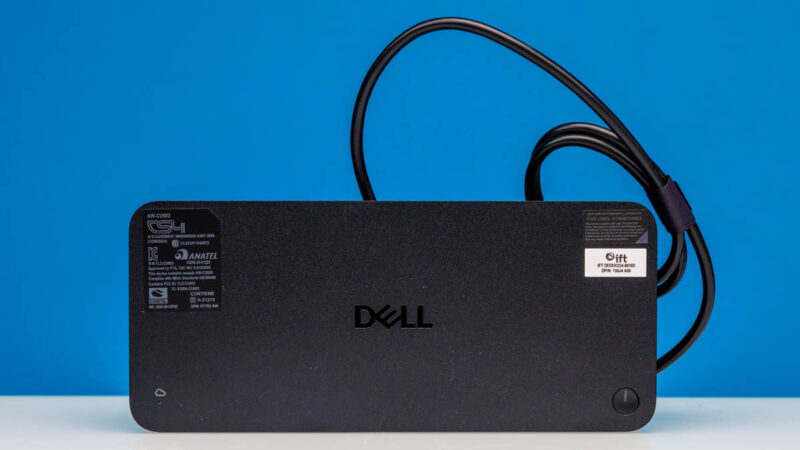
At the top, we find more labels, a power button, and a small cloud icon in the bottom corner. Dell has this version, the SD25TB5 which is the Smart Dock, and then also a WD25TB5 version that is not a Smart Dock. The Smart Dock allows the unit to connect to a WiFi network for remote device firmware upgrades even if the PC is not connected. I think there are a decent number of our readers who manage large remote fleets that will understand why that is so cool. There are others who will prefer the WD25TB5 without this feature.
Next, let us look at the huge power adapter for this dock.

What is the point of having a dock with a huge power adapter? Why not combine them into a single unit?
The last Dell dock I had with a built-in usb-c cable died after a couple of years because apparently no one can make a usb cable to last anymore. Had to pitch the entire dock vs replace the cable, which made me swear to myself to NEVER buy another dock with a built-in cable. Seems Dell doesn’t learn, or prefers the planned obsolescence…
I’ve been using the Dell TB3 and TB4 docks for a few years and they’ve been great. One thing I noticed is that the new TB5 docks are no longer modular, but that’s no biggie.
To answer someone else’s question as to why the Power supply isn’t built into the unit and uses an AC adapter brick. It’s to keep the dock itself relatively small on the desk, with the power cord going behind your desk to the brick on the floor, hidden out of site. That’s the main advantage I can see.
@Mike_Butash the Dell WDDTB3 and TB4 docks were modular and the built in cable is hardwired to the smallish removable module. It’s not as ideal as a completely removable cable, as you noticed. But it means if that cable dies on the previous gen TB4 docks you would replace with a new module, not replace the whole dock. A new module is about $30-$60 which is a rip off perhaps, but less than an entire dock.
The new TB5 dock though is not even modular like the TB4 and TB3 docks and we’d have to replace the entire dock if the hardwired cable dies, which would suck.
If I connect a MacBook Pro, how many displays can it support? Can it break the external display limitations of the MacBook Air?
A shame it’s 2.5Gb ethernet and not 10Gb. Any regular reader of StH knows how cheap 10Gb switches have got.
Does it have a built-in fan?
I know that every single dock that Dell has ever made and the perforations on either side make me think that this is no exception, which would probably make me look for another alternative, as I simply don’t want yet another potential point of failure.
@Korev this is made for corporate enviornments which a majority are still on 1gb links and a small amount may have moved to 2.5. If you’re looking for a 10GB dock there are others out there like Cal-Digit that have docks with 10gb
You call Dell’s boosted proprietary power delivery a “neat little trick” but in my experience it’s actually a hassle.
First you essentially are tied to using Dell hubs with Dell laptops else you get warnings in Windows.
And second, it doesnt always negotiate the proper power delivery for non Dell chargers. When booted My XPS 17 will fall back to 5W charging with a 60W Jackery charger. Only when the laptop is off does it negotiate the proper charging rate.
A hassle and a gimmick if you ask me.
How many 4k displays can it handle and what’s the proposed rrp plus all the other useful information … might as well have just chatgpt’d the specs page in the dell website and got a better article!!!
I’m With Andy Rossi, Dell have a bad habit of bandwidth limiting the USB-C, so you can’t hook up multiple 2K+ screens.
I would have liked some external monitor testing. A single DP 2.1 stream muxed in would have 80 Gbit of bandwidth which is enough for four 4k displays at 60 Hz and the this dock has the connectivity to split a DP 2.1 MST feed into such.
Conceptually a fifth and sixth display is possible using both DP 2.1 and DP 2.0 to saturate the 120 Gbit TB5 uplink bandwidth. However, that would require some complex DP demux in the hub itself and the host system providing two MST feeds into the TB5 controller.
As for the power brick, it is annoying that Dell uses proprietary voltages to reach 300 W (likely 5 amp at 60V where the official USB-PD spec tops out at 48V). Dell laptops are annoying in that they do throw an error with a non-Dell USB-C power supply but they’ll still work at standard USB-PD values.
I owned one of these briefly and ended up sending it back due to two problems, one minor and one major. The minor issue was that it would sometimes cut out for a moment, interrupting network traffic and resetting the screens. It didn’t happen regularly but did happen, on average, once every 5-10 minutes.
The major problem was that Dell absolutely refused to offer any tech support whatsoever because I was connecting it to an Alienware laptop (a Dell product!), but they had a list of compatible laptops for each dock and no Alienware laptop was to be found on that list.
This is after I had been advised by Dell Pre-sales that the SD25TB5 was compatible. So at Dell, the right hand doesn’t know what the left hand is doing. It was almost comical how the tech support person ran in circles. “It’s not compatible.” “What IS compatible?” “Contact Dell Sales for that information.” “I did that, they advised me to buy THIS.” “It’s not compatible.” and on and on.
I eventually, since the laptop was still within its return period, returned both it and the dock and purchased a different brand of laptop entirely.
The sad thing is: I really liked that laptop. I like the dock, too. Just returning the dock under warranty for a replacement probably would have solved everything. But Dell themselves convinced me that what otherwise would have been my 3rd Dell laptop would be my last.
I don’t write this to rant about Dell or the bad experience I had, but to warn others that you will not get any support at all from Dell for this relatively new product except under very limited, specific circumstances. Caveat Emptor.
“Also interesting is that the adapter has a barrel jack output not a USB Type-C output.”
Not interesting. Author is ill-informed.