Dell Pro Rugged 12 Tablet Performance
As noted in our introduction, Dell has based the current generation of the Rugged 12 Tablet around Intel’s highly integrated and ultra-low-power Core Ultra 200V hardware, also known as Lunar Lake. Sparing almost no expense to minimize the SoC’s power usage, Lunar Lake relies on on-package LPDDR5X memory, making the chip a SoC in the purest sense of word.
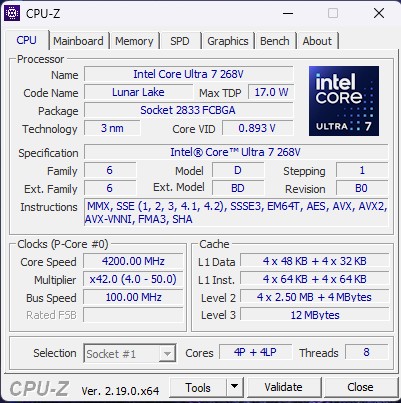
Between Intel’s integration efforts as well as their work to optimize the Lion Cove and Skymont CPU cores for the chip, Lunar Lake has tested very well in other devices, making it a good fit for a device with very restricted ventilation options. All Lunar Lake chip SKUs ship with 4 P-cores and 4 E-cores, offering a solid mix of cores for both lightly and heavily-threaded workloads. Which is not to say that the Rugged 12 Tablet will be giving any recent desktops a run for their money, but it is reasonably powerful for an x86 tablet.
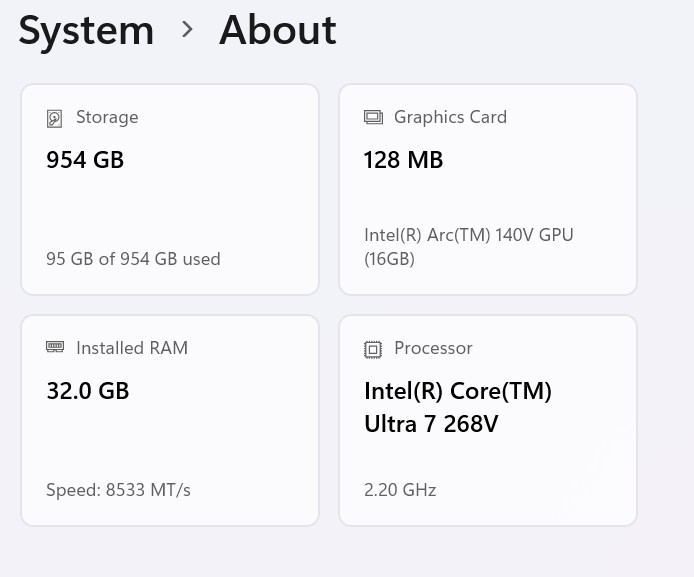
Similarly, while this is not by any means a gaming device, the integrated Xe2-LPG based GPU, the Arc 140V, has little trouble handling just about anything you can think to throw at it.
Geekbench 6 results
Seeing as how we do not regularly review tablets – and ruggedized tablets, even less so – what to compare Dell’s Pro Rugged 12 Tablet to is largely arbitrary. In this case, we will see how it compares to contemporary hardware, as we are reviewed a few devices based on Intel’s Arrow Lake hardware over the last year. In this specific case, we will use Lenovo’s ThinkStation P3 Tiny Gen2, a tiny 1-liter small form factor PC, as our baseline.
With the Lenovo SFF desktop PC sporting a more powerful mobile chip – and perhaps most importantly, a desktop power connection – the two systems are not on equal footing. But this is not a race to see who will win, so much as how much performance of a SFF desktop the hefty tablet can retain. And, in practice, it is quite close at times.
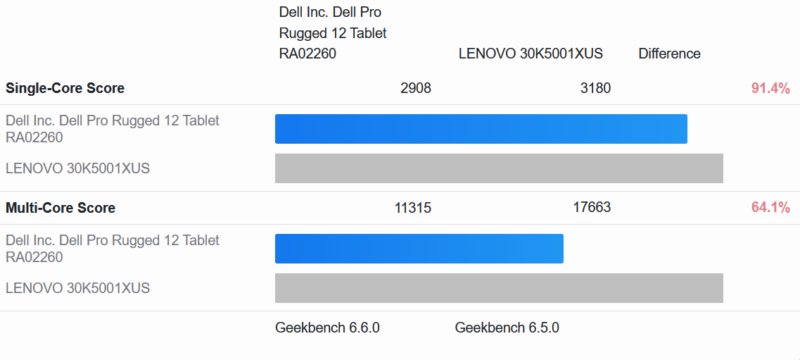
In single-threaded benchmarks, the Intel Core Ultra 7 268V SoC performs extremely well, delivering 95% of the Lenovo’s performance. And most of that comes down to the peak clockspeed differences, with the Intel chip in the Lenovo SFF system being allowed to turbo as high as 5.6GHz, versus 5.0GHz for the ultra-mobile chip in the Rugged 12 Tablet. Multithreaded performance finds a wider gap, however, thanks to the far larger number of CPU cores in the Lenovo box. This is one of the key differentiators between Intel’s Lunar Lake and Arrow Lake chips – energy efficiency versus peak performance, particularly in heavily threaded workloads.
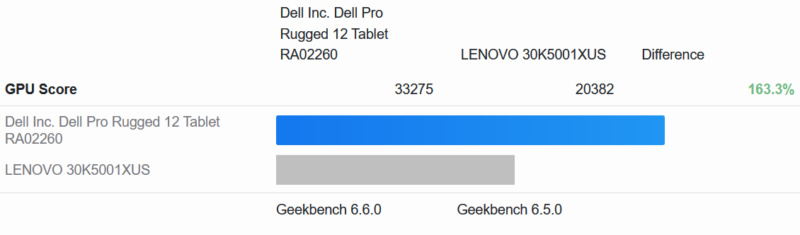
Meanwhile under Geekbench 6’s GPU compute benchmark, Dell’s tablet actually pulls well ahead here. This is thanks to the architecturally newer and far more performant GPU used in the Lunar Lake SoC, which helps to ensure that the ultra-mobile chip does not find itself short on GPU compute performance. As a result, the Dell Rugged 12 Tablet punches higher than one might expect for GPU performance, giving all but the very latest integrated x86 iGPUs a run for their money.