
Centec ZX530S-24S2CQ Performance
The RFC2544 throughput and latency run used CentecOS 6.0.2.1. Ports eth-0-1 through eth-0-24 were connected at 10G to the Keysight IxNetwork XGS2 traffic generator, and eth-0-25 and eth-0-26 were connected at 100G with RS-FEC. This QuickTest overview shows the full frame-size sweep from 64 bytes through IPSec IMIX with green pass markers on the iteration timeline. The selected statistics show zero frames delta and an Rx rate of 41.983 Gbps for one traffic item.
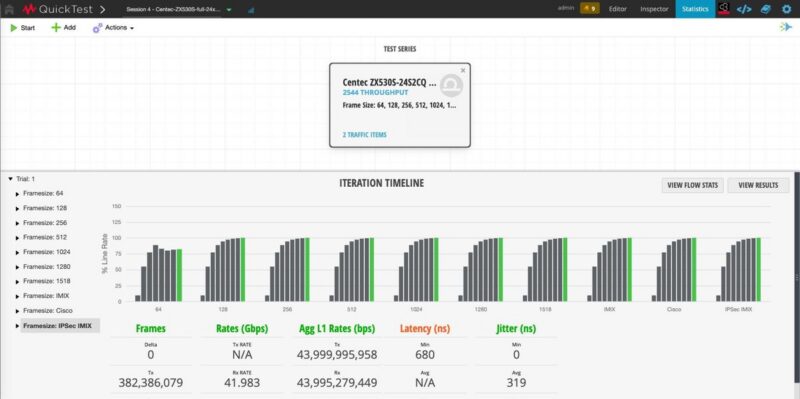
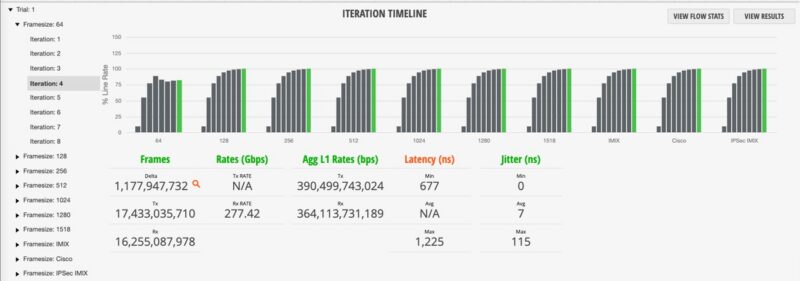
The 64-byte case is where the switch fails line rate. This iteration timeline at iteration 4 shows frame loss with a delta of over 1.1 billion frames when offered load reached 88.75 percent of line rate.
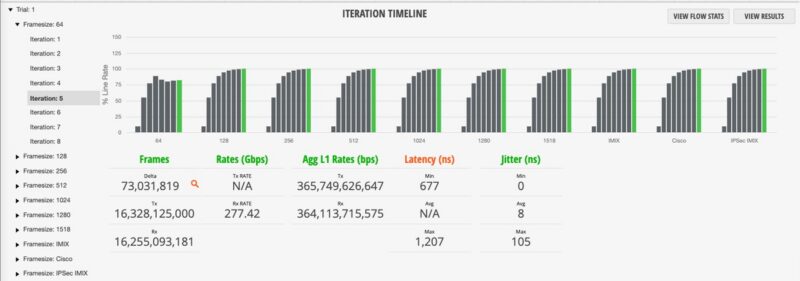
At iteration 5, the binary search stepped down to 83.125 percent offered load but still showed continued frame loss with a delta of approximately 73 million frames. The switch delivered roughly the same output as the previous iteration despite receiving less traffic.
The binary search found a zero-loss pass at iteration 8, which corresponds to 82.422 percent of aggregate line rate. This timeline shows matching transmit and receive counts with zero frame loss at that offered load.
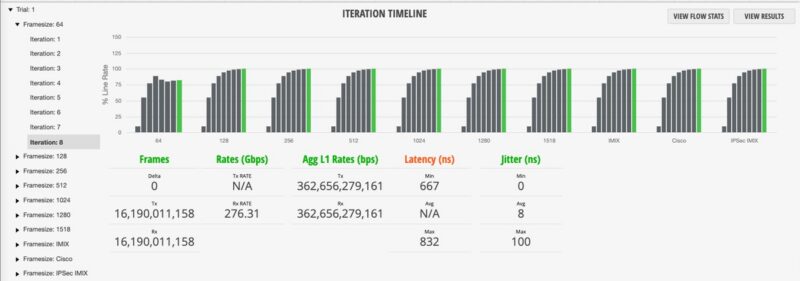
At the passing 64-byte rate, the switch delivered approximately 539.7 million frames per second and 362.66 Gb/s aggregate Layer 1 receive throughput. At higher offered loads of 88.75 percent and 83.125 percent, the output stopped increasing at roughly 541.8 Mpps while dropping the extra traffic.
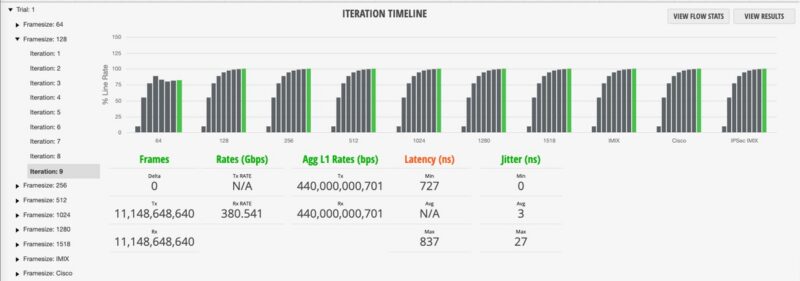
Looking at the other RFC 2544 results, the screenshot for iteration 9 with a 128-byte frame size shows zero packet loss. The switch achieved 100% of the offered load, resulting in an aggregate Layer 1 receive rate of 440 Gbps. Maximum latency was recorded at 837 ns. This aligns with broader testing where all fixed frame sizes of 128 bytes and larger passed with zero loss and full aggregate line rate.
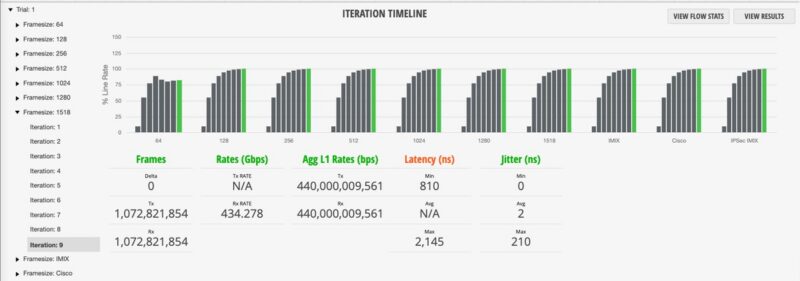
The 1518-byte test also passed at full line rate, reaching 100 percent in iteration 9 with zero loss and a maximum latency of 2,145 ns. Larger frames are easier on the forwarding pipeline because there are fewer packets per second to process.
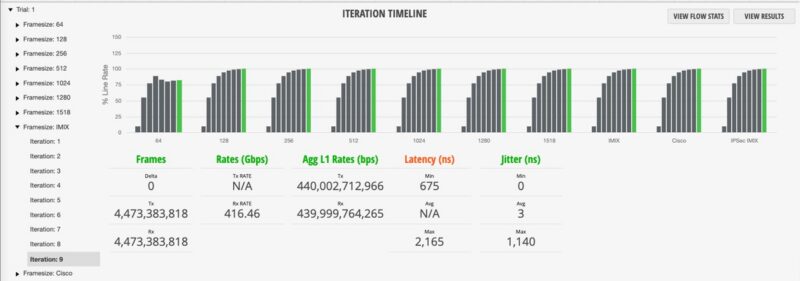
Mixed-size profiles behaved similarly since their average packet size keeps the frame rate below the ceiling. The IMIX profile passed at full aggregate line rate with zero loss and a maximum latency of 2,165 ns in this iteration timeline.
The contrast between the zero-loss results and the lossy trials is striking. At every frame size from 128 bytes up through all three IMIX profiles, the switch held full aggregate line rate at 440 Gb/s with zero dropped frames. But at 64 bytes, the picture changes completely: offered loads of 88.75% and 83.125% both produced exactly 541.8 Mpps received (364.1 Gb/s L1), with frame loss of 6.8% and 0.45%, respectively. The switch delivered the identical packet count in both trials regardless of how much additional traffic was offered, pinning output at a fixed rate while dropping everything above it. That flat receive plateau is the signature of a forwarding-pipeline packet-rate ceiling. After all, the same hardware forwards 371.6 Mpps at 128 bytes with zero loss. For a higher-end switch, this kind of performance would be a bummer. For this class of switch, perhaps not being able to do 64B at full line rate is a worthwhile trade-off.
Centec ZX530S-24S2CQ Power Consumption
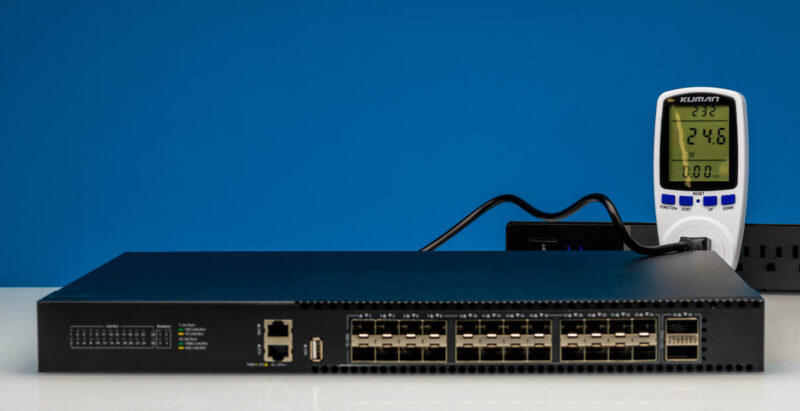
Meter readings with nothing plugged in and idle show approximately 24.6 W on the power meter.
We plugged in an SFP+ to 10GBASE-T adapter and saw 25.3 W under similar conditions.
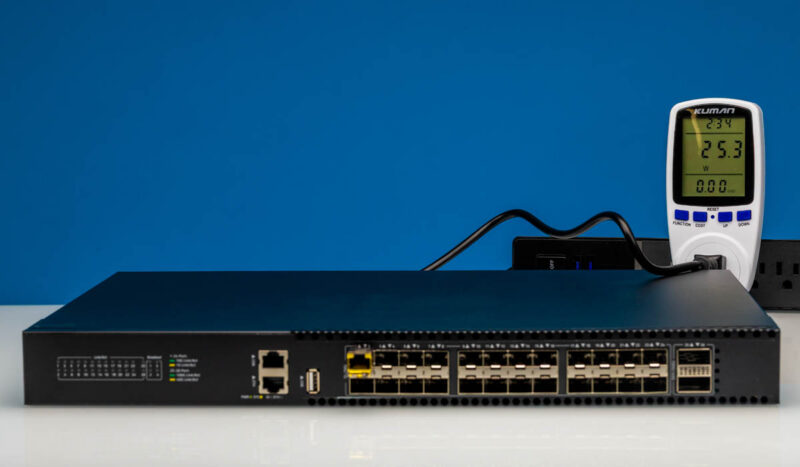
Overall, this is about what we would expect from this class of switch.
Key Lessons Learned
The real reason we bought this switch was that we wanted to test a Centec-based switch after seeing it in the forums many times. Centec describes CTC7132 as a sixth-generation Ethernet switch silicon family with an embedded ARM A53 CPU core, support for QSGMII and USXGMII-M ports, and full-rate port capability from 100M to 100G.
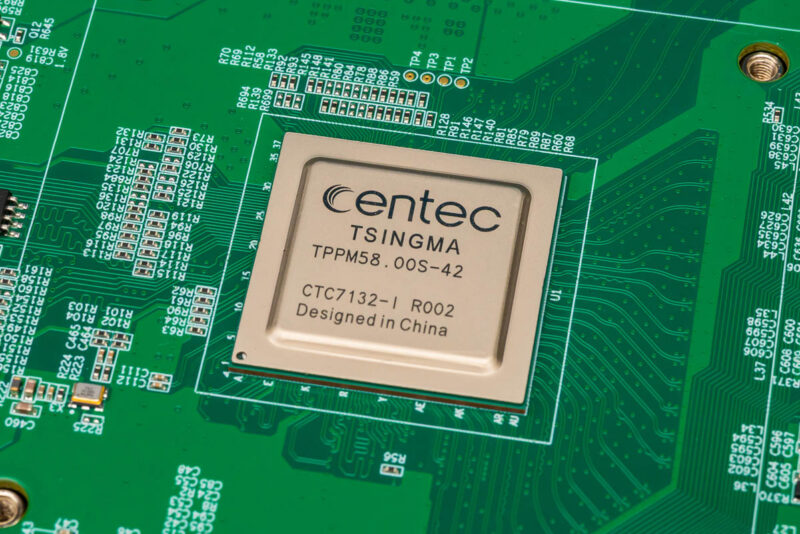
Overall, the Chinese switch chip performed OK, but the 64B results clearly showed where it could not hold up. If we were paying $1000+ on a switch, this would be less exciting. Realistically though, I think most people buying a $480-600 switch will not be using it to pass more than 80% line rate of 64B packets.
A switch can reach 440Gbps Layer 1 rate from 128 bytes and upward, which is still fairly good. Maybe the cooler part of this is that we were able to actually do the first real test of this chip that we have seen. Without high-end IxNetwork hardware testing gear, we probably would not have been able to see this result and instead just said it was good with iperf3.
Final Words
A different switch chip with its own network operating system, both from China, will appeal to some and repel others. Our real goal was simply to get the hardware and to see how it performs.
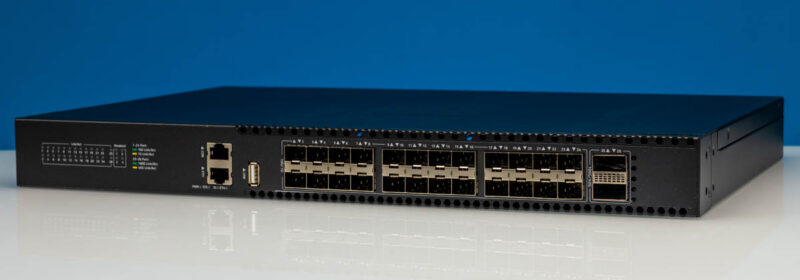
What I really like about this switch is just the flexibility. 10G SFP+ is good for connecting to SFP+ servers, a few 10Gbase-T ports using adapters but also downstream 1GbE and 2.5GbE switches. The 100G QSFP28 ports allow you to have higher-speed workstations, servers, and NAS devices connected, or to use them to connect to higher-speed switches, such as the MikroTik CRS520-4XS-16XQ-RM.
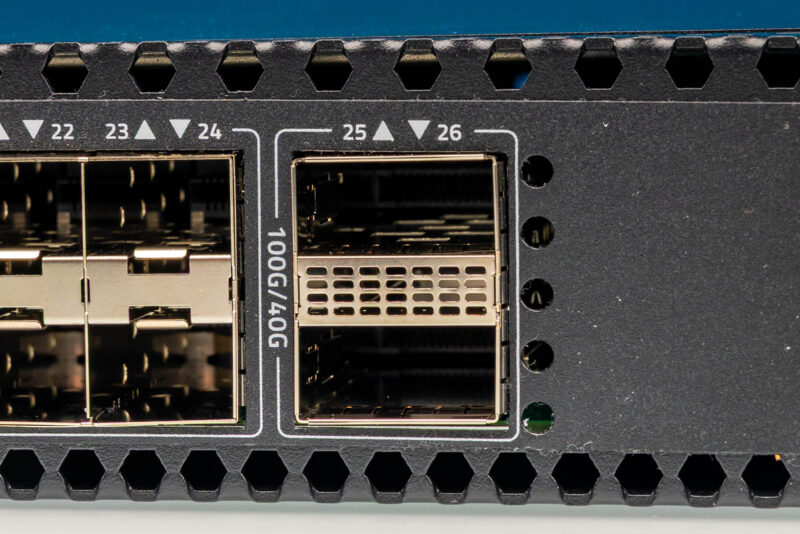
Put differently, the port configuration is great. The overall build quality is about what you expect from a $480-600 switch. We are not crazy about the Centec switch chip, but realistically it is enough for this segment.