

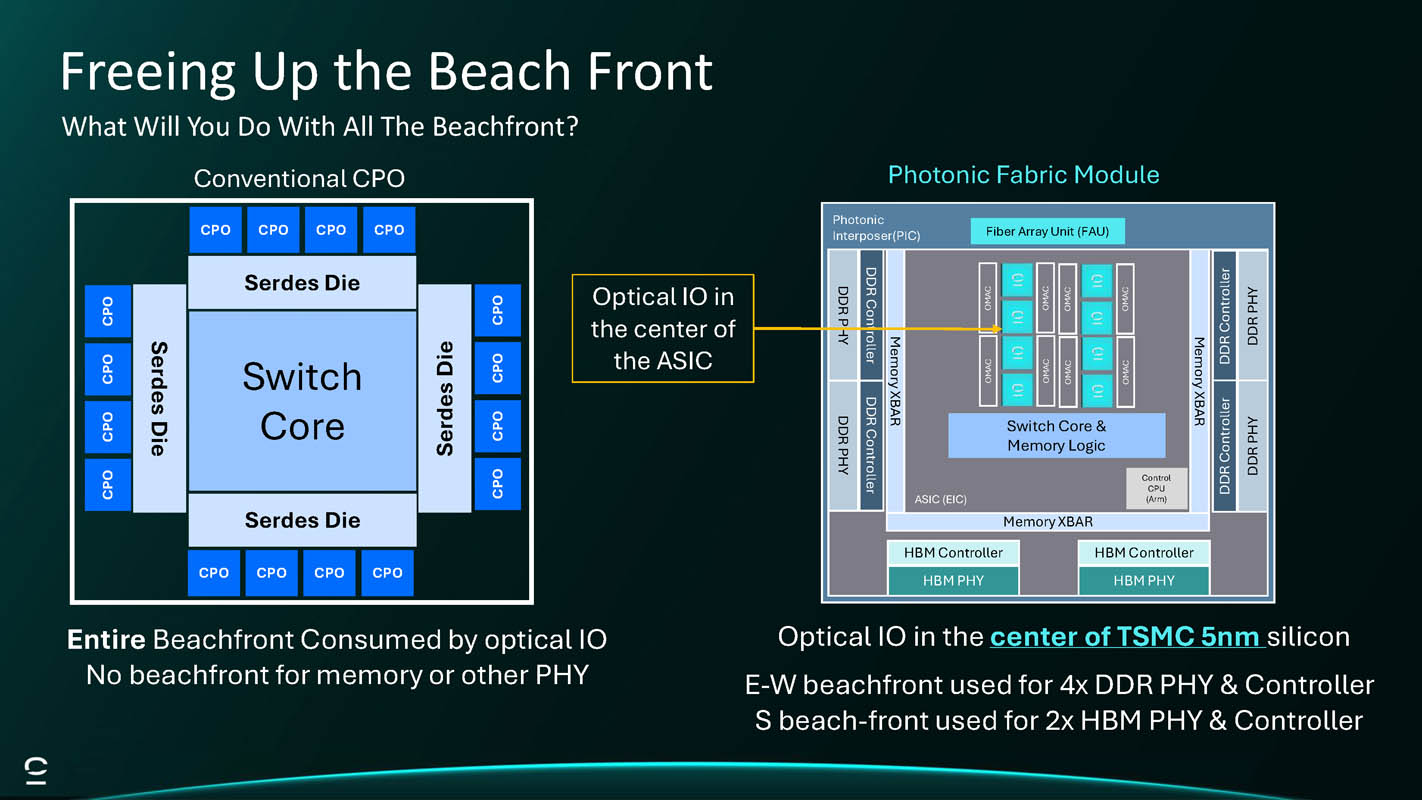
At Hot Chips 2025, we get to see Celestial AI’s Photonic Fabric link. This technology enables the connection of chiplets for next-generation massive GPUs and accelerators using light, replacing the electrical connections currently in use.
We are doing these live, so please excuse typos.
Celestial AI Photonic Fabric Module at Hot Chips 2025
Celestial’s idea is not just to do co-packaged optics, but then bring it to large GPUs with the right packaging and thermals.
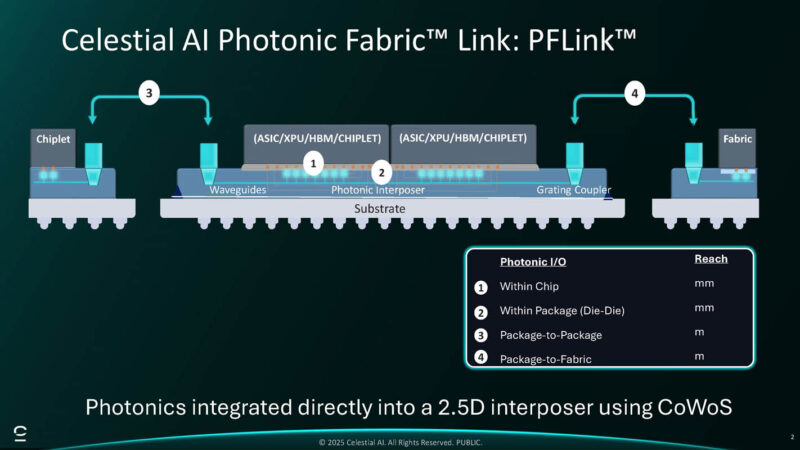
Right now the focus is on HBM with an interposer below. Celestial AI PFLink has a silicon photonics layer with both passive and active components. Celestial matches the SerDes to the channel to be very power efficient. The company is also doing things like building its own optical MAC (OMAC) for RAS features.
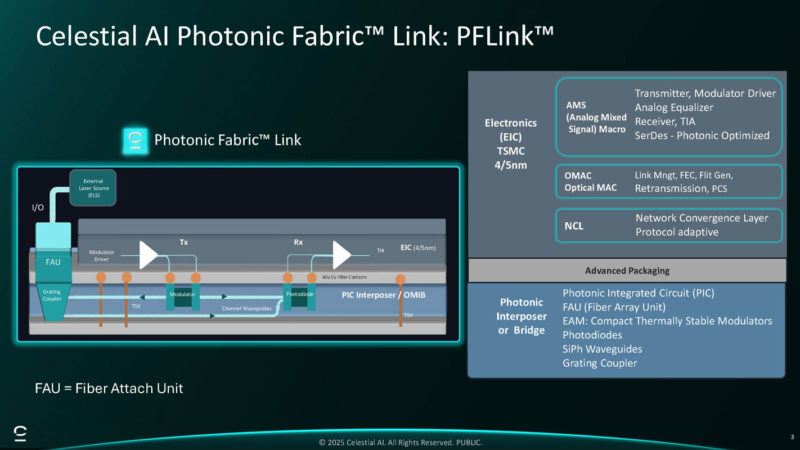
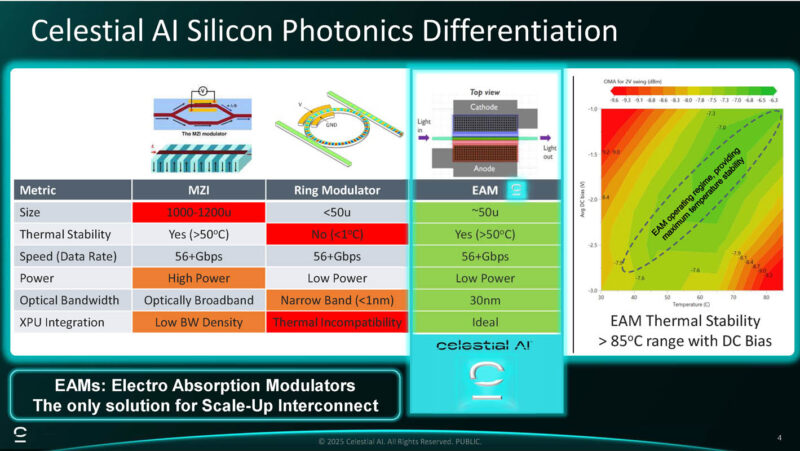
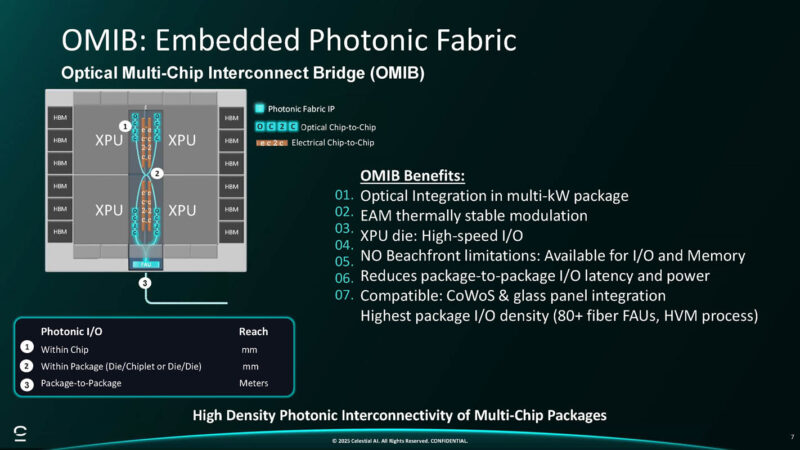
The company is using different modulation technology than others. We have seen a lot of ring modulators on STH previously. EAMs are seen as being better from a thermal standpoint.
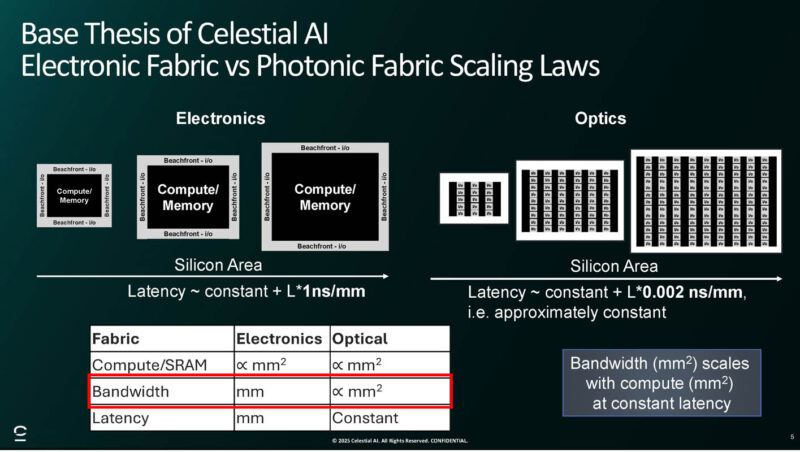
Bandwidth and compute bandwidth are not scaling at the same rate. With multi-die packaged getting larger the perimeter is growing room for off package I/O linearly, but the area is squared.
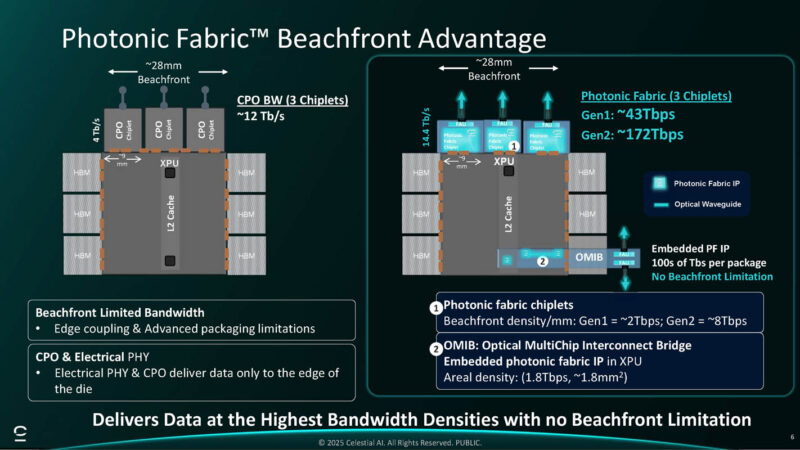
Here is a slide on the beachfront advantage which may impact how caches are built and used in chips.
A use for this is doing package to package interconnects.
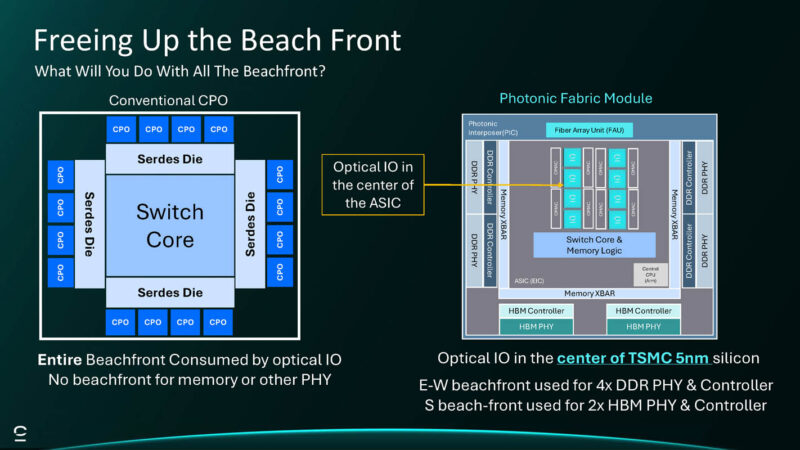
The idea is that with this type of photonics, it frees up beachfront. The conventional CPO is more of a Broadcom CPO switch model. With Celestial AI, that optical I/O can occur in the center of the ASIC. Then the rest of the chip can be used for electrical I/O such as for HBM.
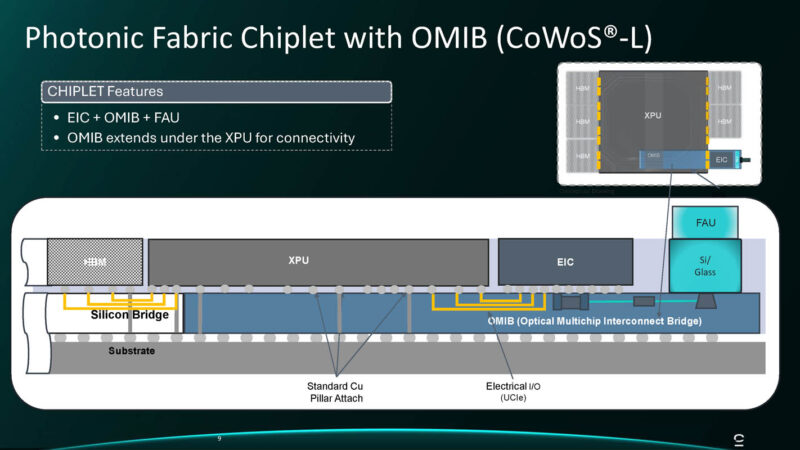
Here is what this looks like with CoWoS-L with a chiplet that has the EIC, OIMB, and the optical multichip interconnect bridge. Just keeping the optical interfaces safe during manufacturing is a challenge, so Celestial AI says they have technology to solve packaging.
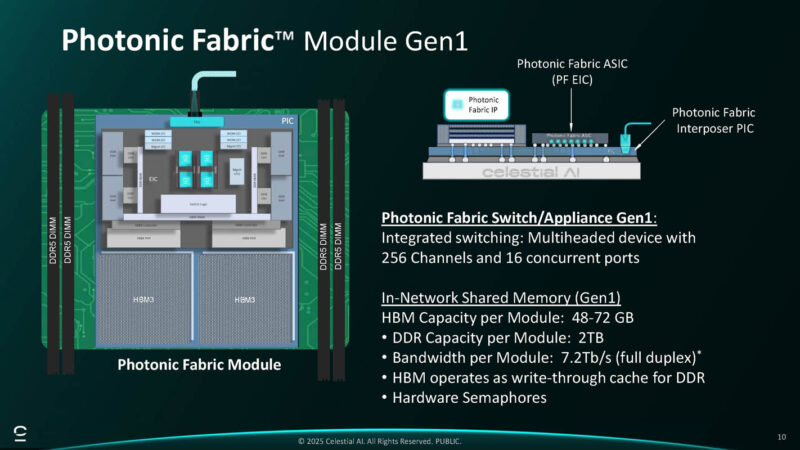
In the Photonic Fabric Module Gen1, it is being used in a 16 port switch with switch attached memory.
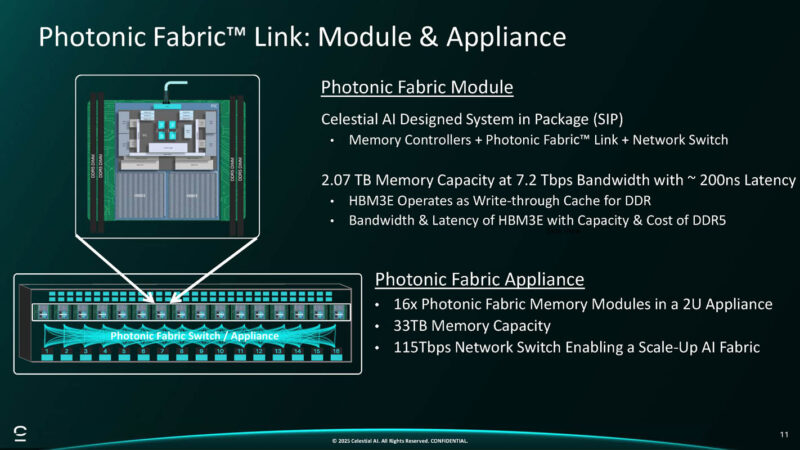
Here there are some neat stats on the module and appliance.
The company has done four tapeouts.
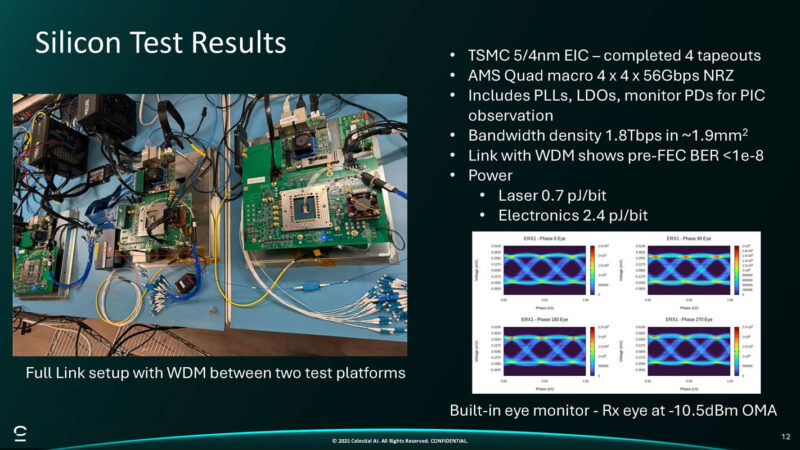
Here is the package.
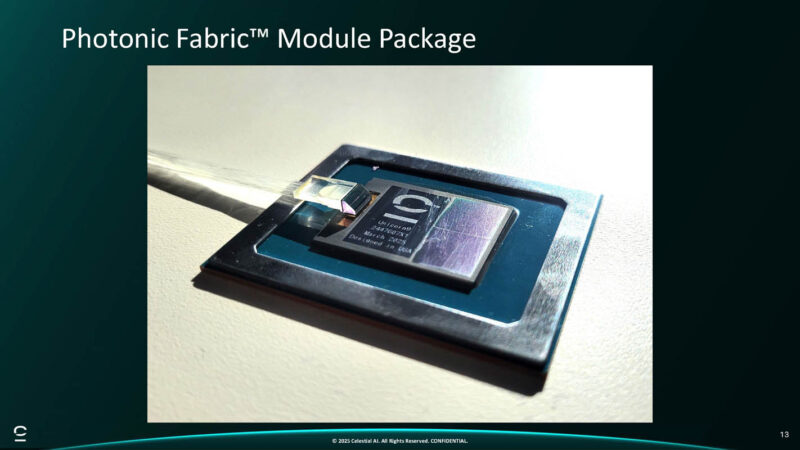
It is neat to at least see one.
Final Words
Overall, this seems very cool. I wish we heard a bit more about if or how this is being implemented, but at least we saw one example. Overall, this one seems pretty cool.


“OMIB Benefits 01: Optical integration in multi-kW package.”
Versus the rows of circa 2009-ish racks I inherited in 2012 each with 32 1U dual-Xeon 4-core non-HT servers in < 10 kW racks…Muy caliente!
This is really cool. I’m wondering how long will it be until we start seeing the photonics not just shuttling signals around, but actually running instructions and code, doing actual computation. Surely the tech is getting there.