

BZIZU RTL8127 PCIe 10GbE Network Adapter Performance
We tested the BZIZU RTL8127 with two adapters connected back-to-back to measure cumulative throughput. This setup isolates NIC performance from switch or cabling variables.
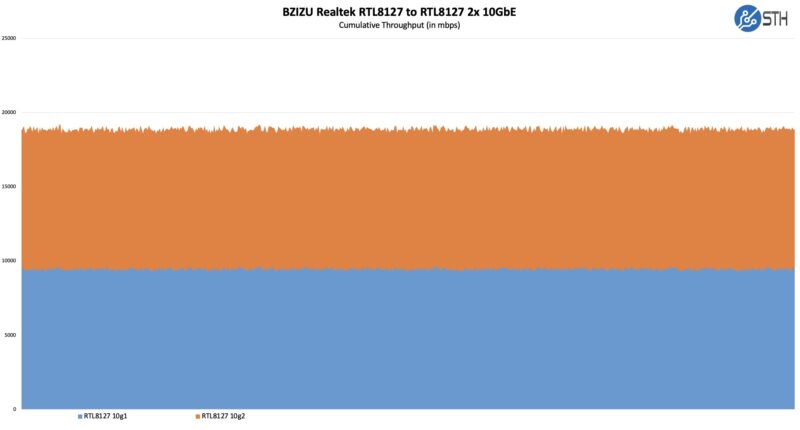
Overall, this is exactly what we saw in our previous piece. Driver support varies by operating system, so buyers should check compatibility for their specific OS before purchasing. Realtek provides Windows drivers, while Linux support depends on kernel version and may require additional configuration. Today, it likely means you will be installing drivers from Realtek’s website. Over time, Realtek’s drivers have been incorporated into many OSes.
Key Lessons Learned
Low-cost 10Gbase-T options have expanded beyond Marvell AQC107 and AQC113-based adapters. Realtek RTL8127 brings another affordable choice for home labs and workstations that need faster networking without enterprise pricing.
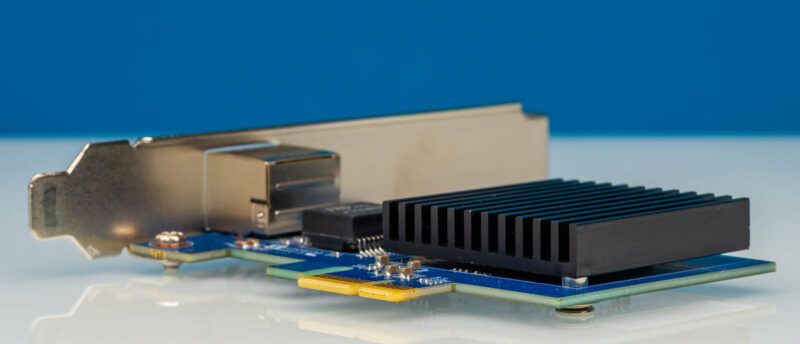
PCIe Gen4 x1 provides sufficient bandwidth for 10GbE in each direction, making these cards practical for systems with limited expansion slot availability. A single-lane interface also reduces power consumption compared to wider PCIe NICs.
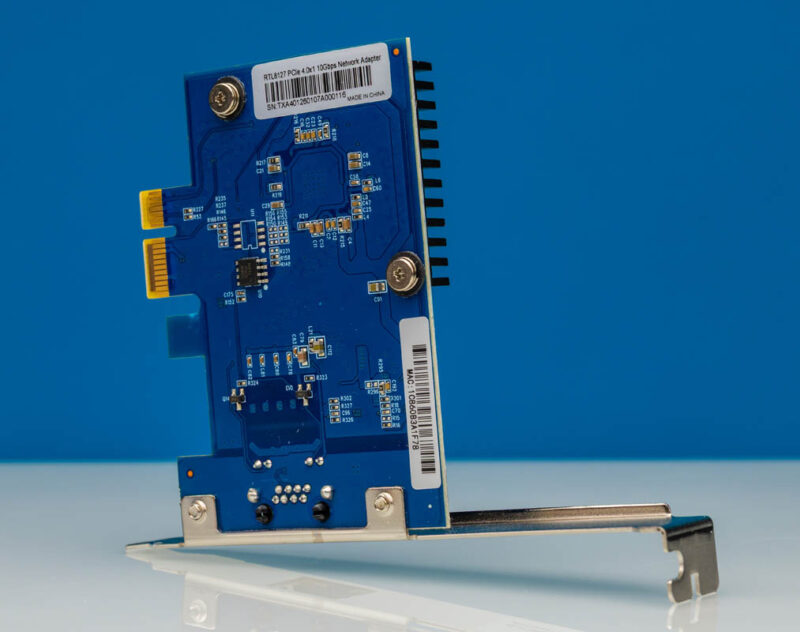
When we saw this card, we thought that it looked familiar. Of course, it did. It seems like there are just sellers that are reselling the same RTL8127 card that we saw in our BZIZU Realtek RTL8127 PCIe 10GbE Network Adapter Review.
Final Words
At $46, the BZIZU RTL8127 delivers accessible 10Gbase-T connectivity for budget-conscious builders. This rebranded version of the earlier RTL8127 design maintains the same value proposition. This offers affordable 10GbE without sacrificing basic functionality. Amazon availability makes this option more accessible than prior AliExpress-sourced cards with similar (or really the same) hardware.
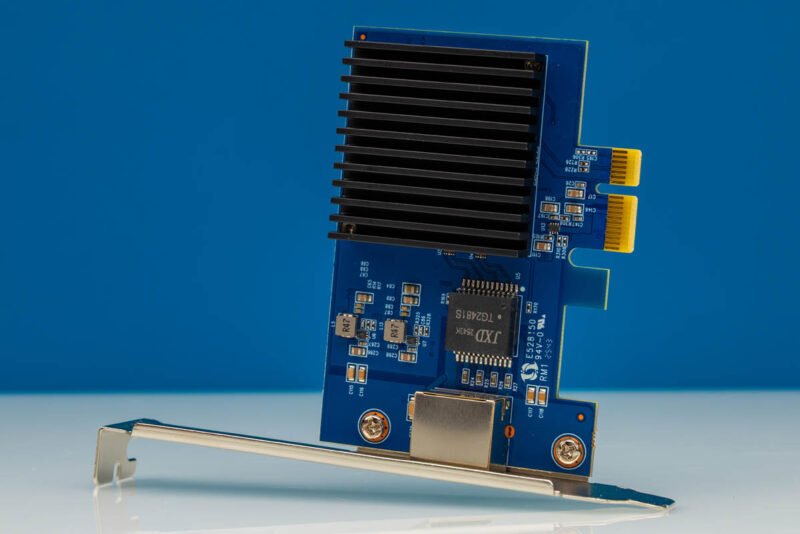
If you just need an inexpensive 10Gbase-T interface on your machine, then this is a decent option. Unlike when we ordered the same cards off of AliExpress a few months ago, this one arrived in a day rather than a few weeks.
Where to Buy
You can find the BZIZU Realtek RTL8127 PCIe 10GbE Network Adapter via this Amazon affiliate link.


The heatsink is hot with the RTL8127 on this card or not excessive ?
Did you mean to link back to the SAME review?
It seems like there are just sellers that are reselling the same RTL8127 card that we saw in our BZIZU Realtek RTL8127 PCIe 10GbE Network Adapter Review.
How’s the power draw compared to the AQC113? How well does it perform in an older PCIe v3.0 platform?
When I click on the link Amazon shows me the RTL8127 card that is reviewed here, but then suggests a similarly branded BZIZU 10Gb card based on Aquantia AQC107 that is $5 cheaper. The “also like” menu also includes a $17 cheaper 10Gb card based on the Intel 82599EN.
Suppose this is for Linux where both latency, bandwidth and CPU loading are considerations. How do I choose? At the level of these cards is it a only a matter of price?
This still doesn’t present all useful essentials.
Like what does the chip actually offloads/accelerates ?
What capabilities does it have ? How does it differ from 10G Intel or Marvell/Aquantia ?
Not everything is in raw iperf3 numbers.
Eric Olson, do you have PCIe 4 slots? That’s what this card requires for full performance. The older cards are PCIe 3 (or even 2!) and require more lanes. The size of the heatsink is a good indicator of power/heat.
@flo – It’s mostly for show, the cards use less than 2 W of power.
@Cheezehead – less than half. There’s a PCIe 3.0 x2 variant of the chip for older systems.
If the pcie gen 4.0 x1 slot is run through the chipset this hinders the speed of the 10G card because the chip doesn’t allow rss and only utilizes 1 cpu core. Dropping the speed down to 1G. I fount this out the hard way on my x670 Gene mobo.
Most of the images return a 404 error when you click for bigger versions.
Also no mention of whether this supports 2.5Gb/5Gb operation (I assume being a recent chip it does)?
# RTL8127 10GbE + Jumbo Frames under Linux/r8169
I tested a **Realtek RTL8127 10GbE PCIe 4.0 x1 NIC** under Nobara Linux (kernel 7.2.3, in-tree `r8169` driver), directly connected via 10GBASE-T to a TrueNAS system.
## Result
With **MTU 9000**, `ethtool -k` shows:
“`text
tx-checksumming: off
tcp-segmentation-offload: off
tx-tcp-segmentation: off [requested on]
“`
iperf3 results:
“`text
RTL8127 -> TrueNAS: ~6.9 Gbit/s
TrueNAS -> RTL8127: ~9.9 Gbit/s
“`
After switching both ends to **MTU 1500**, the TX offloads became active again:
“`text
tx-checksumming: on
tcp-segmentation-offload: on
tx-tcp-segmentation: on
“`
iperf3 then reached:
“`text
RTL8127 -> TrueNAS: 9.42 Gbit/s
TrueNAS -> RTL8127: 9.42 Gbit/s
Retransmits: 0
“`
So in my setup, Jumbo Frames reduce RTL8127 TX performance from about **9.42 to 6.9 Gbit/s**.
## Not RTL8127-specific
The Linux `r8169` driver contains logic that disables TX checksum offload and TSO for newer Realtek MACs when `MTU > 1500`.
I confirmed the same behavior on the onboard **RTL8125B 2.5GbE** in the same PC, using the same kernel and driver:
“`text
RTL8125B @ MTU 1500:
TX checksum ON
TSO ON
~2.36 Gbit/s
RTL8125B @ MTU 9000:
TX checksum OFF
TSO OFF
~2.48 Gbit/s
“`
At 2.5GbE the CPU can apparently compensate, so the limitation is easy to miss. At 10GbE it becomes a significant bottleneck.