
ASRock Industrial AI Box-A395 Block Diagram
Atypical for a Ryzen AI Max system, but very on-brand for ASRock Industrial, the company has included a detailed block diagram in the manual for the AI Box-A395, outlining how all of the various ports and chips within the system are connected.
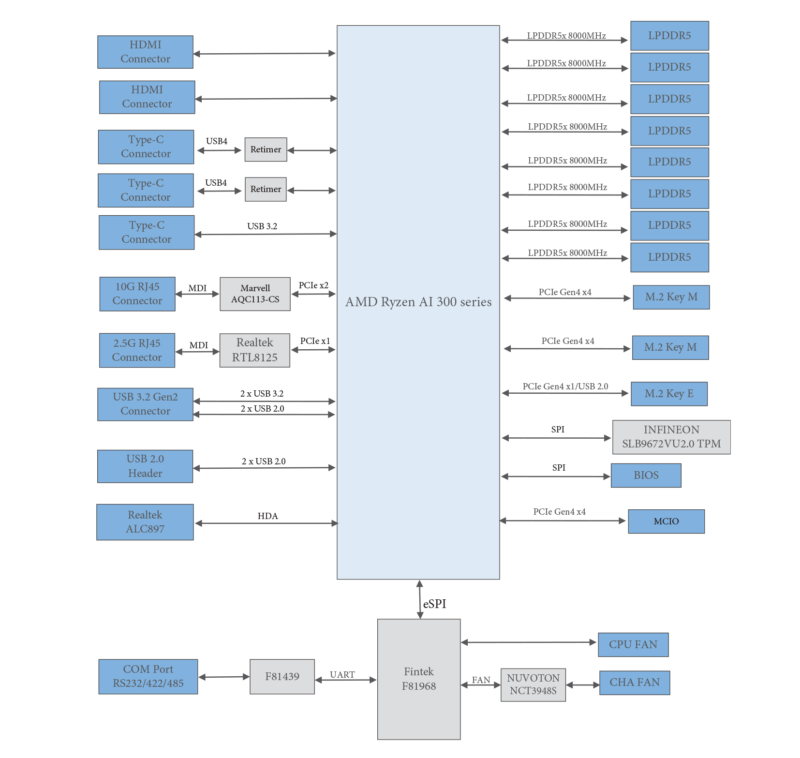
Nothing here is to be unexpected. The Strix Halo silicon offers 16 lanes of PCIe Gen4, and ASRock Industrial has put all of them to good use. 8 lanes to the M.2 slots, 4 lanes to the MCIO connector, a lane to the Wi-Fi radio, a lane to the 2.5GbE controller, and finally 2 lanes to the 10GbE controller. Otherwise, the diagram is detailed enough to even draw and name the fan driver on the motherboard – in this case a Nuvoton NCT3948S.
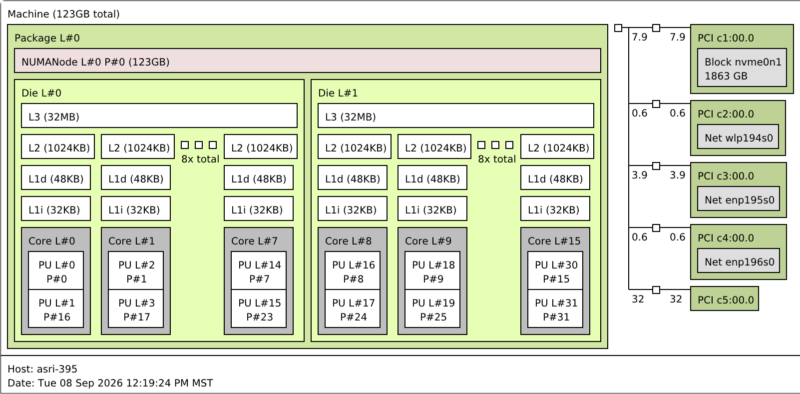
Meanwhile, here is a look at the system’s topology through lstopo, which reinforces how the various network controllers and M.2 slots hang off of the PCIe bus.
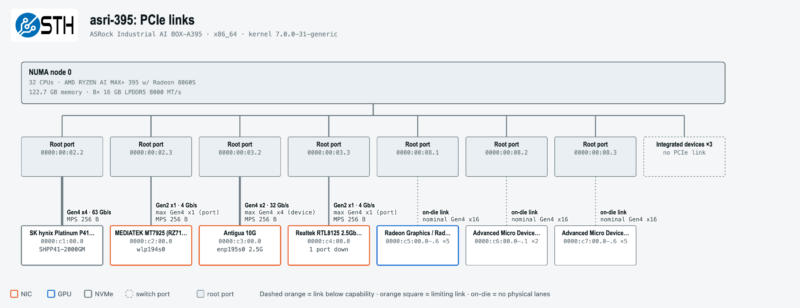
Here is our output from our STH Topology tool that surveys link widths and speeds:
Next, let us get to the performance.
ASRock Industrial AI Box-A395 CPU Performance
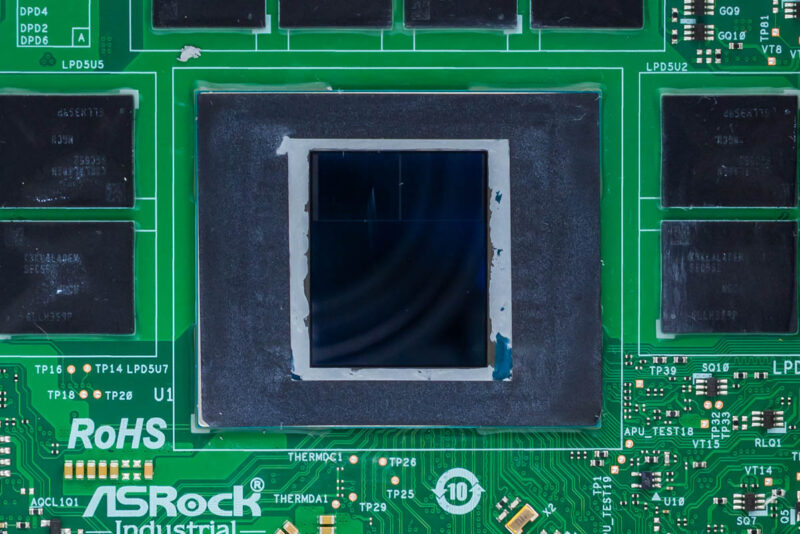
At the heart of the AI Box A395 is AMD’s Ryzen AI Max+ 395, the company’s top-end, fully-enabled Ryzen AI Max+ 300 series SKU. This configuration is the Strix Halo platform at its finest, offering all 16 Zen 5 CPU cores and 40 graphics CUs baked into the underlying silicon. The net result, as we have seen time and time again in other reviews, is that Ryzen AI Max+ 395 can deliver tremendous performance across both CPU- and GPU-bound workloads. The tradeoff is that with 441mm2 of silicon, the chip can pig out on power when system builders allow the chip to run at high TDPs.
Unlike some of the Strix Halo mini-PC vendors, ASRock Industrial has not opted for multiple performance modes for the system. Instead, it offers the next best thing: two cooling modes. The default cooling mode sets the maximum CPU fan speed to 85% to keep system noise to a minimum. You can increase this to 100% if desired, at the cost of making the system louder. In principle, this would throttle the 120 Watt TDP SoC if it got too hot, though that would not be easy given the size of the heatsink and fan cooling it.
Finally, since the AI Box A395 ships as a barebones system, we installed a 2TB SK hynix P41 SSD for storage and loaded Ubuntu Linux 26.04 on it for testing.
AMD Ryzen AI MAX+ 395 Latency
We wanted to start out by looking at the core-to-core latency of the chip.
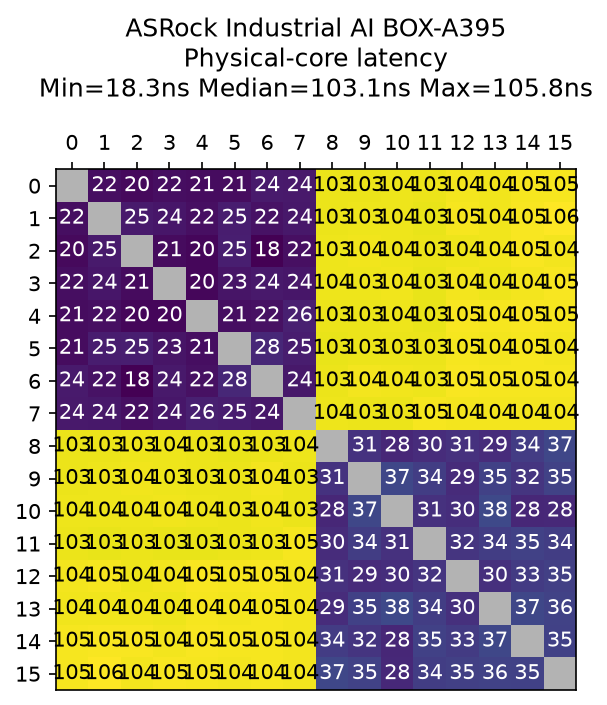
Overall, this is very typical of AMD Zen 5 CPUs. Here, staying within the 8-core cluster was a short latency hop. Going across to the other 16 cores is a bigger hop.
Next, we ran lmbench.
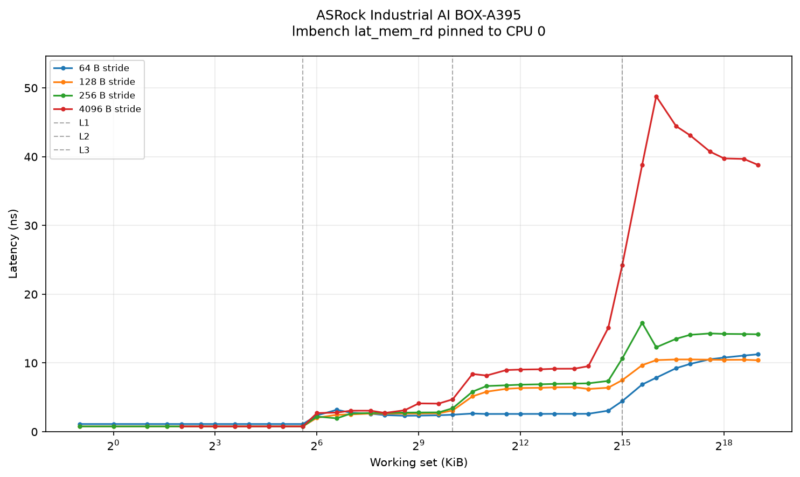
This is fairly typical output compared to the other systems we have tested.
Geekbench 7
We will start things off with Geekbench 7, the latest iteration of Primate Labs’ high-level benchmark suite. For this review, we have rounded up a few of the different Ryzen AI Max+ 395 systems we have looked at in the past few months to get an idea of how they compare and how close together (or far apart) the systems score.
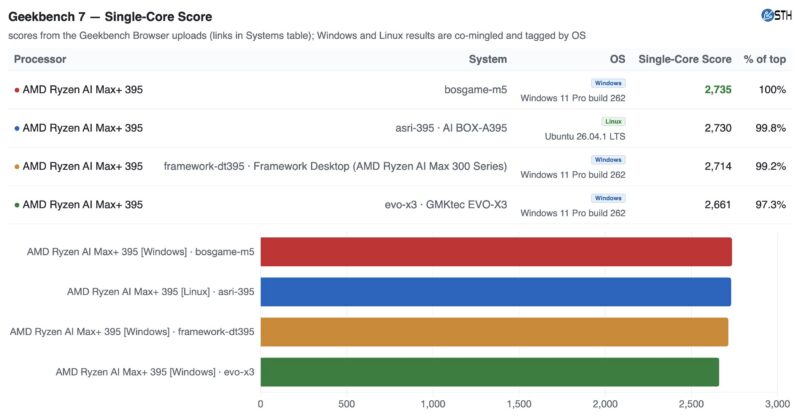
The Geekbench 7 single-threaded scores are tightly clustered, within 2.8% of each other from best to worst. This is very consistent and within our usual 3% margin of error for desktop benchmarking. The ASRock Industrial system, in particular, is 5 points short of tying for the top spot.
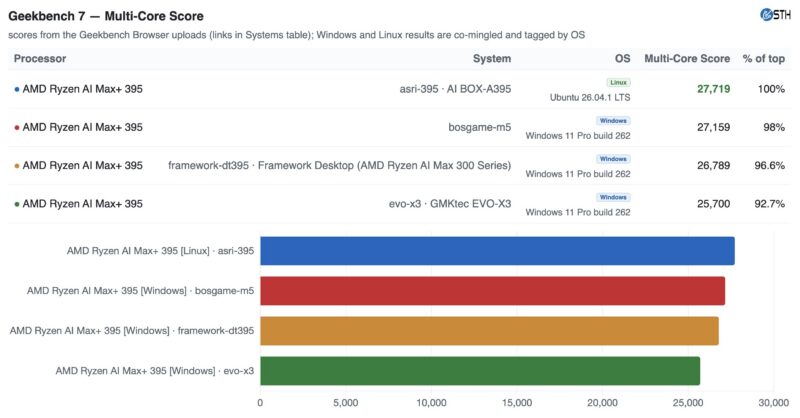
Things get more interesting with the multi-threaded benchmarks, however. The overall spread is wider here, with the top system about 8% faster than the slowest Ryzen AI Max+ 395 system. This shows there is room for performance differentiation, even though all these mini-PCs use the same SoC at their core.
This chart also looks particularly good for ASRock Industrial. Their A395 is taking the top spot, and by enough to keep it from being a neck-and-neck race.
Estimated SPEC CPU2026 Performance
For a deeper look at CPU and memory performance in particular, we have the SPEC consortium’s 2026 version of SPE CPU. SPEC succeeds SPEC CPU2017, and STH runs it with open-source compilers at -O3 optimization to produce estimated results. Those figures are only comparable to other STH runs, not to official SPEC submissions.
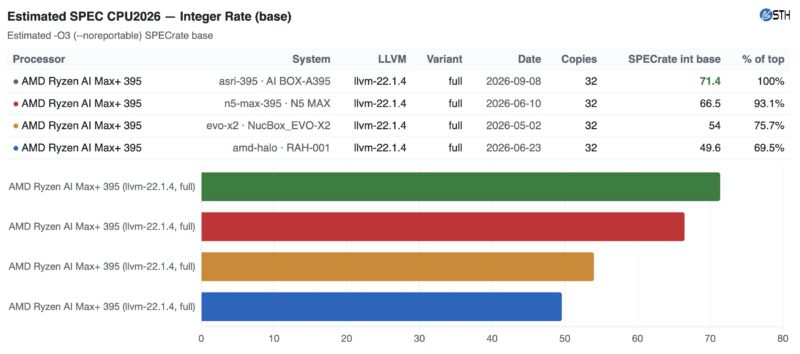
Compared to the largely homogeneous Geekbench 7 results, things take a much more interesting turn with SPEC CPU2026. This is a heavily multi-threaded benchmark, and it quickly uncovers some rather large differences between Ryzen AI Max+ systems. The spread here is nearly 44%: the top-performing system is nearly 44% faster than the bottom-performing system across this integer benchmark suite.
This was quite surprising at first, given that we expected these systems to perform more similarly (especially after seeing the Geekbench results). But SPEC CPU really drives a wedge between them, with ASRock Industrial’s A395 coming out on top.
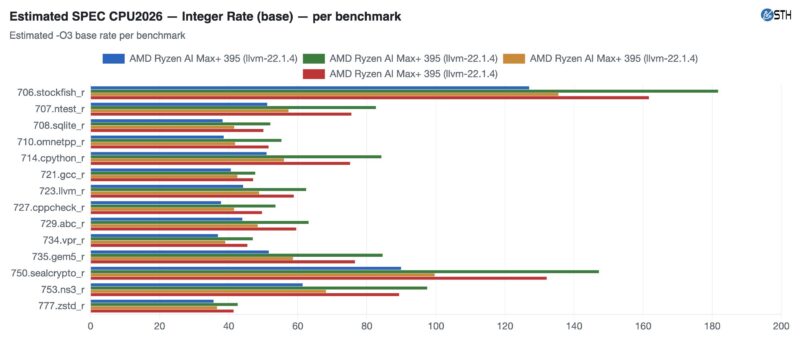
The breakdown of the integer suite scores by individual benchmark shows this is not a fluke limited to a handful of workloads. The system performance order is the same throughout.
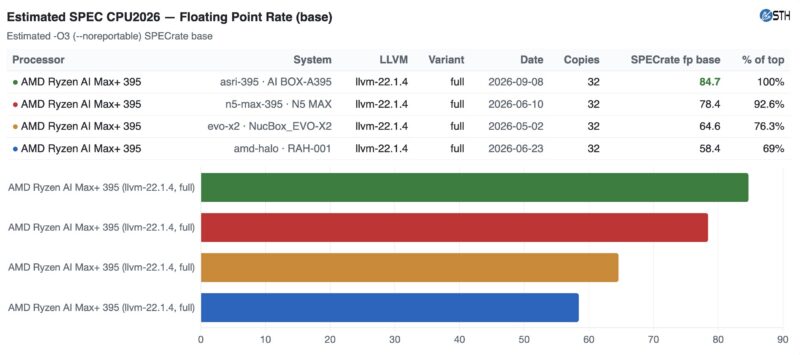
Meanwhile, the SPEC CPU2026 floating-point results paint a very similar picture. Despite the significantly different workload (and one that, on average, pushes memory bandwidth a lot harder), all four systems end up at virtually the same performance levels relative to each other.
Our best guess is that this relates to TDP and cooling. The A395 happens to be the largest of the A395 systems in this collection (after accounting for drive bays on the Minisforum NAS), and is the most PC-like in construction and in cooling, whereas the other systems are all much more laptop-like. This gives ASRock Industrial ample cooling headroom to handle a Strix Halo chip while it is turboing hard under a sustained workload. As a result, they may have tuned the system to run at higher power levels.
Agentic AI: AgentSTH V7
Finally, here is a look at system performance with an agentic AI workload, using our own AgentSTH V7 benchmark. This is a suite of tests that represents the types of agentic AI workloads we see in many trace runs, performing real-world tasks ranging from coding and infrastructure management to creating financial models and more. We also focus on running different shapes on processors to stress the CPU in ways that traditional benchmarks do not. Since we are not testing the LLM side here, it turns out that much of this looks very similar to how multi-tenant server CPUs are used outside agentic AI workflows.
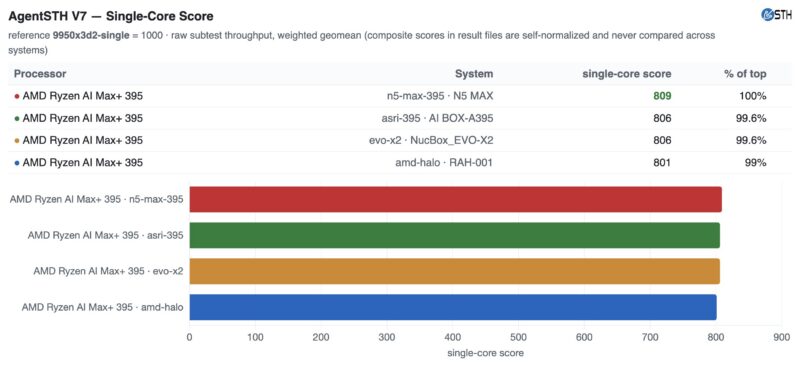
With AgentSTH V7, we see a spread not unlike our SPEC CPU results, but not as wide. For single-core performance, all four systems are within an incredibly tight 1% of each other, or about 8 points.
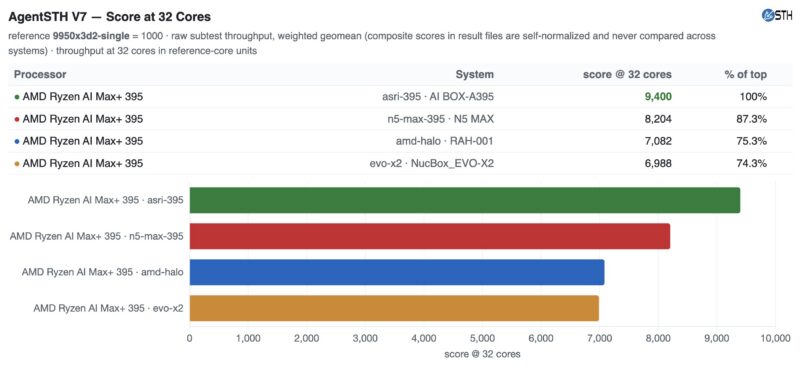
But when we throw open the floodgates with all 16 cores (32 threads) at work, we start seeing performance spreads closer to our SPEC CPU results. Which goes to show that the SPEC results are not a fluke, and that these performance spreads between Ryzen AI Max+ 395 systems occur with other long-duration multi-core workloads as well.
Fittingly, the ASRock Industrial box is on top here. It is interesting to see how far ahead it is. In SPEC CPU, another system was at least within 10% of the A395, but not here. The A395 is 15% ahead of the next-closest 395 box in this benchmark.
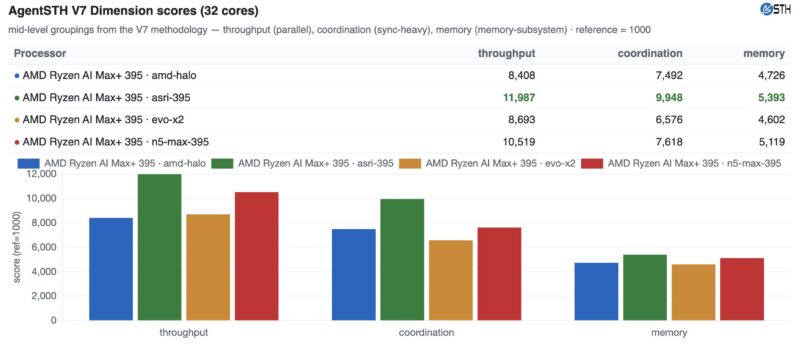
Diving a bit deeper into the benchmark’s dimensionality metrics, we find that the high-performing systems clearly lead in both total throughput and multi-agent (multi-core) coordination. Perhaps the most interesting finding is where the lead is not large: memory performance. Again, memory performance in AgentSTH V7 is in workloads largely influenced by memory, but it is not a straight memory benchmark dimension like STREAM. The top systems still win there, but the top-to-bottom spread is only 17%, lending credence to the idea that the overall performance differential between the two systems comes from CPU performance rather than a large difference in memory performance.
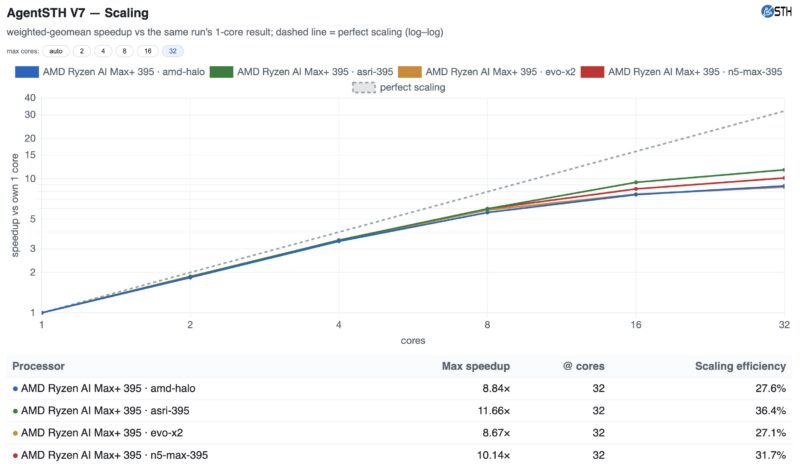
That advantage also means the highest-performing systems see the greatest overall scaling in this benchmark. To be sure, nothing here reaches better than 36% of its theoretical scaling efficiency at 32 threads active. But the A395’s higher headroom lets it scale a bit higher than other Ryzen AI Max+ 395 systems at high thread counts.
Graphics Performance: SPECviewperf 15.0.1 Linux Edition
Finally, for a quick look at the A395 iGPU’s performance in graphics, here is a run-through with SPECviewperf 15.0.1 Linux Edition to see how the system performs under some workstation graphics workloads.
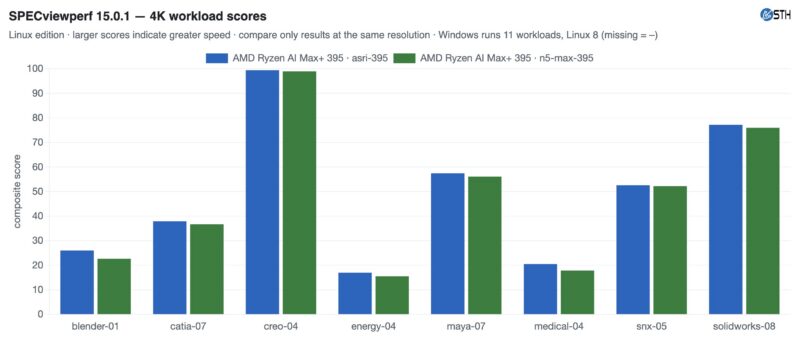
As we saw with our multithreaded CPU testing, ASRock Industrial’s A395 has an edge over the other Ryzen AI Max+ 395 systems that we have tested. Though unlike those heavy CPU tests, or even the AI tests, the A395’s edge here is far narrower. It beats the Minisforum N5 in every test, but it is never by more than 15%, and it is often by much less. Still, it is one of our heavy workload tests for ASRock Industrial.
Next, let us take a moment to look at the LLM performance.