

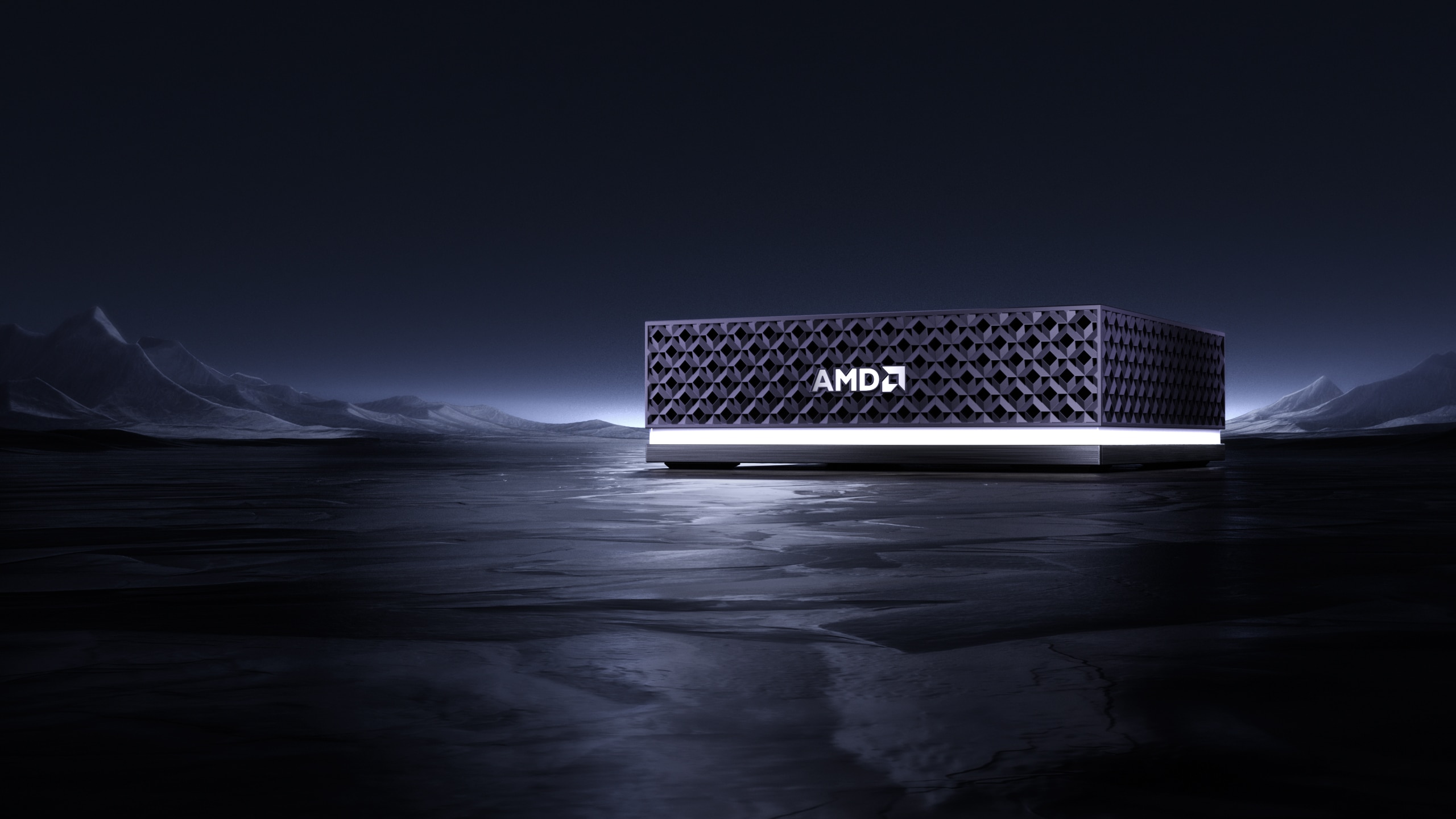
Among a spate of AMD announcements during the company’s CES 2026 opening keynote, CEO Dr. Lisa Su briefly teased a forthcoming AMD-branded AI development box, dubbed the Ryzen AI Halo.
Seemingly taking a page from similar AI development boxes that have popped up over the last year – both those built using AMD’s hardware and those from rivals such as NVIDIA and their DGX Spark – AMD is going to be launching their own high-end mini-PC for developers within AMD’s ecosystem.

The short CES teaser was light on details on the Ryzen AI Halo ahead of a proper introduction that is slated to take place in the second quarter of the year. But the key feature of the box hardware-wise is that it is based on AMD’s Ryzen AI Max+ processors, which AMD’s partners have been using to build similar developer workstations. Also known by the codename Strix Halo, the Ryzen AI Max+ processors pair AMD’s Zen 5 CCDs with a high-performance I/O die that contains an integrated RDNA 3.5 architecture Radeon GPU with 40 CUs, and which in turn is wired up to (up to) 128GB of LPDDR5X memory via a 256-bit bus. The resulting combination of high memory bandwidth, high iGPU performance, and large memory capacity has made the Ryzen AI Max+ chips uniquely well-suited among x86 SoCs for local LLM work, something AMD’s partners have been capitalizing on – and which AMD soon will, as well.
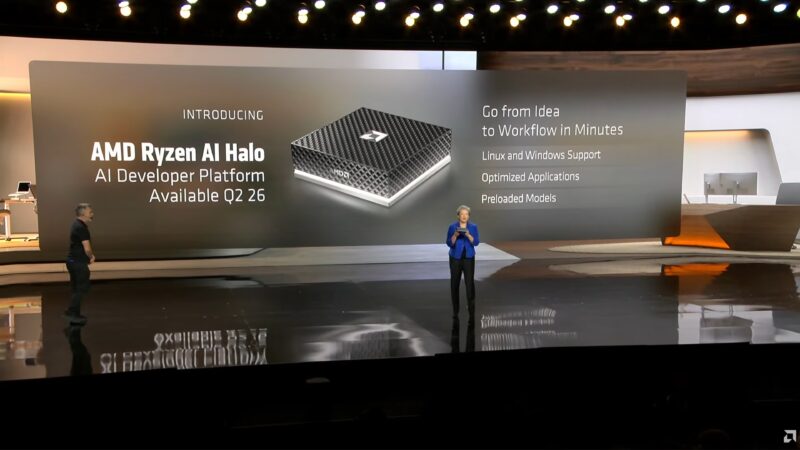
Beyond the fact that they are basing it on the Ryzen AI Max+ chip however, AMD is not sharing any further hardware details about the box. Most notably, AMD is leaving themselves plenty of wiggle room with regards to performance specifications, claiming “up to” 128GB of memory and 60 TFLOPS of GPU performance, leaving the door open to offering cheaper lower-spec boxes as well.
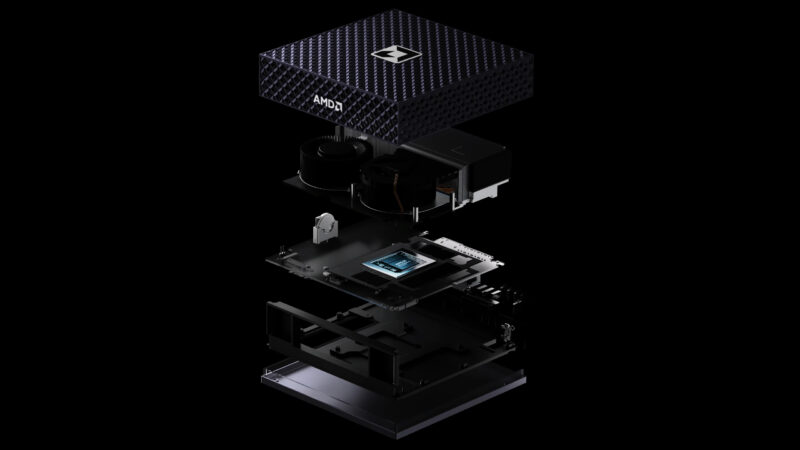
And with NVIDIA’s DGX Spark also being a clear impetus for the Halo, it leaves open an important question about networking support. Besides its own flavor of high-performance iGPU paired with gobs of LPDDR5X, the DGX Spark line’s other major feature is its inclusion of 200Gbps Ethernet ports, provided via an integrated ConnectX-7 NIC. Though not necessary to make use of the Spark in all configurations, NVIDIA has treated it as a marquee feature that lets developers scale-out over multiple Sparks – both allowing them to build more powerful mini-clusters, and to test how well their projects run in a scale-out environment. AMD does have their own NIC hardware with the Pensando Pollara, but it is left to be seen whether AMD wants to include that here, especially given how much that ultra-fast networking can add to a system’s price tag.
Hardware matters aside, the other big draw for the Ryzen AI Halo will be its software environment, with AMD promising to pre-load it with the latest in ROCm optimized models and applications. Notably, the company is promising both Windows and Linux support for the Halo, a sharp contrast to most AI development boxes currently being Linux-only. Otherwise, it remains to be seen if AMD is going to try rolling their own Linux distribution so that they control the entire software experience under Linux (ala DGX OS), or if they will be shipping with a standard Linux distribution with the ROCm environment and additional AMD software pre-loaded.
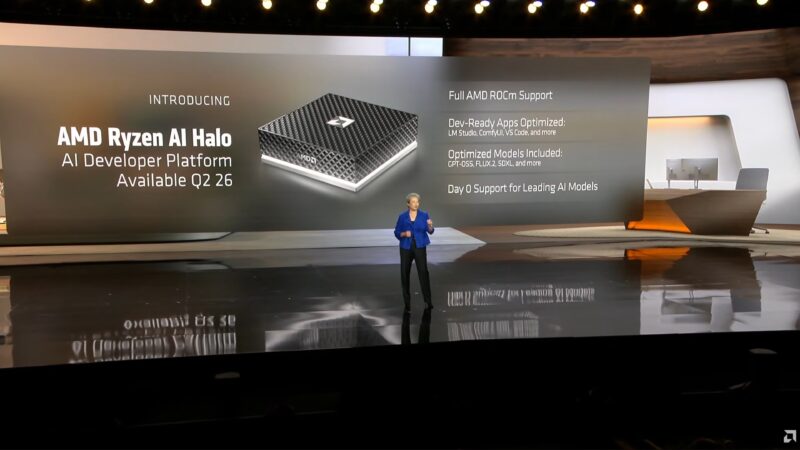
Finally, it is notable that AMD is promising day 0 support for leading AI models on the Ryzen AI Halo. Delivering on that will require that the underlying Strix Halo APU is treated as a first-class citizen within the ROCm ecosystem going forward, which is itself a big deal since the RDNA 3.5 architecture GPU is quite different from the CDNA architecture that goes into AMD’s Instinct accelerators.
With the underlying Ryzen AI Max+ hardware already available and shipping in volume, AMD should have a relatively quick ramp-up for their first AI development workstation. According to the company, the Ryzen AI Halo will get a proper introduction and launch in Q2 of 2026.




This makes zero sense. They’re going to launch a new product with a chip that’s a year old TODAY, and a year and a half old when these are available? Is there a refresh coming before Medusa Halo?
The relatively slow rollout of Strix Halo, and Medusa Halo not coming anytime soon, make it make sense. Potentially.
IF they address the networking gap, that would also differentiate it from all the Strix Halo products that came before it.
No sense. None of the technologies this “station” is supposed to be based on can seriously compete with the Spark GB10 that was announced 18–24 months ago.
Unless you move to a 4–8 channel memory configuration with 256–512 GB of unified RAM and add an OCuLink bus to attach a real dedicated GPU, even Apple will be doing a better job in this segment.