

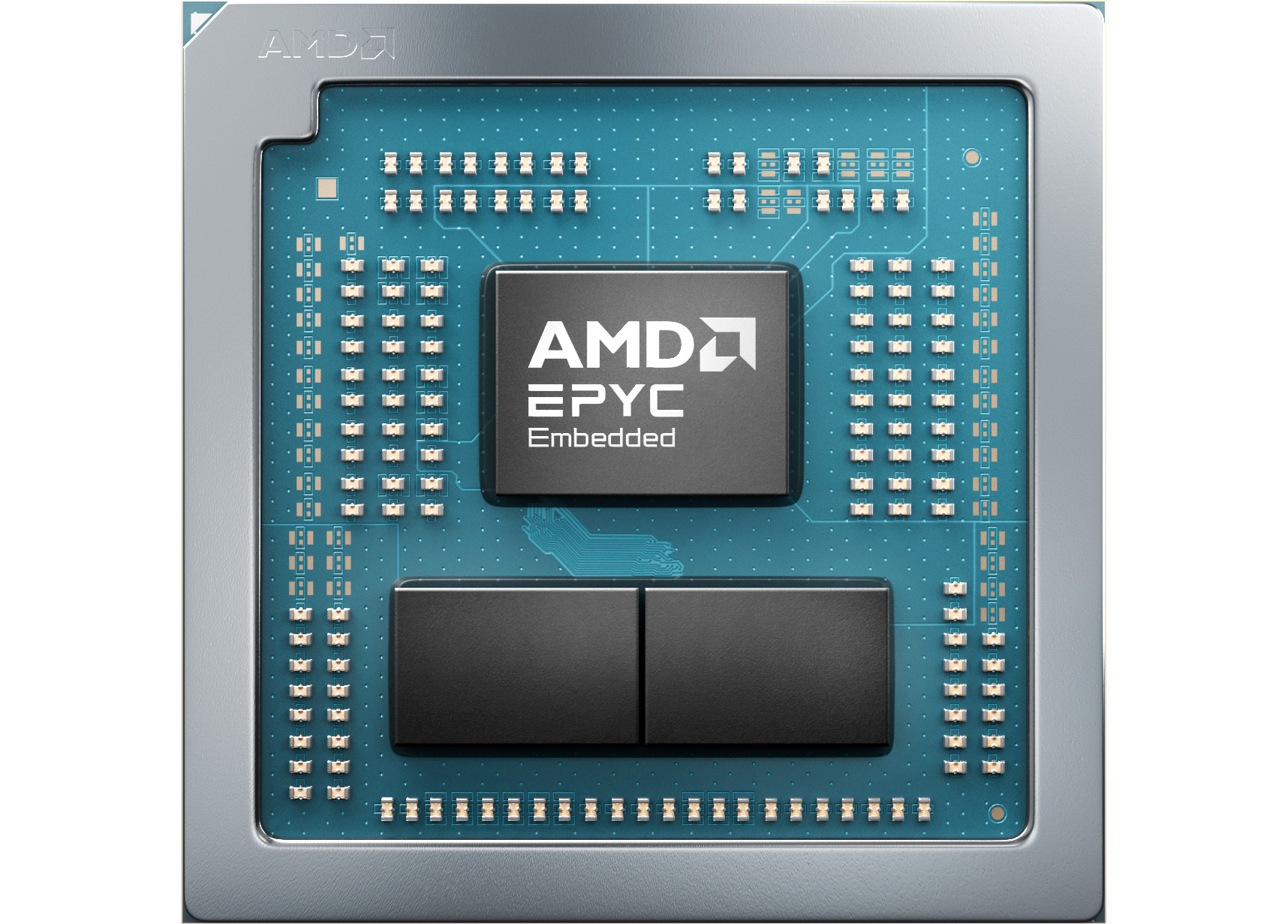
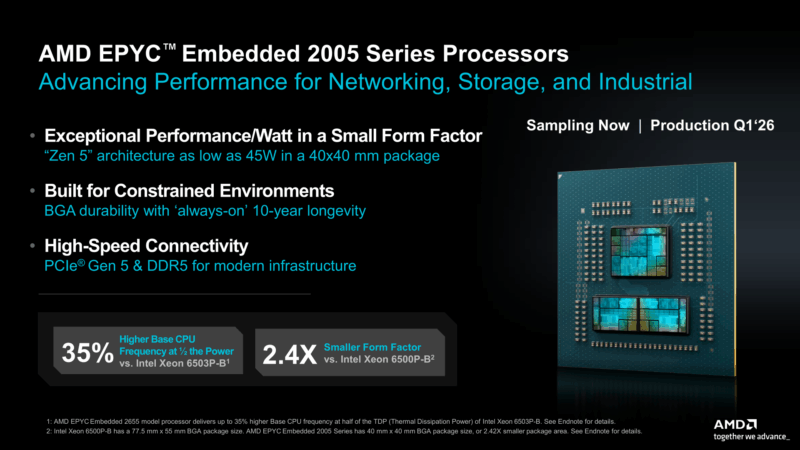
AMD this morning is taking the wraps off of the EPYC Embedded 2005 series of processors, the company’s next generation of embedded-class CPUs for the networking, storage, and associated markets. Joining AMD’s existing array of embedded-class CPUs, which already ranges up to the truly EPYC Embedded 9005 series, the 2005 series is a particularly interesting release from AMD as it is the first new BGA-packaged EPYC Embedded platform out of the company in several years. As a result, it gives AMD a fresh lineup of hardware to offer to customers who are building higher density and lower power devices that require a similarly smaller CPU.
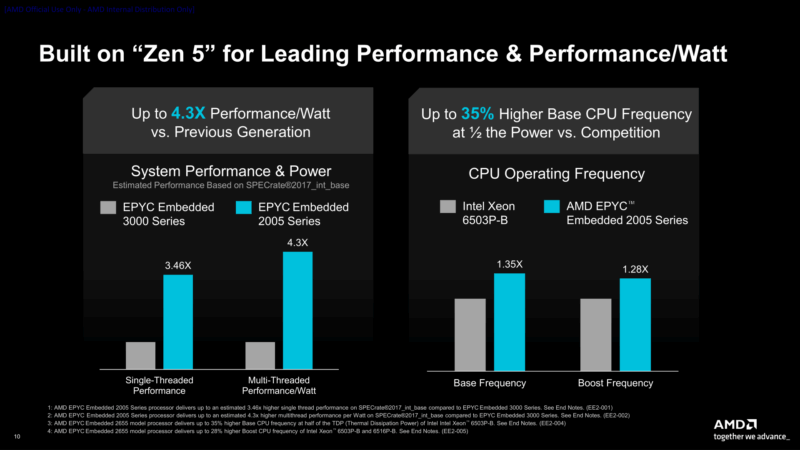
Sampling now and set to go into mass production in Q1 of 2026, AMD will be offering a trio of EPYC Embedded 2005 chips, with 8, 12, and 16 Zen 5 CPU cores respectively, with TDPs topping out at 75 Watts. And as these are EPYC-branded parts, they come with every last feature in AMD’s toolbox for their current generation of processors, including ECC support and AMD’s full suite of RAS functionality – with “reliability” being a keyword as AMD is rating these processors for 10 years of use.
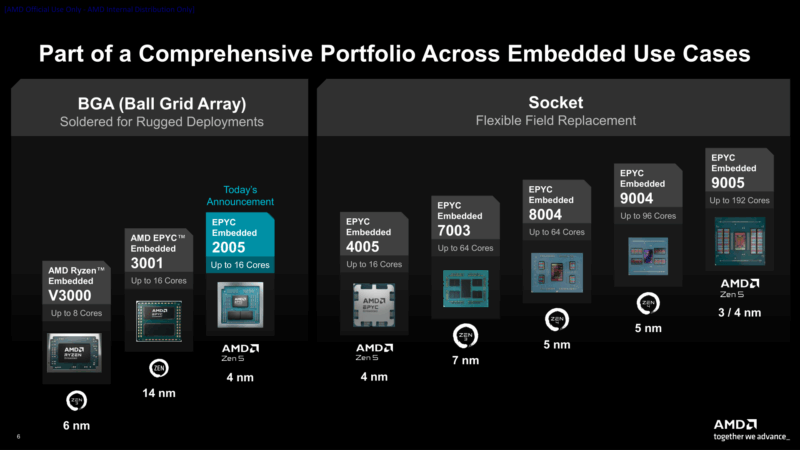
Notably, this is the first new EPYC Embedded platform to come in a BGA form factor in several years. AMD’s last “proper” BGA EPYC Embedded release was based around the Snowy Owl platform all the way back in 2018, which used the original Zen (1) CPU core architecture. And while AMD has offered some interim embedded parts under the Ryzen family based on the Zen 3 architecture, this is the first time in quite a while that AMD has launched a full EPYC product stack for embedded BGA users. All of which means that the performance and feature upgrades are significant for customers already using EPYC Embedded BGA processors – and AMD is hoping to woo more than a few Intel users over, as well.
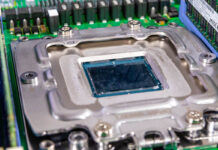
AMD EPYC Embedded 2005 Series Hardware
As noted above, AMD has three SKUs for the new EPYC Embedded 2005 processors.
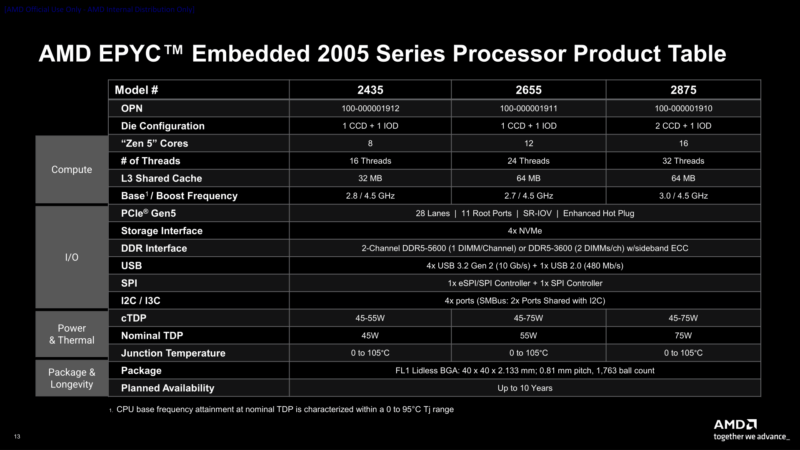
The EPYC Embedded 2435, 2655, and 2875 sport 8, 12, and 16 Zen 5 CPU cores respectively. Besides scaling up in CPU core counts and L3 cache, these parts also scale up in nominal TDPs as well. All of the chips can be cTDP’d down to as low as 45 Watts, though out of the box the largest chip’s nominal TDP is a heftier 75W.
As these are BGA chips, they use AMD’s FL1 BGA “socket”, which is a 40mm x 40mm footprint with 1,763 balls.
This makes the EPYC Embedded 2005 series a laptop-sized chip, and indeed for anyone who closely follows AMD’s hardware, this platform is a dead ringer for on one of AMD’s laptop platforms: Fire Range. Fire Range is currently used in AMD’s Ryzen 9050HX series of processors for high-end gaming laptops, and is itself a BGA-packaged version of AMD’s desktop Granite Ridge chips (Ryzen 9000 series). Fire Range exists to offer AMD’s desktop hardware in a smaller package for lower power packages, and after doing just that for laptops, it’s now being called on to do the same for the embedded market.
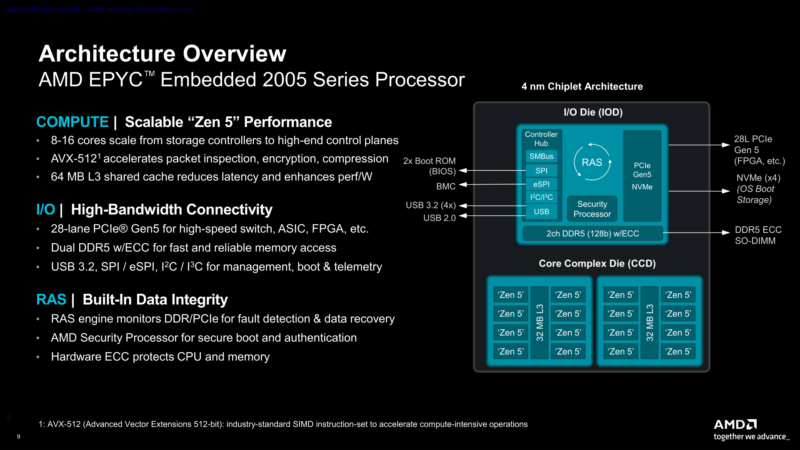
At a high level, this means Zen 5 CPU cores being paired with DDR5 memory support, 32/64MB of L3 cache, and 28 lanes of PCIe 5.0 connectivity. All of which is a massive step up from the original EPYC Embedded 3001 series, a Zen (1) platform with DDR4 memory and PCIe 3.0 for I/O. All of which has become relatively long in the tooth – and in the case of DDR4 memory, is getting outright rare – calling for AMD to finally refresh their long-lived, long-term EPYC Embedded platform with a new generation of hardware.
Consequently, nothing here is really new hardware. This is the same TSMC 6nm-based I/O Die we’ve seen since the Zen 4 era, and the same TSMC 4nm-based Zen 5 chiplets as used in AMD’s socketed EPYC Embedded 4005 chips. What is new, besides bringing this hardware to the embedded market, is that AMD is making all of their enterprise features available on a Fire Range chip for the first time.
Rah, Rah, RAS – And 10 Years of Support
As the 2005 series is not just an embedded processor lineup, but an EPYC processor lineup, these processors are meant to be the cream of the crop from AMD in terms of enterprise features.
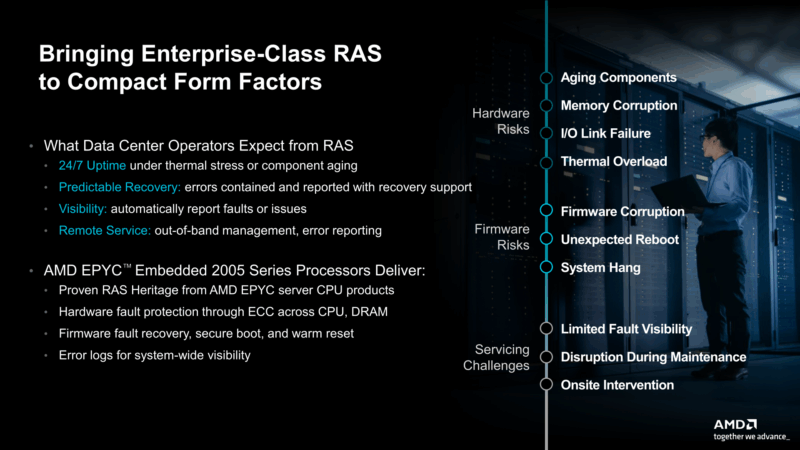
That means not only officially supporting ECC memory, but also the rest of AMD’s RAS features available in the Zen 5 hardware platform. BMC, multiple boot ROMs, error logging, and Memory Guard (AMD’s hardware memory encryption tech) are all available with the new embedded chips.
But perhaps most important of all for long-lived, long-supported systems is that these chips get some of the longest support commitments of any AMD x86 hardware platform. The EPYC Embedded 2005 processors are rated for 10 years of operation, and AMD intends to offer the chips for 10 years – meaning that EPYC Embedded 2005 chips are to be available through 2036, and with a 10-year operating lifetime will likely be running through 2046 and beyond.
Taking Aim at Small Spaces
Ultimately, the purpose of the EPYC Embedded 2005 series is to take aim at a specific niche in the embedded market: customers who need desktop-level performance, but with strict space, power, and reliability/ruggedness requirements that socketed chips like the EPYC Embedded 4005 can’t meet. Compared to some of AMD’s other markets, it is not a big one, but it is a market that truly lives up to the “embedded” name.
The traditional markets for these sorts of BGA chips tends to be spread between storage, networking, and industrial systems.
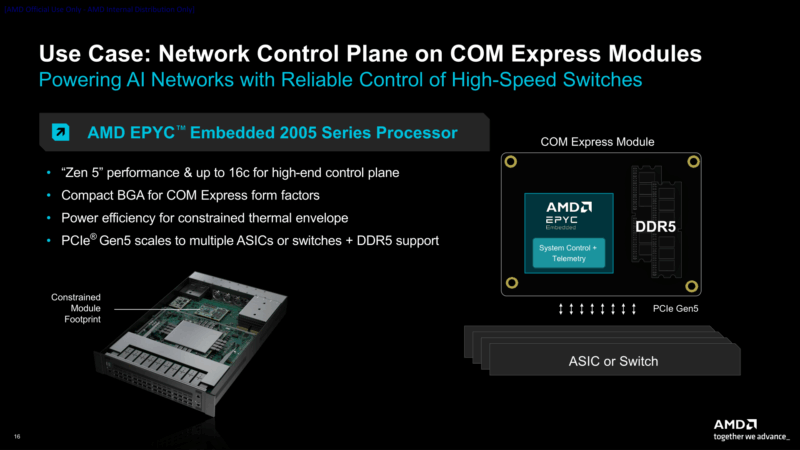
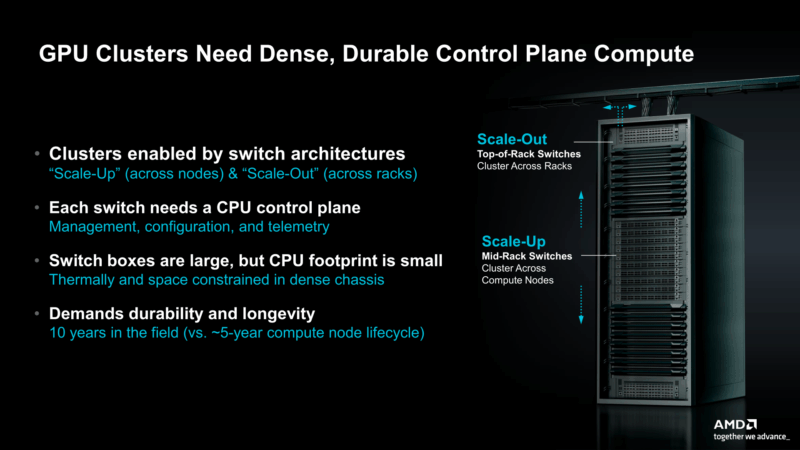
But with the AI market encompassing more and more hardware, AMD sees the 2005 series as being a play for the AI space as well. Be it for customers who just need a denser chip option than socketed chips, or to power the storage and networking hardware that is then going into those AI systems.
This is also a specific niche that AMD believes they can outmaneuver Intel in, as the company has long held a large share of this particular market with its various flavors of BGA-mounted Xeon chips. Against Intel’s current lineup, AMD believes they can split the difference in features and size between Intel’s increasingly aged Ice Lake-D chips, and their newer and far more powerful Granite Rapids-D chips – the latter employing a 77.5mm x 50mm package that is over 2.4x the size of AMD’s.
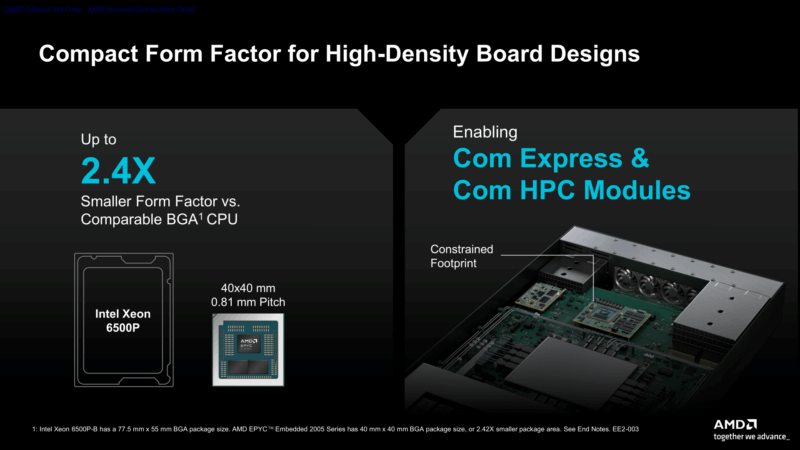
Granite Rapids-D scales quite a bit higher in terms of core counts and memory channels overall, so it is not a particularly apples-to-apples comparison. But in computer hardware sales tradition, AMD is focusing on their strengths, and niches where they believe Intel does not have a competitive product.
Final Words
Wrapping things up, AMD is announcing the EPYC Embedded 2005 series ahead of the hardware’s full launch next year. The chips are sampling to customers now, while formal production kicks off in Q1 of 2026.

Curiously the 12-core 2655 is listed with 1 CCD + 1 IOD, which looks like a typo. Otherwise if it’s real, then it’s probably using Zen5c CCD, with a very high 4.5 GHz boost clock.
the IOD is responsible for a relatively high idle power draw if I’m not mistaken – a shame they haven’t done something about that in all these years.
@Kawaii: Yeah, the CCD count on the 12 core part is a typo. AMD has confirmed that this part is using 8 core CCDs – and thus two CCDs on that part. Which is also why the 12 core part has 64MB of L3 cache.
In the slide “AMD EPYC Embedded 2005 SKUs” it claims 12 cores in *one* CCD. Surely that’s a typo? Because if not that would be a significant thing. AFAIK all Zen 5 CCDs so far have been 8 cores.
…oops. Sorry, for some reason the other comments did not appear until I posted mine. Ryan already responded, so ignore it.
@Frank
Can’t power down SerDes without rendering the CPU worthless