

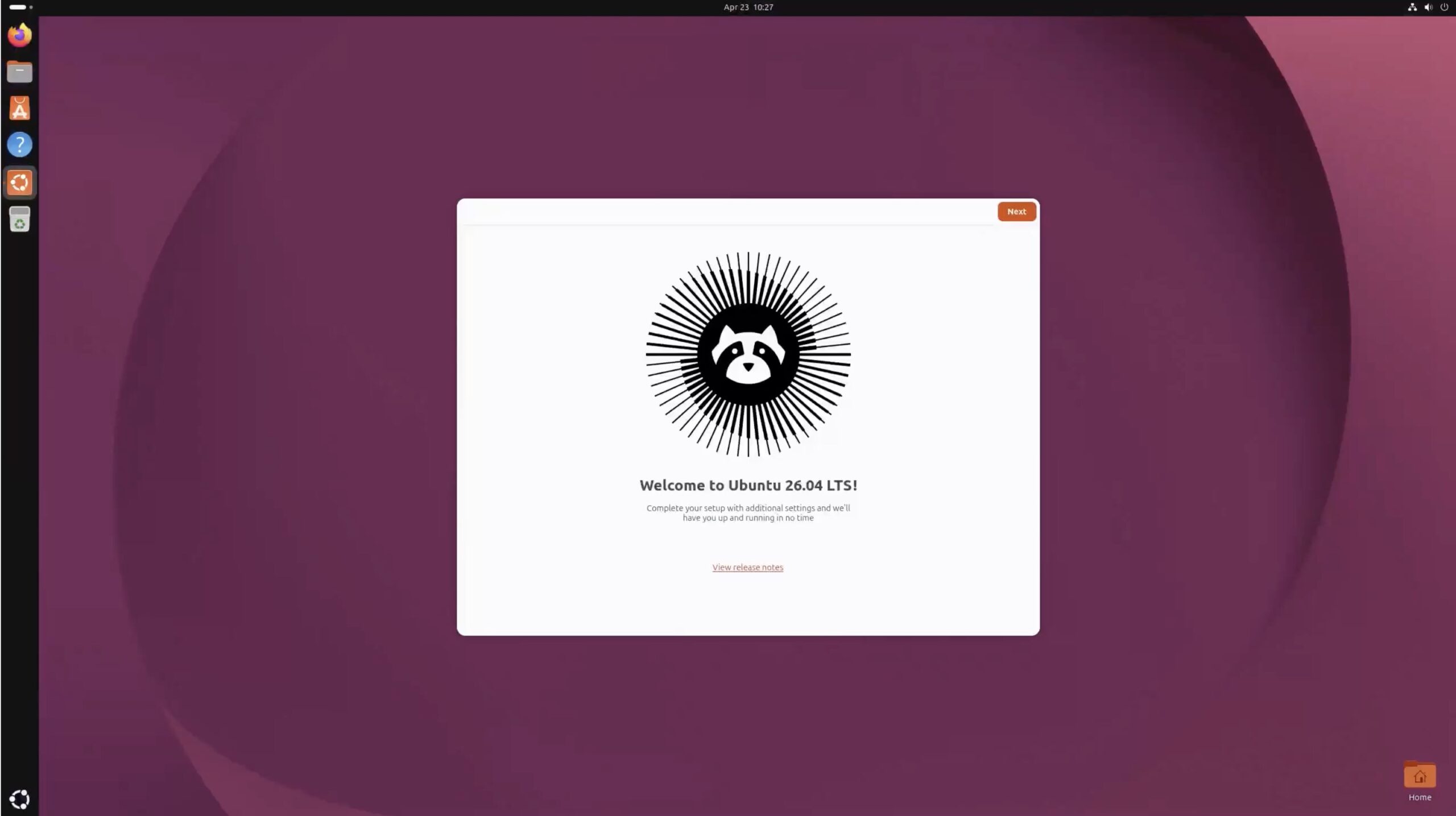
Ubuntu 26.04 LTS (Resolute Raccoon) was released today in April 2026 (hence the “26.04”) with significant updates for server and infrastructure deployments. This long-term support release brings Linux kernel 7.0, a new HWE virtualization stack model, Intel TDX confidential computing host support, and numerous improvements across virtualization, databases, and security. Since the Ubuntu LTS edition releases only happen every two years and offer a five-year support cycle, they tend to be important industry milestones given how popular Ubuntu is. Let us get into some of the details.
Here are just a few of the highlights from the release. We were able to download the server and desktop images for the amd64 and arm64 ISOs and install them, but it appears some mirrors are still catching up.
Linux Kernel 7.0 and Hardware Enablement
The generic kernel stack upgrades from version 6.8 to Linux kernel 7.0, delivering improved hardware support and performance optimizations. A few of the highlights are:
- Intel Panther Lake Support – Enhanced support for Intel Core Ultra Series 3 processors with targeted optimizations for Intel Xe3 integrated graphics and the integrated NPU (Neural Processing Unit)
- EtherCAT Industrial Networking – Integrated IgH EtherCAT module and generic driver for real-time industrial Ethernet networks
- Real-Time Kernel Availability – The PREEMPT_RT real-time kernel is now available in the main archive outside of Ubuntu Pro, following upstream integration
- ARM64 Livepatch Support: Kernel Livepatch now supports ARM64 architecture for security patches without rebooting
- Crash Dumps Enabled by Default: Kdump is enabled by default for desktop and server installations
- Sched_ext Support: New eBPF-based scheduling system allows user-space scheduler implementation
The lowlatency kernel package has been retired in favor of linux-generic, combined with the user-space lowlatency-kernel package for tuning GRUB command line parameters.
Virtualization Stack Updates
The virtualization stack receives updates, including QEMU, libvirt, edk2, and seabios improvements:
- NVIDIA Multi-Instance GPU (MIG) – Support for NVIDIA MIG configurations in libvirt and QEMU
- Intel TDX Support – Continued support for Intel Trusted Domain Extensions, confidential computing with host-side enablement
- Firmware Selection – Better firmware selection capabilities in libvirt
- NUMA Affinity – Support for NUMA affinity of PCI devices. This is ultra important as systems grow to larger topologies and latency/ bandwidth are under scrutiny
- NVMe Disk Support – Enhanced NVMe disk management
- AMD IOMMU and SEV-SNP – AMD IOMMU device support and SEV-SNP confidential computing features
- RISC-V RVA23 Profile – Support for RISC-V RVA23 profile specification
A new Hardware Enablement (HWE) virtualization stack is introduced, similar to the HWE kernel model. This virt-hwe stack includes qemu-hwe, libvirt-hwe, seabios-hwe, and edk2-hwe packages that will be updated twice yearly to align with interim releases while maintaining stability on the LTS base.
Database and Application Server Updates
Ubuntu 26.04 LTS brings major updates to database servers and application runtimes:
- PostgreSQL 18 – New I/O subsystem with up to 3x performance improvements for storage reads, improved index utilization, virtual generated columns, uuidv7() function for better indexing, and OAuth 2.0 authentication support
- MySQL 8.4 LTS – MySQL’s first official long-term support release with internal improvements and configuration changes (32-bit server support removed)
- DocumentDB – New MongoDB-compatible document database built on PostgreSQL, starting with version 0.108-0
- Valkey 9.0 – Updated to version 9.0 with atomic slot migrations and hash field expiration
- PHP 8.5 – Property hooks, asymmetric visibility, updated DOM API, URI extension, pipe operator, clone with functionality, NoDiscard attribute, closures in constant expressions, persistent cURL share handles, array_first() and array_last() functions
- Django 5.2 LTS – Updated from Django 4.2 LTS to the latest long-term support release
- .NET 10 – Updated from .NET 8 with expanded IBM Power platform support
- OpenJDK 25 – Default Java version updated to OpenJDK 25, TCK certified on AMD64, ARM64, S390X, and PPC64EL; LTS versions 8, 11, 17, and 21 also available
- GCC 15.2 – Compiler toolchain updates, including binutils 2.46 and glibc 2.43
- Python 3.14 – Updated from Python 3.12
- Rust 1.93, LLVM 21, and Golang 1.25
Infrastructure Service Upgrades
OpenSSH 10.2
The upgrade from OpenSSH 9.6p1 to OpenSSH 10.2p1 includes the headline changes of a post-quantum hybrid key exchange algorithm “mlkem768x25519-sha256” available by default, and the removal of weak DSA signature algorithm support
Chrony Default Time Daemon
Chrony replaces systemd-timesyncd as the default time synchronization daemon for new installations. NTS (authenticated and encrypted NTP) uses Ubuntu time servers by default, configured in /etc/chrony/sources.d/ubuntu-ntp-pools.sources.
Samba 4.23
Major update with SMB3 Unix Extensions enabled by default, NetBIOS disabled by default for fresh installs, LDAP TLS/SASL channel binding support, Group Managed Service Accounts, and functional level 2012R2 support claim.
HAProxy 3.2 LTS
Updated to the latest upstream LTS release with performance improvements, faster QUIC protocol support, detection of accidental multiple Runtime API commands, stricter URI parsing, and renamed tune.ssl.ocsp-update to tune.ocsp-update.
Security Enhancements
Post-Quantum Cryptography
OpenSSL includes support for post-quantum cryptography algorithms (ML-KEM, ML-DSA, SLH-DSA) and QUIC client/server support. OpenSSH enables hybrid post-quantum key exchange by default.
Intel TDX Host Support
Hardware-based confidential computing with Intel Trusted Domain Extensions provides isolated virtual machines (Trusted Domains) that protect guest workloads from hypervisor, host OS, and other VMs through encrypted memory and hardware-level isolation. Guest support available from Ubuntu 24.04 LTS; host support began in Ubuntu 25.10.
AppArmor Profiles
New AppArmor sandboxing profiles added for many applications to improve system security through better confinement. Users are encouraged to report bugs for common use case breakage via Launchpad.
cargo-auditable Support
Rust packages built on Launchpad now have opt-in cargo-auditable support, embedding JSON-formatted dependency metadata in binaries for CVE impact assessment.
Container and Virtualization Upgrades
Container Stacks
The containerd and runc packages follow a pattern of either regular updates to the latest versions or slower stable paths throughout the release lifecycle, providing flexibility for different deployment requirements.
Cloud images use AMD64v3 Default: All cloud provider AMD64 images are now built with AMD64v3 microarchitecture level by default
System Changes and Requirements
Architecture Requirements
- RISC-V – Only supports hardware implementing RVA23S64 ISA profile; Ubuntu 24.04 LTS continues supporting earlier RVA20 cores
- IBM Z – Minimum z15 architectural level required; z14 and older no longer supported; performance improved on z15 and newer
- Samba i386 – python3-samba package no longer built for i386 due to python3-cryptography dependency
Common Infrastructure Changes
- sudo-rs Default – Rust-based sudo implementation is now default; original sudo renamed to sudo.ws; sudo-ldap package removed in favor of LDAP via PAM
- rust-coreutils – Core utilities now provided by rust-coreutils with performance improvements (GNU utilities remain available for compatibility)
- Dracut Default – Dracut replaces initramfs-tools as default initial ramdisk infrastructure; supports Bluetooth and NVMe-oF in initrd
- APT 3.1 – New dependency solver, switched from GnuTLS to OpenSSL for TLS connections, automatic pager for show/list commands, apt-key command removed
Final Words
Ubuntu 26.04 LTS delivers substantial infrastructure improvements for server deployments, from Linux kernel 7.0’s hardware enablement through PostgreSQL 18’s performance gains and Intel TDX confidential computing host support. The new HWE virtualization stack model and post-quantum cryptography readiness position this release for modern datacenter requirements. It is a slight bummer that we did not get the 7.1 NTFS native driver in this one.
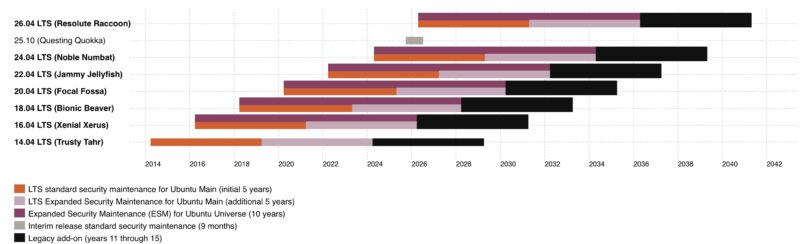
Ubuntu 26.04 LTS is supported until April 2031 with five years of standard security updates and critical bug fixes. The Ubuntu Pro subscription extends support to 10 years with ESM.
The removal of older architecture support (IBM Z z14 and earlier, RISC-V RVA20) reflects Ubuntu’s progression toward contemporary hardware platforms while maintaining broad compatibility across AMD64v3-capable systems deployed in the past decade. Adding post-quantum encryption readiness in OpenSSL may seem small, but quantum is moving fast. We know many will wait until a dot release is ready, but for many, this is a big one. Also, we have noticed that we managed to download all of the ISOs, distribute them to the network shares as well as the KVM devices, and install the ISO on several machines, but it seems like some mirrors are catching up.
For full release notes, you can find them here.

Yeah they’re moving the industry a step forward, at the same time they’re moving it two steps back by continuing to peddle ridiculous garbage like snap.
… and a minimum requirement of 6GB RAM
“continuing to peddle ridiculous garbage like snap”.
@Matt H Really NOT a big deal. You can still use .deb and now the store app manages those too. You can even add Flatpak if you want very easily.
Having snap as an option is just not a problem, and hardly two steps back as you put it.
This is looking to be a great OS and a huge leap forward for Linux IMO.
@minimum It’s really a recommendation, not a requirement. It will work with less, but you might not like the results. Finding a new or used PC with at least 8 GB RAM is pretty trivial. Or you could use a more lightweight distro, or a minimal/server Ubuntu install.
One foisted with Rust based coreutils with a *lot* of known CVE level bugs in them. Because while it might be memory safe, not all exploits are due to memory problems, but that is something the Rust zealots are unable to comprehend.
The title of this post should be “Canonical is dragging Linux down” or something along those lines. This is just as disconnected from reality as what is written now, but at least the connotation would be right.
Ubuntu in 26.04 continues to migrate in the opposite direction to where the Linux community is heading. Forcing their snap service is just as stupid as their past attempt to take over the Linux Desktop with Unity. Yes, a lot needed to change in the Desktop sphere and Unity was undoubtedly a revolutionary thing, but the community’s efforts were fragmented.
Or let’s be honest – Canonical is a corporation just like Microsoft or RedHat (IBM). That, at least, would be honest. But they need to completely stop with messages like “we love you so much” and honestly write: “we love money and are doing everything in our power to make sure you use nothing but ubuntu”.
Back to the days of 6.06 LTS I was a part of great movement to force Ubuntu and been a part of Ubuntu LoCo in Russia since I was thinking that is a great project. Now I heavely regret.