Tag Archive | "x8sil-f"
Posted on 04 November 2010. Tags: hitachi, LSI SAS 2008, raid 0, Seagate 7200.11, Supermicro, Western Digital Green, x8si6-f, x8sil-f
The question of whether or not one can mix 7,200rpm hard drives with 5,400rpm (5,900rpm or other speed) “green” drives in RAID is one that I get asked constantly. My general advice is to not do it. While testing the Supermicro X8SI6-F and Supermicro X8SIL-F with a LSI 9211-8i (essentially making the setups very similar) I ran some Windows ATTO benchmarks which is a pretty decent benchmark for testing best case throughput. Read the full story
Posted in Disk Subsystem Performance
Posted on 01 June 2010. Tags: amd phenom, consumption figures, home server, i3-530, i5 750, Intel, intel pro, intel xeon, intel xeon x3440, maximum power consumption, mechanical disks, n330, Norco, offshoot, openfiler, picopsu, server v1, server v2, Supermicro, Supermicro x8sil-f, vail, virtual machines, x25, x25-v, x4, x8sil-f, xeon cpu
As a follow-on to the Supermicro X8SIL-F review, I had some interest in seeing power consumption figures for the CPU’s involved. I have already discussed the Intel Core i3-530′s low idle power consumption and relatively low maximum power consumption extensively. As I have a habit of doing, I decided to use an Intel Xeon X3340 in the new server for two reasons. First, I wanted to see a performance of the X3440 versus the other CPU’s I have tested for video encoding and transcoding on a Windows Home Server platform. Second, I wanted to have a server running Microsoft Hyper-V Server with Windows Home Server and Ubuntu 10.04 as guest operating systems running in Hyper-V virtual machines. In the end, I found that the Xeon X3440 provides a great feature set, relatively low power consumption, and performance all at a reasonable cost.
Posted in Server CPUs
Posted on 24 May 2010. Tags: 8u, adaptec, Areca, Core i3, Core i7, cpu intel, DDR3, Enclosure, expanders, gigabit switch, home server, host os, intel pro, main switch, Norco, rackspace, Seagate 7200.11, Server, server v2, stock fans, storage capacity, Supermicro, Supermicro x8sil-f, The Big WHS (30+ Drives), virtual machine, virtual machines, virtualization, WHS, Windows Home Server, x25, x8sil-f
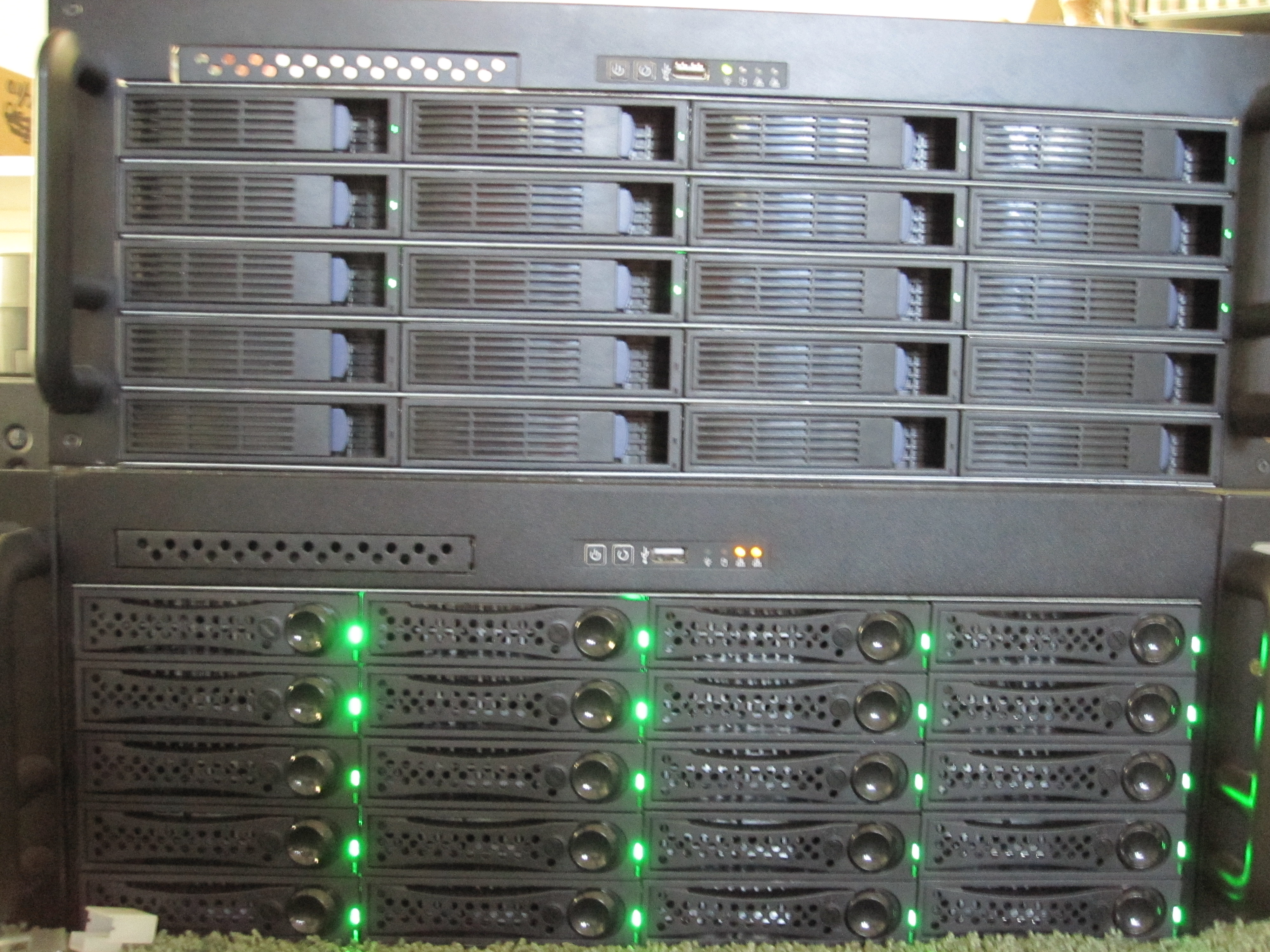
The Big WHS was originally supposed to house approximately 30TB of storage when the plans were first detailed on an Excel spreadsheet BOM in December 2009. This was a big upgrade to my first DIY Windows Home Server box that had well under 20TB. About five months later, the storage capacity has crested 60TB, with further room to expand. The Big WHS now spans two 4U Norco cases (using a total of 8U of rackspace and another 4U chassis is in the works) has over 60TB of storage, and requires well over a dozen ports on the gigabit switch.
Read the full story
Posted in The Big WHS
Posted on 23 May 2010. Tags: baseboard, BMC, cpu utilization, h55, h57, heatsink fan, intel core i3-530, intel ssd, intel stock, intel xeon, intel xeon x3440, management controller, motherboard review, picopsu, power consumption, real server, server hardware, SSD, Supermicro, Supermicro x8sil-f, wall socket, watt power, webgui, x25, x8sil-f, X8SIL-F v1.02
To update to my review of the Supermicro X8SIL-F, I took some Kill-A-Watt power consumption numbers with the Supermicro X8SIL-F to answer a few questions regarding power consumption with real server hardware compared to consumer-level hardware. Below I am focusing on idle power consumption as with the Intel Core i3-530, Xeon X3440, and other LGA 1156 CPUs the CPU utilization while running a NAS application will be very low. After a bit of testing I found the i3-530 again leading the pack in idle power consumption and the Xeon X3440 turning in very respectable idle power consumption numbers.
Posted in Low Power Servers, Motherboards, Server CPUs
Posted on 20 May 2010. Tags: business storage, DDR3, dual nic, enormous benefit, eon zfs storage, expansion card, expansion slots, file server, flash drive, freenas, home server, home servers, htpc, intel xeon, internal usb header, motherboard, nics, Norco, openfiler, overclocking board, realtek nic, Review, server test, server v2, small business servers, storage drive, storage servers, Supermicro, Supermicro x8sil-f, test configuration, unraid, usb thumb drive, vail, virtual machine, WHS, Windows Home Server, windows home server v2 vail, x8sil-f, X8SIL-F v1.02
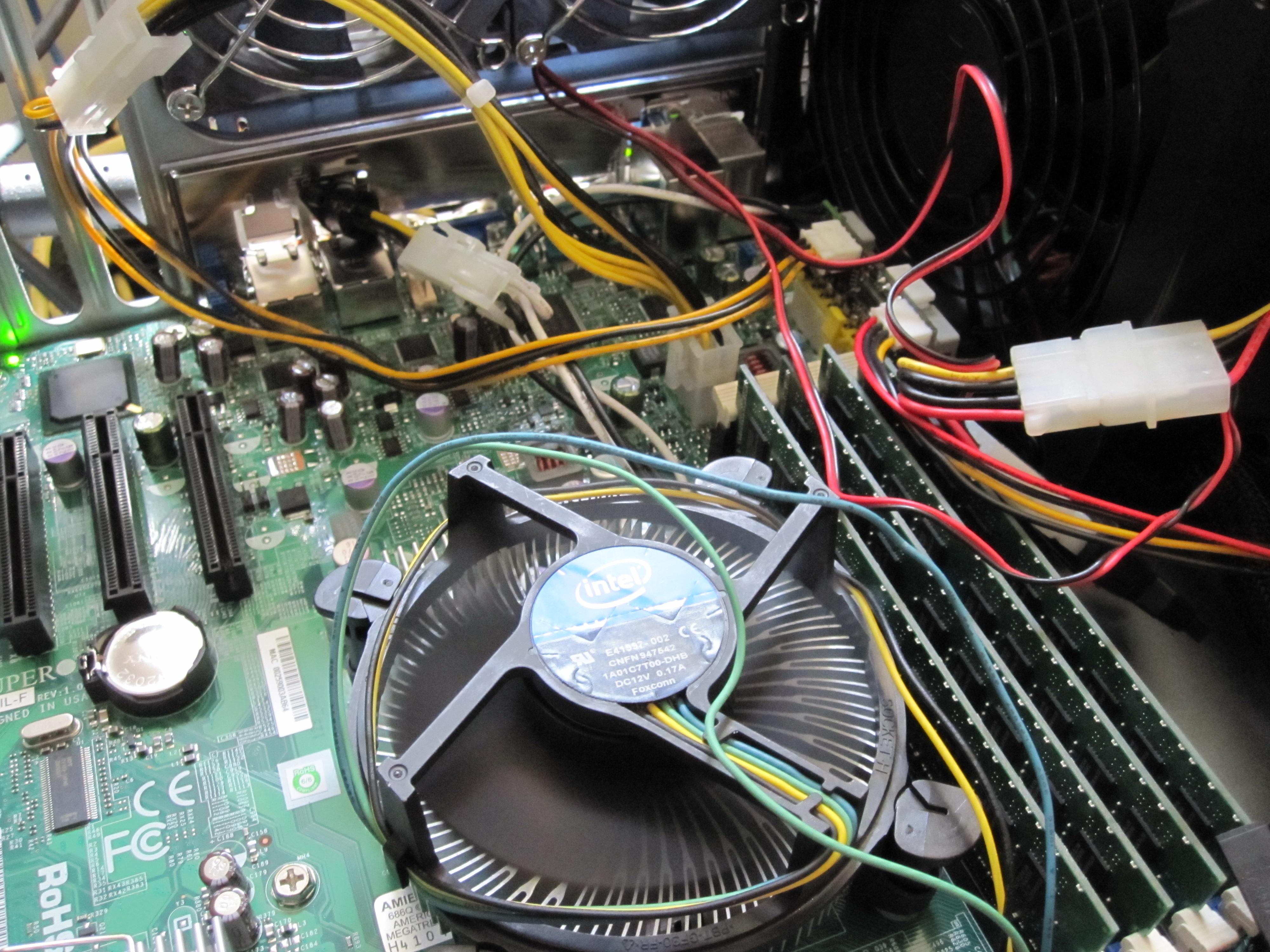
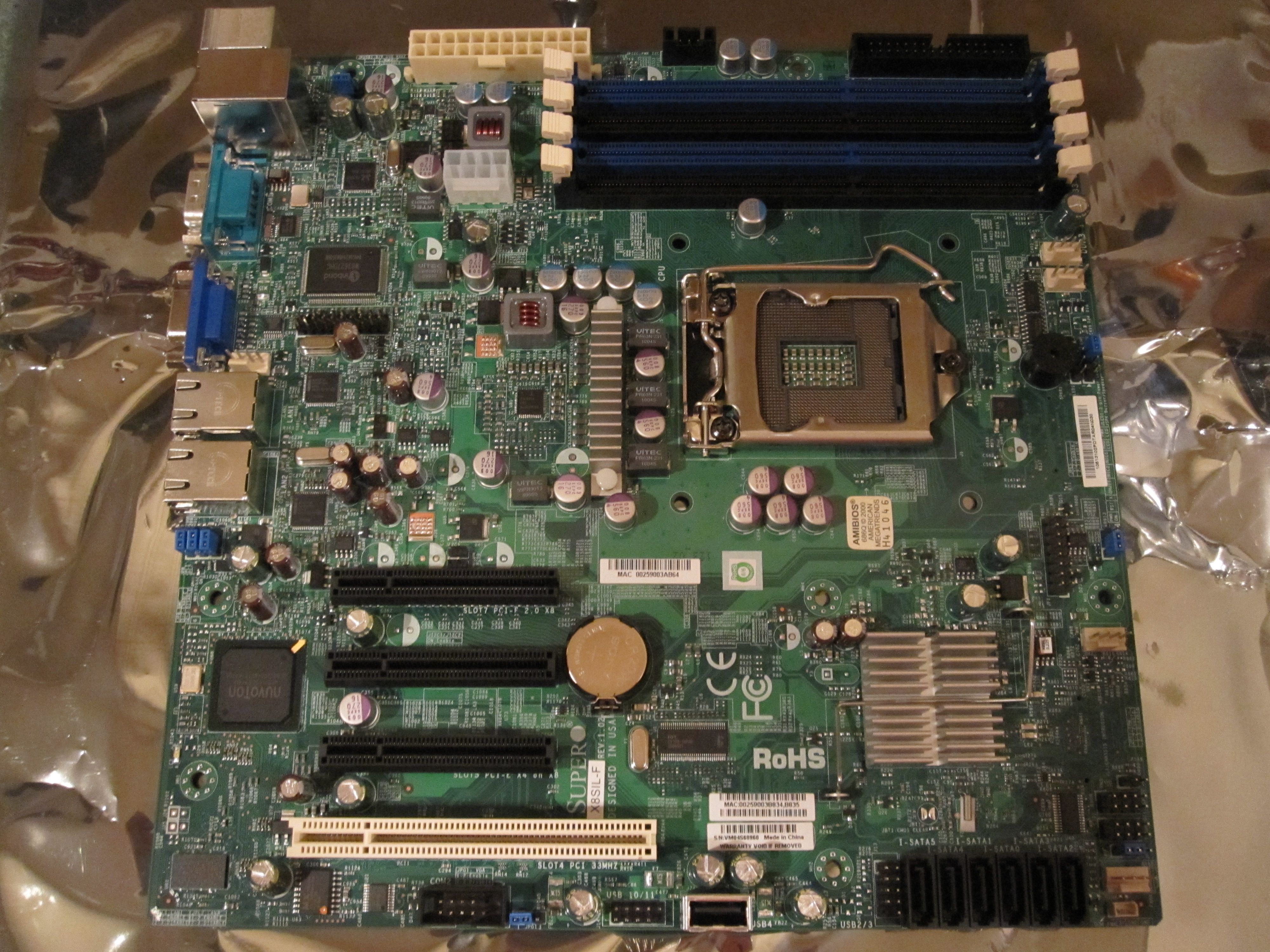
The Supermicro X8SIL-F motherboard is an excellent board for home and small business servers. When building a file server built upon Windows Home Server (V1 or V2 Vail) or another open source NAS project such as FreeNAS, Openfiler, EON ZFS storage, the Supermicro has a feature set that differentiates itself from both AMD and Intel based consumer-level motherboards. Compatibility with those operating systems and virtualization platforms such as Microsoft’s Hyper-V make the X8SIL-F a strong contender for a DIY storage or virtual machine server.
Read the full story
Posted in Motherboards
Posted on 14 May 2010. Tags: capacitors, Core i3, Core i5, expandability, home servers, hyperthreading, Intel, intel pentium, intel xeon, matx motherboard, network attached storage, pcb rev, physical differences, power combination, power consumption, processors, rev 1.01, rev 1.02, rma, Supermicro, supermicro motherboard, Supermicro x8sil-f, v1.01, v1.02, virtual machine, virtual machines, x8sil-f, X8SIL-F v1.02, xeon cpu
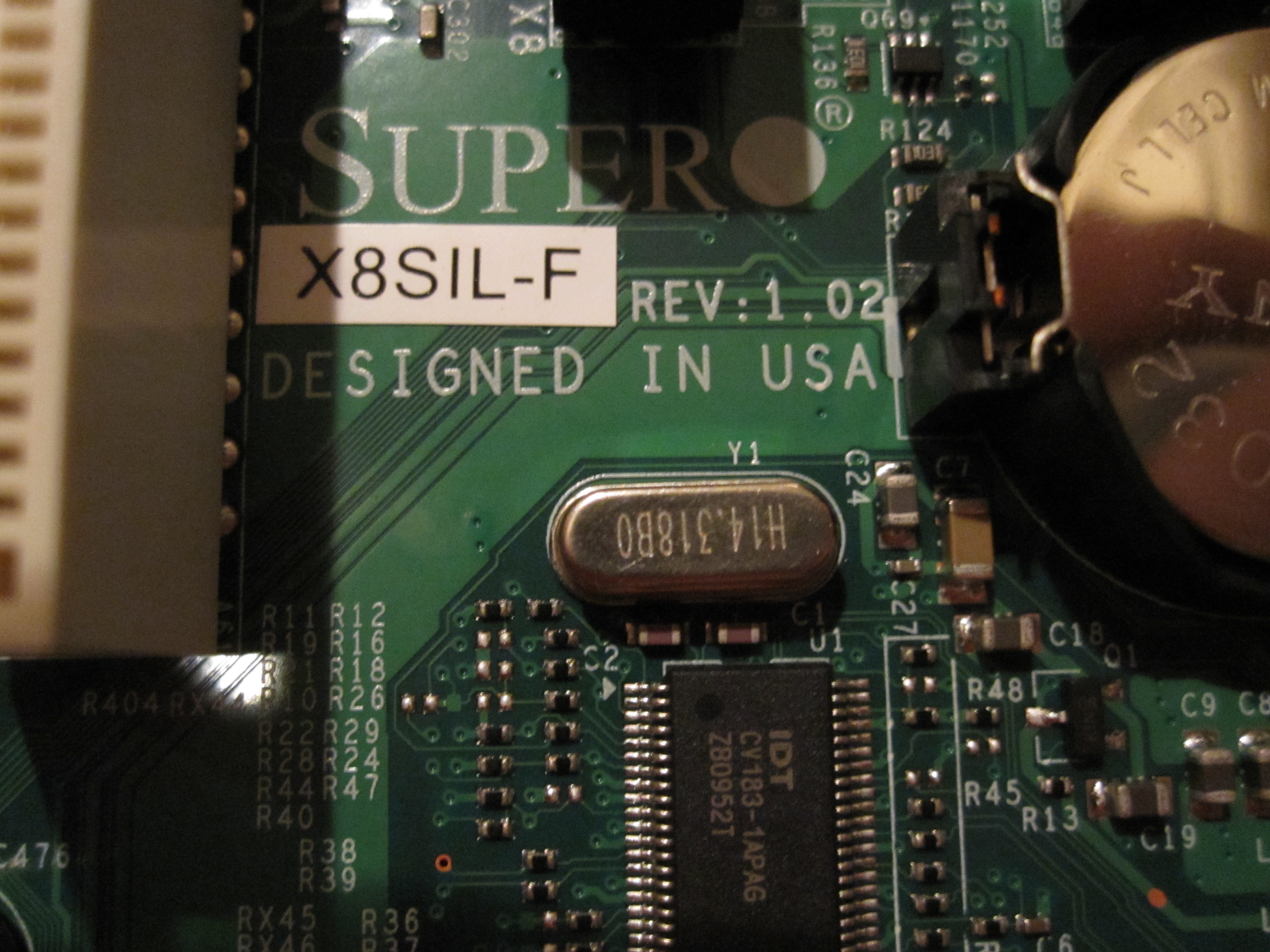
The Supermicro X8SIL-F mATX motherboard is becoming a favorite for home servers, especially those built upon Core i3′s and Core i5′s because it provides lots of expandability in a small form factor, and has IPMI 2.0. The Supermicro X8SIL-F’s supported processors can easily handle a network attached storage (NAS) virtual machine as well as additional virtual machines for other purposes. As I eluded to in my previous post, the major difference between the revision v1.01 and v1.02 boards, at least as far as I have seen, is the support for the Intel Core i3 and i5 CPU’s as well as the Intel Pentium G6950 in the v1.02 X8SIL-F versus support only for Intel CPU’s in v1.01. With the virtualization support and hyperthreading in the Intel Core i3 and i5′s as well as the low power consumption of Intel’s 32nm process, it is a great, low cost and low power combination.
Read the full story
Posted in Motherboards
Posted on 10 May 2010. Tags: Areca, clarkdale, compatibility issue, doorstep, dual intel, e mail, gigabit, i3-530, intel core i3-530, lga, linux freebsd, matx, monday afternoon, Norco, rma request, rma support, rpc, server board, Supermicro, Supermicro x8sil-f, test environments, ups, virtual machines, WHS, x8sil-f
As I mentioned in the previous post on the compatibility issue, I had to RMA my Supermicro X8SIL-F (mATX LGA 1156 server board with IPMI 2.0 and dual Intel gigabit NICs) last week because it was version 1.01 PCB instead of v1.02. The difference being support for Clarkdale CPU’s.
Just to give an idea of why Supermicro’s support is so good here is the timeline:
- Sunday (day 0) - Sent a note to Supermicro tech support explaining my problem.
- Monday morning (day 1) - Received a confirmation that I needed v1.02 PCB of the X8SIL-F to use with my Intel Core i3-530.
- Monday afternoon – submitted my RMA request online
- Tuesday mid-day (day 2) - was contacted by Supermicro RMA support, I gave the requried information for advanced RMA. Later that day I got a follow-up e-mail saying that the advance RMA request had to be approved and that it may take until the next day.
- Wednesday (day 3) – confirmed that I accepted the Supermicro advance RMA policy, and that ground shipping would be fine (I live only a few miles from a Supermicro facility).
- Thursday (day 4) – New X8SIL-F shipped.
- Friday (day 5) – X8SIL-F was at my doorstep. I was not home to sign for the delivery, so made arrangements to pick up at the UPS facility. Bottom line is that Supermicro had the replacement board at my doorstep within 96 hours of submitting my RMA request.
Overall great service from Supermicro! I have also decided that I will house this in the Norco RPC-4220 that serves as the DAS box for the Big WHS. That way I can use it to add drives for the test environments. Odds are I will either run ESXi with a few Linux/ FreeBSD/ OpenSolaris virtual machines or just run OSes directly on the PC. I am also planning to power this system independently of the rest of the enclosure and drives so that I can power cycle the server without taking the drives off of the Areca array.
Posted in Motherboards
Posted on 03 May 2010. Tags: Areca, beep, bios update, dual intel, expansion cards, expansion slots, gigabit, google, google research, green ears, hitachi drives, home server, intel pro, lga, matx motherboard, network ports, server board, server v2, Supermicro, supermicro motherboard, Supermicro x8sil-f, x8, x8sil-f
Just as a quick note. I purchased a Supermicro X8SIL-F (mATX LGA 1156 server board with IPMI 2.0 and dual Intel gigabit NICs) last week, along with two 2TB Western Digital Green EARS drives using advanced format, and two Hitachi 2TB drives. First off, I was very excited about the X8SIL-F because it is a great mATX motherboard with IPMI 2.0, three PCIe x8 and one PCI slot with two onboard Intel NICs. My plan was to use those expansion slots for:
- PCIe #1: Areca ARC-1300
- PCIe #2: Intel Pro/1000 PT Dual
- PCIe #3: HP SAS Expander
- PCI #1: Intel Pro/1000 GT
That would give me well over 30 SATA ports (since there would be onboard SATA also) and five gigabit network ports (all Intel), and an option to expand to seven assuming I swapped the dual Intel NIC for a quad. I wanted to have a ZFS test box for FreeNAS/ OpenSolaris and for a physical or secondary Hyper-V installation of Windows Home Server v2 VAIL in the future. I had also ordered 4GB of ECC DDR3 1333 since I wanted lots of cache for ZFS.
Read the full story
Posted in Motherboards