

Lenovo ThinkCentre Neo 50q QC Power Consumption and Noise
Built from a platform first and foremost designed for laptops – and including laptop-like design tradeoffs such as soldered-down LPDDR5X memory – the ThinkCentre neo 50q QC is well positioned to deliver on energy efficiency. Especially with a low peak CPU clockspeed and few external controllers to add to the power load, the 50q QC fares very well.
At idle, we measured power consumption in the range of 5W to 9W while Windows was bouncing around. Meanwhile under a full load with CPU-Z’s stress test, we saw power consumption peak at just 26W.

Even by mini-PC standards, this is a very low amount of power consumption. It is the kind of figures we are more accustomed to seeing on things like Core i3 boxes, or low-end boxes based on the N305. In that respect, at times it is more like the Snapdragon X chip in the 50q QC is competing with Intel’s E cores on power, rather than their P cores. Consequently, if not for the need to power multiple USB powers, the 65W power adapter included with the mini-PC would be grossly overpowered for this system.
And the bigger benefit to that low power consumption is arguably acoustics. Or perhaps the lack thereof. Even with a petite 1L chassis, the 50q QC has no problem keeping up with the cooling needs of the SoC and the rest of the system. At idle the system is right along the 34dBa noise floor of our studio, and under full load it is still only nearly 36dBa. While not outright silent, in practice it is effectively unnoticeable when under use.
Key Lessons Learned
With every review we like to end with a look at some key lessons learned; and that is certainly applicable here to our first Windows-on-ARM/Snapdragon X-based mini-PC.
At a high level, what we learned is that the Windows-on-ARM ecosystem can handle most of what we throw at it. Lenovo’s ThinkCentre neo 50q QC had no problem running most of our workloads – and even more out there, we can even get things like WSL running on it, bringing it very close to parity with traditional x86 boxes.
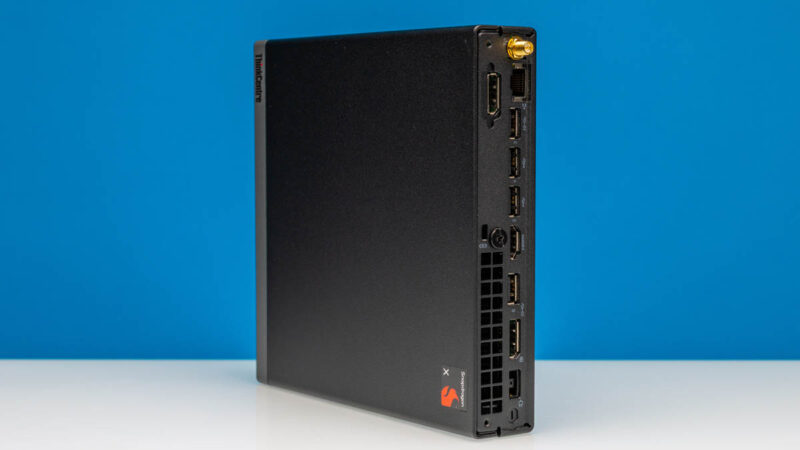
But “very close” is not identical. It is not a frictionless experience – at least not quite yet. The hang-ups we did encounter were far more nuanced than high-level problems such as binary compatibility, which is both a boon and a hindrance. A boon because it shows how good compatibility for the Prism x86 emulator has become over the past several years, and a hindrance because some of these remaining issues are not things that can just be fixed by a better emulator.
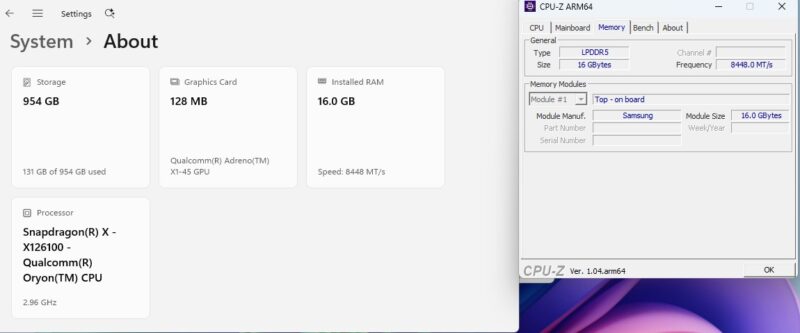
On a side note, our issues here with MLPerf Client and memory capacity reinforced the importance of carefully selecting the amount of memory in advance for a system with soldered-down memory, something that is common in the smallest of these mini-PCs. There is no option to upgrade later, so maybe aim a bit higher than your immediate needs in order to make sure you have some headroom. Or enough memory at all to run MLPerf, as was our situation.
Finally, the lackluster state of the Linux ecosystem for Snapdragon X devices means that the 50q QC is a poor choice for running a native Linux installation. This is a task that some of our other mini-PCs have been assigned to, so it is a use case we like to take a look at. But at least for now, the 50q QC is strictly a Windows machine – though with a dash of WSL thrown on top.
Though conversely, this is the first ARM-based mini-PC that has crossed our desks that can even run Windows. Which gives it a big leg up in some respects since it can run our Windows applications, something the more widely popular ARM-based Mac Mini family could not do.
Final Words
Ultimately, Lenovo’s ThinkCentre neo 50q QC proved to be an impressive machine within its niche – and remains so just so long as it is not pressured to go outside of that niche.
The hardware underlying the modestly-priced mini-PC is a very good fit for a 1L chassis. With a peak power measurement of just 26 Watts, even that small chassis has no trouble cooling the system. And those minimal cooling needs, in turn, mean that the PC is whisper-quiet even under full load. It is not a fully passive system, but with a noise level only a double of decibels above our studio noise floor, it is among the quietest systems we have reviewed.
With that said, a mini-PC probably is not the best place for the power consumption advantages of the Snapdragon X platform to flex its muscles. In a laptop, power consumption is battery life – something most of us could always use more of. However, that is not the case for a desktop system plugged into a wall. A low-power system like this still saves on the electric bill at the end of the day, but that is not as much of an advantage for most users.
As for performance, the 50q QC uses Qualcomm’s lowest-tier Snapdragon X SoC, and it shows. The system can put up a very good fight against other low power systems, but anything with enough of a power budget to run a 35W Intel or AMD chip is going to run right past the 50q QC, thanks in large part to its low peak clockspeed of just 3.0GHz. All of which are things we would have expected just looking at the specifications and the pricing of the 50q QC before even reviewing it, and which is confirmed by our testing.
Still, within ServeTheHome the tiny Lenovo PC has certainly proven its utility. We use several of these boxes around our studio/labs for driving various testbeds and displays, and we will likely be using the 50q QC to swap out one of our older Core i3-N305 systems for something more powerful but similarly low-power. Which given the commercial focus of Lenovo’s ThinkCentre system lineup, is exactly the kind of use case the 50q QC was made for.
Where to Buy
You can find the unit at Lenovo’s web store: Affiliate Link


These will deprecate in value quickly.
1L is too big for this pc. Specially with the soldered ram.
Same lack of linux support as any random unknown ARM SBC.
It was my, admittedly layman’s, understanding that the UEFI ARM stuff was supposed to be generically discoverable and not require hardcoded device tree data. Is that only kind of/sort of true; and ARM vendors only care on server hardware?
Am I the only one looking at the first picture thinking it is a CD-ROM?
Qualcomm is synonym of not able to run Linux
I also understand the Neo 50q Tiny QC is unable to run Linux.
For a home server that makes this hardware a nonstarter. Unsuitability for use in a home lab or other server environment is something I would expect emphasized in an article from a site called Serve the Home.
If, in fact, there were a way to load a mainstream distribution such as Ubuntu, Debian, Redhat or Suse, then it would be greatly appreciated to test that claim and explain how.
Qualcomm says it wants to be a player in the PC space, but their behavior still resembles something of a locked in cell phone. The Nuvia tech they acquired and bragged about for so long as surpassing Apple’s M chip is exactly why everyone scoffed at Nuvia pre-buyout. It never could and it still can’t.
I have tried working with Qualcomm on the 7C and it was a massive waste of time. Just too many proprietary bits and stupid design decisions to keep out the educated. Even working with their “Developer Community” portal, was a massive joke (on me).
You wont see them anywhere in my world. Good riddance.
You wrote “it can run our Windows applications, something the more widely popular ARM-based Mac Mini family could not do.”
But that’s not really true, is it?
This review would have been much more interesting if you had compared it head-to-head with a Mac Mini. Put Windows on the Mini, both with UTM (free) and Parallels or VMWare, and bench them that way. Also telling us about compatibility issues with Windows for both ARM PCs would be great.
After all, you seem to be OK with Linux through WSL, which is at least as much a stretch as UTM or another virtualization tool. Oh, and speaking of which, how about comparing and benching WSL with Linux in UTM?
This feels like a really not-useful review, because it doesn’t really answer the most important questions.
justsomeguy: Hey the Mac Mini advocate is back! Just as an aside, UTM Windows is only free for evaluation purposes!
This device has no reason to exist. It costs $629 (Amazon) yet gives worse performance than a 2018 Intel Core i5 Mac Mini that you can get refurbished for under $200. It is appalling that no good workstation or even prosumer ARM APU exists after all this time. They are simple to make.
1. Use 16-32 Cortex X cores i.e. Cortex X-3 or Cortex X-295.
2. Use 8-16 Neoverse N1, N2 or V1, V2 cores.
Nothing keeps the ARM client companies like MediaTek and Qualcomm from doing 1. Nothing keeps ARM server companies like Ampere and Marvell from doing 2. And nothing keeps Nvidia, who makes ARM client AND server chips, from doing so.
No, you can’t run Windows on them because of this ridiculous contract that Microsoft signed with Qualcomm for Windows on ARM exclusivity to cut Microsoft’s losses. But you can run Linux on them, and let’s face it, developers, systems architects and other Linux users are going to be the only ones with a real need for an ARM workstation that doesn’t run macOS in the first place.
@rano: I’m hardy a Mac Mini advocate. I believe in the proper tool for the proper job, which is why all my servers are EPYCs. But it’s an astonishingly compact and low-energy device for so much power. That makes it tempting to find novel uses for it.
Your claim that “UTM Windows is only free for evaluation purposes” is BS. UTM is free, period. (So is VMWare for Mac, last I checked, though that company seems utterly toxic now and I’m avoiding them.) Of course, *windows* isn’t free, but that’s true on every platform.
Also… “Nothing keeps the ARM {client, server} companies…” Clearly *something* is doing exactly that, because they haven’t done it. That something is, of course, economics. Which comes right back to the main question, which is, it the Mini a better (= “more economical”) solution to some problems? It clearly isn’t, for your problems. But your problems are just one category.
@justsomeguy:
” Of course, *windows* isn’t free, but that’s true on every platform.” Which is what I meant: the Windows license is only free for evaluation purposes.
Sorry, but any temptation to find novel uses for a device with 2100 single core performance, worse than a Core i3 14100F and not much better than a Ryzen 3 110, is removed by the $630 price. “But it’s an astonishingly compact and low-energy device for so much power” is only true for a Mac Mini. You can set one to low power mode and still get better single core performance at less than 25W.
Is the Mini a better solution for some problems? Clearly. But not all of them which is why we need better Linux ARM tech. System76 will sell you a 32-core Ampere Altra CPU, 4 GB VRAM Nvidia card and 64 GB RAM system for $3300, which is M4 Max 16″ MacBook Pro money. ($350 more will get you a 16GB Nvidia 5060 Ti.) The Nvidia DGX Spark is cheaper, but not much and isn’t practical for much more than LLM development.
I say that a good ARM SOC would sell and that MediaTek, Nvidia, Samsung etc. are leaving money on the table by not making them. Indeed, Samsung actually wanted to do something in this area for Chromebooks but Google wouldn’t let them. Google later tried to design one themselves, didn’t like the early results and just gave up. Right now it looks like Valve’s desire for an ARM APU to replace the AMD one in the Steam Deck is the best bet to finally get movement on this.
No Linux compatibility. Soldered RAM. Only 1GbE. I’ll pass.
What I believe is more interesting is that Lenovo thinks Windows on ARM has (or will have) a big enough part of the market to justify making this thing.
@rano: No argument about the Lenovo. My comment about novel uses was referring to the Mac Mini, not the Lenovo (or QC PCs in general, so far).
It’s not clear to me that the Ampere is a better buy than an M4 Studio or M3 Ultra, depending on configuration and what you’re trying to do. (Clearly, if you need a ton of fast SSD, the Mac’s going to be crazy expensive, and depending on how parallelizable your tasks, the Ampere might have a performance edge… though probably not in most cases.) It will probably again be a question of compatibility.
So, yeah, better Linux ARM tech sounds good. But you don’t have it right now, and that makes for interesting questions when you don’t want to (or can’t) use x86.
@justsomeguy:
Oh no, Mac Minis aren’t just good for novel stuff. They are great for anything that doesn’t absolutely require running Linux (or Windows) natively as opposed to virtually. Sadly, there are more than a few things that do.
But I think that you are missing my point. The Ampere with more than 4 GB VRAM is $3600. Your M3 Ultra Mac Studio is $4000. Both are WAY more powerful than most people need and you are very much paying for all that power. Meanwhile you can get a great x86 system, Ryzen 9 with Nvidia 5080, for $2500. You can get a very good one, Intel 7 with Nvidia 5070, for $1500. And you can get a mini PC with integrated graphics that are as good as an Nvidia 3050 on a lot of workloads for under $700. Those are what a lot of people need and ARM options simply aren’t available. And if you need discrete graphics or to run a different operating system natively, not even Macs are an option.
My take on this is that there’s zero benefit over an i5 or Ryzen U unless it’s fanless or cheaper (and it’s neither of those things). If that requires a differently shaped chassis (to accommodate eg a Macbook Air-style cooling system), so be it.
Incidentally, happy to see Ryan Smith’s byline – miss Anandtech a lot.
“Even then, the only user-serviceable parts are not covered by the fan or heatsink, so it is not necessary to disassemble the 50q QC any further to make any upgrades. But where is the fun in that?”
Love it!