

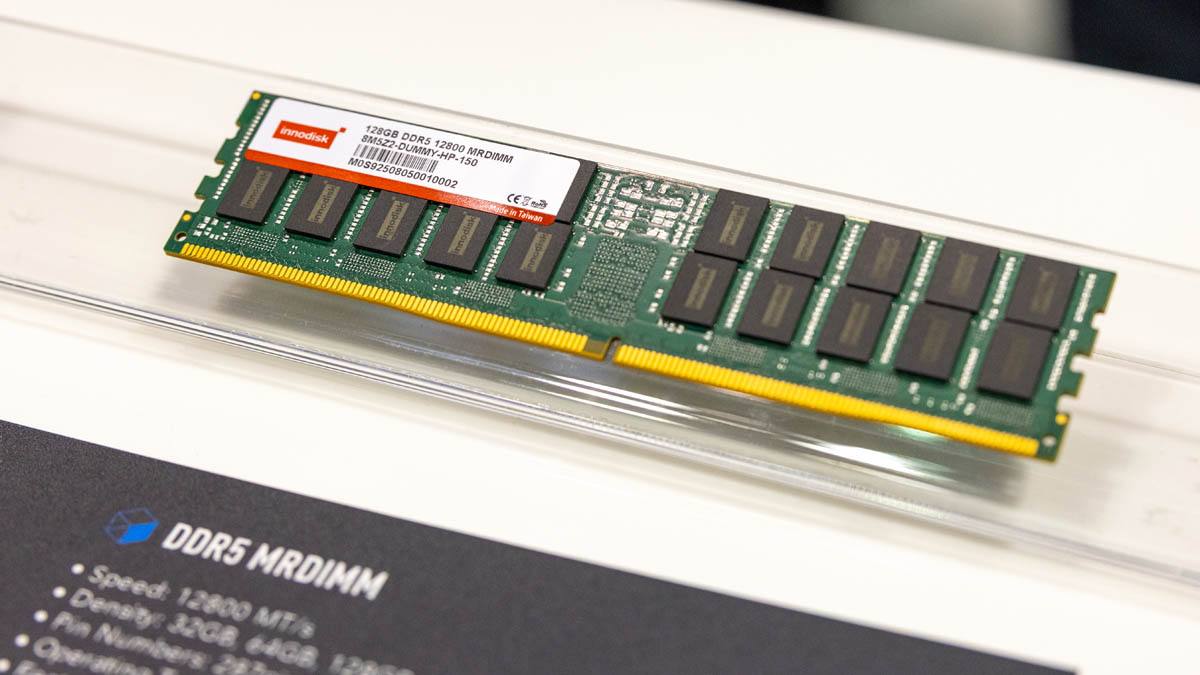
Your memory is slow. Innodisk had this neat little display at their booth at FMS 2025. We saw what looked more like display MRDIMM units, but with a twist. These modules are labeled as DDR5-12800 samples.
InnoDisk Shows DDR5-12800 MRDIMMs at FMS 2025
Here is the module that we saw at FMS 2025 on display. You can see that there are several components that have not been placed. The “DRAM packages” do not have markings, and so forth. The label is 8M5Z2-DUMMY-HP-150, which tells you that this is a dummy part not an actual module.
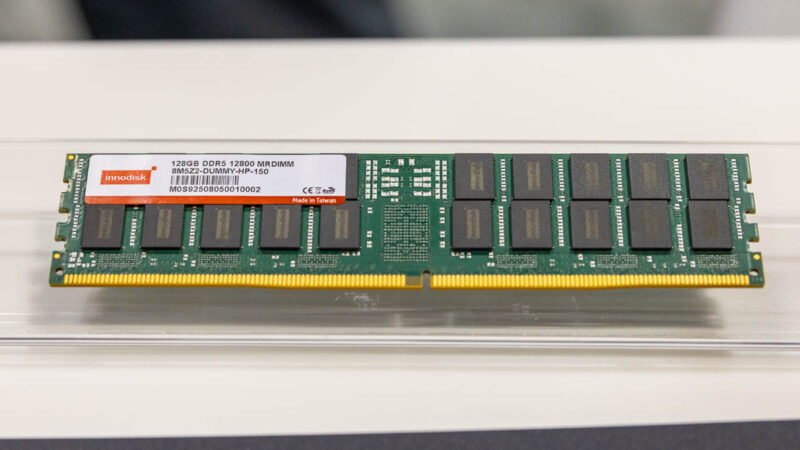
Capacities are listed at 32GB, 64GB, and 128GB. Oftentimes 256GB MRDIMM modules these days need to be 2U height instead of 1U.
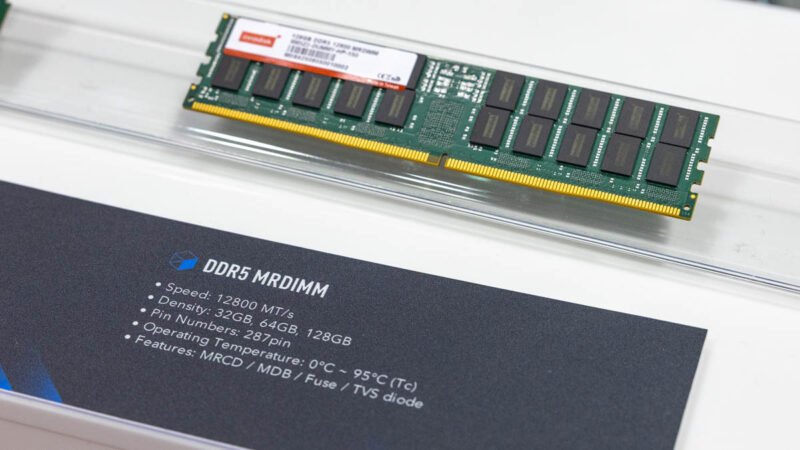
Still, the fact that we are seeing these is important. Intel supports MCRDIMMs/ MRDIMMs in their current Intel Xeon 6 P core lineup. That support is limited to 8-channels at DDR5-8000 speeds with the Xeon 6700P and 12-channels at DDR5-8800 speeds with the Xeon 6900P series. For some other reference points, standard server memory speeds in 1DPC mode today is DDR5-6400. Intel is doing this by supporting MCRDIMMs and calling them MRDIMMs.
That may seem trivial, but to be fair, using MCRDIMMs/ MRDIMMs at DDR5-8800 speeds and 12-channel memory controllers effectively meant that Intel could stop the Intel Xeon Max line with integrated HBM.
In the future, bumping the speed up to DDR5-12800 means that we get roughly twice the throughput per channel. We also are expecting next-generation server platforms to support 16-channel memory. One major challenge is that as servers move to higher core counts and PCIe Gen6, memory bandwidth becomes a large bottleneck, so we need faster solutions as an industry.
Final Words
Let us be clear, we saw a “DUMMY” but the point is that the DDR5-12800 MRDIMMs are coming. For those applications where high-performance memory is required, adding 33% memory channels and roughly doubling the throughput of each channel should yield a lot more memory bandwidth on future CPUs that support the technology.



The need for web servers and transaction processing is currently bottlenecked by human population growth. This is no longer a problem as AI now drives growth in computing.
Hopefully faster memory will provide a relief from those memory-bandwidth-starved high-core-count processors designed to run low-performance microservices in the cloud. On the other hand Intel might cancel their MRDIMM capable processors in order to focus on their primary business.
@Eric
I don’t think it would be a matter of Intel cancelling MRDIMM processors, Intel is simply letting the processors binned with really good memory controllers run MRDIMMs because they are capable of it and so they make a SKU out of it.
I could see fast memory support on Intel CPUs being dropped if they follow AMD and put the memory controller on a separate chiplet from the CPU without advanced packaging; This is something I’m actually worried about.
Could this be used for next-gen beefy desktop APUs ? These do need the bandwitdh.
And capacity.
@Paul
It doesn’t matter if IMCs are separate chiplets or not for MRDIMM support. The physical connection in question is between the IMC and DIMMs, not the rest of the CPU.
Also Intel’s version is MCRDIMM, which is incompatible with JEDEC MRDIMM that supposedly AMD is going to support.
@Lini Ban
Capacity is going to be a problem for MRIDMM since it can only be used in 1 DIMM per channel configuration (simply put it’s two “classic” ranks on one DIMM multiplexed and buffered by additional circuitry). Currently MRDIMM 8800 tops at 256GB. This article shows 12800 at “just” 128GB.
@Kyle
While you are technically correct about chiplet-MRDIMM support, no competent chip designer is going to adopt MRDIMM support while being bottlenecked by non-advanced packaging to the CPU cores; It’d be like giving a Honda Civic sticky hoosier drag tires while not changing the stock engine at all.
Intel’s current Xeon 6 chips work with MRDIMMs just fine. While it isn’t true in every sense that the MCRDIMM spec is a subset of the MRDIMM spec, more often than not that is the case, hence why Intel’s processors are currently the only x86 processor that can run MRDIMMs.
@Paul
What makes you think that AMD or Intel do not have advanced packaging already? Intel Xeon 6 supporting MCRDIMM is already built on chiplets and there is no significant bottleneck between them in terms of memory. Not to mention the scope of advanced packaging that went into Intel Ponte Vecchio or AMD’s MI series.
No, Intel Xeon 6 is not using JEDEC’s MRDIMM, it is using Intel’s proprietary MCRDIMM that is not compatible with it. Intel went to great lengths to hide that fact, but you can go to Micron’s MRDIMM side and look at their FAQ:
Q: Is this MRDIMM compliant with the JEDEC standard for MRDIMM?
A: No. JEDEC has not yet released the standard for MRDIMM. This is the first version of MRDIMM that supports Intel® Xeon® 6 processors.