

Realtek RTL8127 NIC Performance
We took two NICs, hooked them up “back-to-back” and this is what we saw:
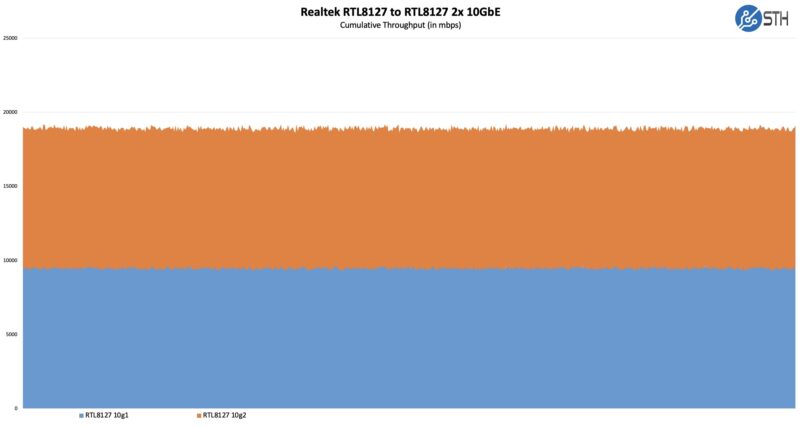
This is reasonably good in terms of performance, we are certainly hitting 10GbE speeds. Something worth noting is that we did this using the card versions of the NICs. We also have a number of systems that integrate these NICs, and so we double-checked our results. We tried PCIe card NIC to the onboard NIC, and onboard NIC to onboard NIC. The results looked almost identical to the above, so it seems not to matter how these are implemented, so long as they are on PCIe Gen4 x1 lanes.
Key Lessons Learned
Let us take a step back for a moment. We have had 10Gbase-T NICs for many years at this point. The Realtek NICs tend not to have the most virtualization features. Support for these in Windows and Linux is ok, but you most likely want to go to Realtek’s site and download drivers today. Many OSes will not recognize these NICs out of the box.
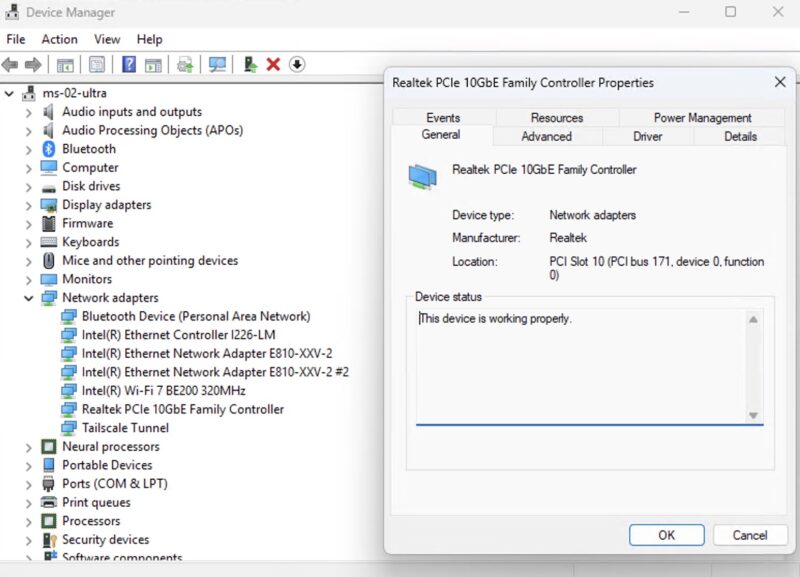
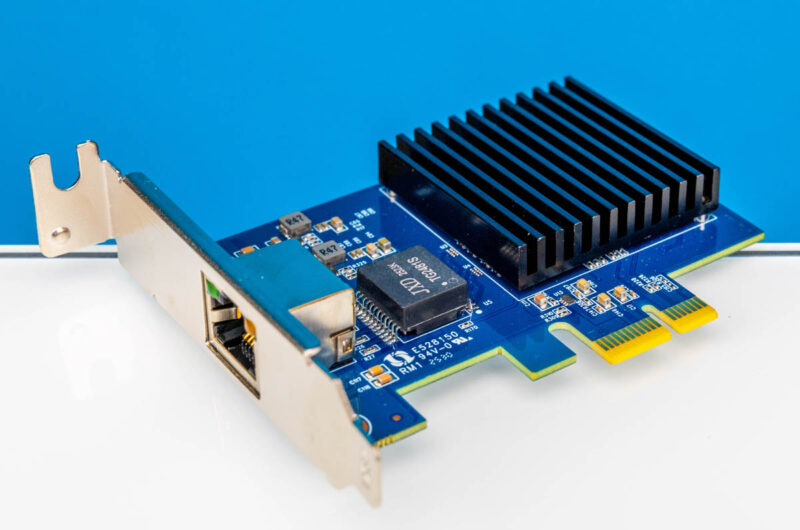
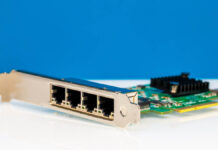
The impact of this NIC is really twofold. First, this is the footprint, and an x1 electrical interface that is ideal to integrate into motherboards. Even the PCIe Gen4 x1 card is a bit awkward. Adding an x1 slot consumes significant motherboard space, so we usually do not see them on mITX motherboards. The package is perfect to integrate onto motherboards that previously had PCIe Gen3 x1 lanes driving 2.5GbE NICs. Having a Gen4 x1 NIC means we effectively get four times the bandwidth due to the better lane utilization.
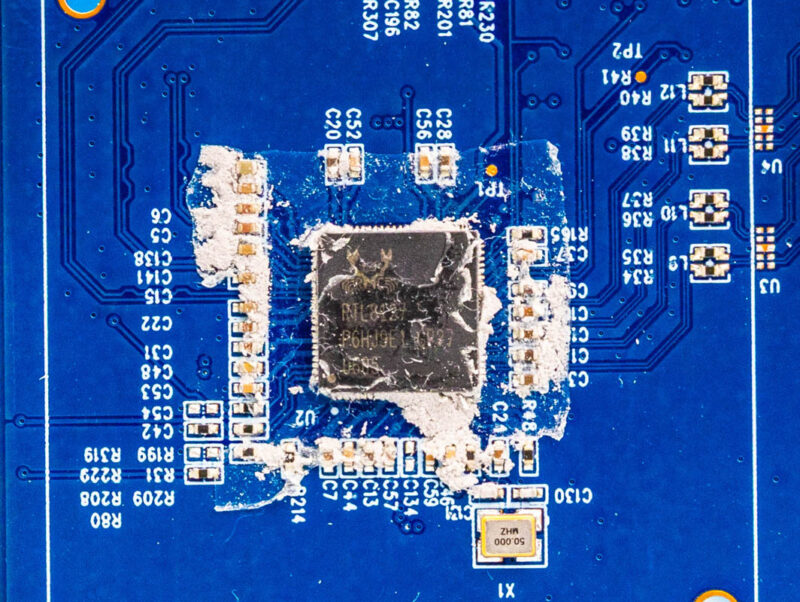
Perhaps the bigger benefit for the PCIe card is the cost. Folks have given us wildly different pricing, but $10ish for a NIC seems to be common to hear at this point. That means these PCIe cards are $35-45 each. Adding 10Gbase-T for $45 if you have an open PCIe Gen4 x1 slot and around 2-3W of power consumption is awesome.
The bigger challenge is that with an x1 NIC, we are now at the end of the line for 10GbE. With a PCIe Gen5 x1 lane we can support 25GbE, so in the future lanes will be massively underutilized with 10GbE NICs.
Final Words
Hopefully we will see more of these NICs, along with some of the fun derivatives in the next few months. This is one where we are probably more excited for the integrated NICs than the PCIe cards. At the same time, at $35-45 for the NICs this makes the NIC side of adding 10Gbase-T networking very affordable. While we do not get the virtualization offloads and so forth, 10GbE networking is really easy for modern processors to handle. That is why we can see low-power Arm-cores drive 10GbE firewall/ gateway appliances without issue.
Still, for many of our STH readers, these Realtek RTL8127 NICs are going to open up awesome systems.
Where to Buy
If you want to find the cards we purchased and current pricing, you can check out AliExpress affiliate link 1 and link 2.

No legacy test with PCIe 3.0 or even 2.0?
Just double checked. They support full Multi-GbE. 100/1/2.5/5/10. That would make them a good defacto choice for all motherboards going forward allowing for folks to support whatever network they might be running up to 10GbE.
With the outrageous prices of motherboards these days, I would hope that all of the manufacturers include 10GbE as the default going forward.
How about interrupt usage and CPU load with 64byte packets ?
Gen3 and Gen2 x1 do not have the bandwidth for 10G speeds.
I think the idea of many motherboards having this, also given the price of memory and such, it starts to make a lot more sense.
Adrian – on the 64b wait until 2026. We literally just rolled in a giant (well) used Pelican case with big packet generation box that we should have up and running later this week. We still will have some time until we publish results from it, but my hope is to be able to test up to the QNAP 25GbE/ 100GbE with it at 64b line rate https://www.servethehome.com/qnap-qsw-m7308r-4x-8x-25gbe-and-4x-100gbe-managed-switch-review/
All part of the process of getting much better networking reviews.
What about linux kernel support and ASPM support?
I don’t understand how you are getting close to 10 Gbps. Shouldn’t PCIe Gen4 x1 be capping around 8Gbps in each direction? It’s hard to tell for sure since your are not mentioning any exact numbers and the graph is not very granular.
I think I’ll get one of these for my 5950X / X570 desktop. Currently I have a T6 25GbE card in there, and while that card lacks nothing beyond maybe an FPGA, I’ve only got a 10G network and it’s not doing anything even remotely fancy. The single-lane card would move LAN to an otherwise unused x1 slot, freeing up an x8 slot for Thunderbolt.
Ok, nevermind, I guess the 1.97 GB/s of bandwidth in PCIe Gen4x1 is unidirectional.
Patrick,
I know, but it would be interesting to see if the card auto-negs 1G/2.5G/5G or does something completely different when installed into a legacy PCIe slot.
Jeff G your math is wrong. gen4 x16 = over 200Gbps so 200/16 = 12.5Gbps per lane. Or just remember that gen4 x1 is 4GB/s. 4 and 4 to remember
Jeff G’s math is correct. PCIe 4.0 is a dual simplex connection with 16 GTransfers/second per lane. Which after accounting for overhead from 130/128 encoding, results in a x1 connection having 1.97GB/sec of bandwidth in each direction.
We need a similar article for 10G SFP+ add in cards! I just bought an old Intel one and I’m wondering if I made the right choice.
I hope the chip is able to connect with Gen3x2 .. that would make it much more useful actually, even in bw limited M2 type M slots (x2). Not all systems have a gen4 x1 port.
@Daniel
Yes, according to other reports the RTL8127 can also be configured for a PCIe 3.0 x2 configuration. Though it remains to be seen how common those cards will be. The x1 card is marginally cheaper to make, since it involves routing fewer traces.
@Patrick
Lack of availabile bandwidth won’t stop companies from releasing products. I remember you reviewing a dual port 100Gb NIC on PCIe 3 x16. It was only able to do 50ish GB with both ports active but it was still released. Do note you said in the review that it couldn’t do 100Gb across both ports at the same time as it only has 128Gb bandwidth from the PCIe lanes. I also remember Linksys releasing an AC1300 USB adapter (they claimed full WiFi 5 on 5Ghz so 1300Mbps) with a USB 2.0 connection or 480Mb. That math doesn’t work out.
@Jeff G
PCIe 4 offers 16Gb per lane. That is enough bandwidth to do 10Gb Ethernet on an x1 connection. The bigger surprise is that it does it on an x1 without external power. For a lot of NICs they don’t need the additional bandwidth of an x4 or x8 slot but instead the power to drive the card without external adapators.
Hopefully either these or the Intel E610 becomes the new default for motherboards, it is always the cheap realtek nics that popularize faster network speeds for consumer devices and diy motherboards.
Any chance we can get a more beginner friendly explanation of the offloading and virtualization features this might lack that E610 might have? I am not too familiar with these features, but I want to know which I want to get if I am upgrading my old boxes.
$50 for a card for AliExpress is not CHEAP, it’s gambling. I will stay with my $80 zyxel with 5 years warranty.
I have several of the USB-versions of these, they can finally do 10GB on USB 3.2 – I’m using for my new Proxmox/CEPh cluster.. and they work surprisingly well, even on a 10Gb USB port, I’m getting 7.8Gbp/s.
I purchased them from AliExpress, I got 2 of them on sale for less that £40.. the rest cost me £50… either way that is extemely good value.
They kinda worked out of the box, but I hasmd issues with VLANs. So I ended up having to compile and install the drivers manually.
Hope to see support of the RTL cards in FreeBSD – pfSense/OPNSense have some limitations. And I agree with others that new motherboards need 10Gbe by default
Getting anything electronics from Ali (a.k.a the largest fake chinese crap marketplace of planet earth) is a big nono for me.
Why on earth are these card available from nameless chinese crap sellers, but not from any “reputable” companies? E.g. dell, hp, lenovo, gigabyte, msi, asus etc are not selling these NICs? Or who is considered to be a sort of reliable manufacturer of NICs in 2025/2026at all?
@Jeremy All power for the PCI-E card is delivered on the first 11 pins, on side A and B, before the keying notch.
@User AliExpress isn’t necessarily the source of choice; but it tends to be a fairly quick option(overall, not necessarily in terms of shipping) vs. waiting for someone to start rebadging ODM cards and selling them locally; and, for parts new enough to probably not yet have clones or desoldered refurb stock floating around, not a bad first-order estimate of what the cost is going to be without needing to convince realtek that you are totally going to buy 10k+ units to get a tray price out of them.
I have on of these, i can confirm lower than 2W Power consumption while having 10G Link.
Current Windows recocnized this NIC as 1Gbit out-of-the-box in my system and worked as such, after installing the driver it became a 10G/5G/2.5G/1G card.
Linux supports it from Kernel 6.16 OOB, for older ones you need to install the driver.
Hence, from Proxmox 9.1 with Kernel 6.17+ , RTL8127 is supported directly.
Also there is now a Board having this Chip onboard: The Asus Pro WS B850M Ace SE. I have one and it works nicely with a 9700X and Kingston Server Premier ECC Udimms (up to 4x48GB at 5400CL30, y-cruncher tested)
Great to see this reviewed. $10 / NIC might allow 8-port 10G switches close to $150 than $250.
And maybe finally fanless. It’s impossible to find 8-port 10 GbE switches without fans.
//
Per CNX, Realtek has a few versions of this platform:
8127AT – 10GbE via PCIe 4.0 x1
8127ATG – 10 GbE via PCIe 3.0 x2
8159 – 10 GbE via USB 3.2 Gen 2×2
RTL8261C – 10 GbE PHY only (1.65W)
The last one is the one for switches et al.
Cool story. What the model of affordable RJ45 10GB switch? There wasn’t one last time I checked. To you buy a suboptimal card and spend 150% of the savings on SFP RJ45 gbics? Hard pass…
@Yurii FreeBSD isn’t really the OS to use if you want good NIC support. pfSense is supposedly moving to a Linux kernel + BSD userspace model within the next few years.
@soder The ODM/OEM manufacturers often show off their products on Alibaba. Soon after, you’ll usually find either the manufacturer themselves or someone else list them on AliExpress direct to consumer. As a manufacturer, being quick to release a design/product based on a new chip is obviously important to attract bind brands.
There are also SFP+ models of these btw. It’s great to see a low power SFP+ NIC with PCI-E 4.0, which I assume is possible for those too. So far I’ve only seen PCI-E 3.0 x2 designs of that version.
Now we just need power efficient 10G switches. This card uses almost the same power as a 2.5G NIC. Last I checked, 10G switches power consumption was much higher than 2.5GbE ones.
I bought my RTL8127 from Alibaba for $36 including shipping ;-)
It exists in M.2 with the Auvidea M20E M.2 10GbE module with a power consumption under 1.5W
The question is when all motherboards will bring a 5Gbe/10Gbe instead an 1GbE ? When there will more swttiches with 24 and 48 ports at 2,5Gbe/5Gbe with 25Gbe/40Gbe uplinks ?
@Jeremy,, by pcie standards power delivery capabilities of x1 and x16 slot are exactly the same. Look at the pinout diagram- everything related to power delivery is before the mechanical key, rest is sense pins, signal lines and ground.
It is another question that some manufacturers might violate the standard and not provide full power to x1 slot, however that shouldn’t happen.
@No Problem Atoll: You’ve obviously already forgotten what happened when 1Gbps was new. 1G switches were expensive because there was no demand for them, as everyone had 100M ports. Then cheap 1G ports started appearing and then one day people realised all their stuff could do 1G, so why were they still using their old 100M switch, and with that demand for 1G switches, the price dropped.
The same thing will happen here – this is just the first step in making 10G ports common across multiple devices, then once people have a few 10G ports available they will look for 10G switches to use them with, and the resulting demand will bring the cost of 10G switches down.
It’s very short sighted to be so dismissive of something new when you’re only at the first step of its multi-step introduction process. Like any chicken-and-egg problem it takes time before all the pieces are in place, so try to look a little further ahead instead of expecting a full ecosystem to be in place on day 1.
@Yurii -current has support for this chipset, https://github.com/freebsd/freebsd-src/tree/main/sys/dev/rge, and should be backported to 15 soon-ish. It builds fine on 14. So pfSense and OPNsense could easily add support now.
@David There is an SFP+ based board design, https://www.aliexpress.com/item/1005010287958266.html, and more will be available later.
Just wanted to say that yes, there is a PCIe 3.0 x2 version of this, which is marginally cheaper on taobao (looking at CNY10-20) and I imagine that will remain to be the case in the western markets as well.
The PCIe 4.0 x1 version when installed in a PCIe 3.0 slot will still negotiate a 10Gbps link, but will be bottlenecked around 7-8Gbps by the PCIe link itself.
Found an SFP+ version on AliExpress with the RTL8127 chip, for the price, I’ll give it a try to see if it’s worth it to replace the AQC113 in my workstation and get rid of a RJ45>SFP module in my switch.
Funny thing is in the product description on Aliexpress, it’s listed as an RJ45, but pictures and some reviews confirm it’s a SFP+ version (also can confirm what I have is SFP+)
I’ve received the RTL8127 cards in PCIe 4.0×1 and PCIe 3.0×2 version.
Indeed the 4.0×1 in a PCIe 3.0 Slot is maxing out at 7.7Gbps.
The 3.0×2 card against a HPE 10GBE card maxed out at 8.8Gbps.
All tested with a Dell Optiplex 7070 (3.0×2) against HPE DL380Gen10 (which is also PCIe 3.0) and Windows 11.
The cards stay cools even under load, so their low energy demand is pausible.
Interesting: all Realtek cards RTL812x support the 2-pair mode defined in NBase-T. So with only 4 wires half of the nominal speed is reached. Normal 10GBE cards drop to 100Mbps in such a situation.
Simulated with an Ethernet Splitter adapter the cards auto-negotiated to half speed:
RTL8127 – RTL8127 -> 5Gbps over 2pairs
RTL8127 – RTL8126 -> 2.5Gbps over 2 pairs
RTL8126 – RTL8125 -> 1GBps over 2 pairs
Now we need cheap NBase-T switches, which supports 1/2.5/5 (!!) and 10GBE
I have two of these in Gen4 x1 slots on two X570 systems. They both receive at 9.9Gbps but transmit is limited to 6.3Gbps on one and 5.1Gbps on the other. I’ve tried different network cables and SFP+ transceivers switch-side. Not sure if it’s a power budget thing or slot power delivery or what.
The other more serious issue I’ve experienced is that sometimes after a warm reboot the NIC is missing. It’s not even in lspci. I have to completely shut down the system and it comes back on cold boot.
Early adopter woes… but I was desperate to add 10GbE links to these two systems that don’t have any other free slots.
> The other more serious issue I’ve experienced is that sometimes after a warm reboot the NIC is missing.
Looks like this is fixed in kernel 6.19, so that’s good.
https://github.com/torvalds/linux/commit/ae1737e7339b513f8c2fc21b500a0fc215d155c3
@bambinone: Are you using a Linux Kernel <6.18?
There is a fix with in 6.18:
r8169: fix RTL8127 hang on suspend/shutdown
Last kernel atm is 6.18.7
6.19 is RC still: 6.19-rc7