Tag Archive | "server v2"
Posted on 16 June 2010. Tags: atx form factor, clarkdale, dual intel, expandability, expansion slots, home server, hyper-v, i3-530, i5-650, installed windows, intel core i3-530, intel pentium, intel xeon, intel xeon x3460, motherboard intel, network adapter, network controllers, power consumption, quality controllers, server motherboard, server motherboards, server v2, Supermicro, test configurations, x16
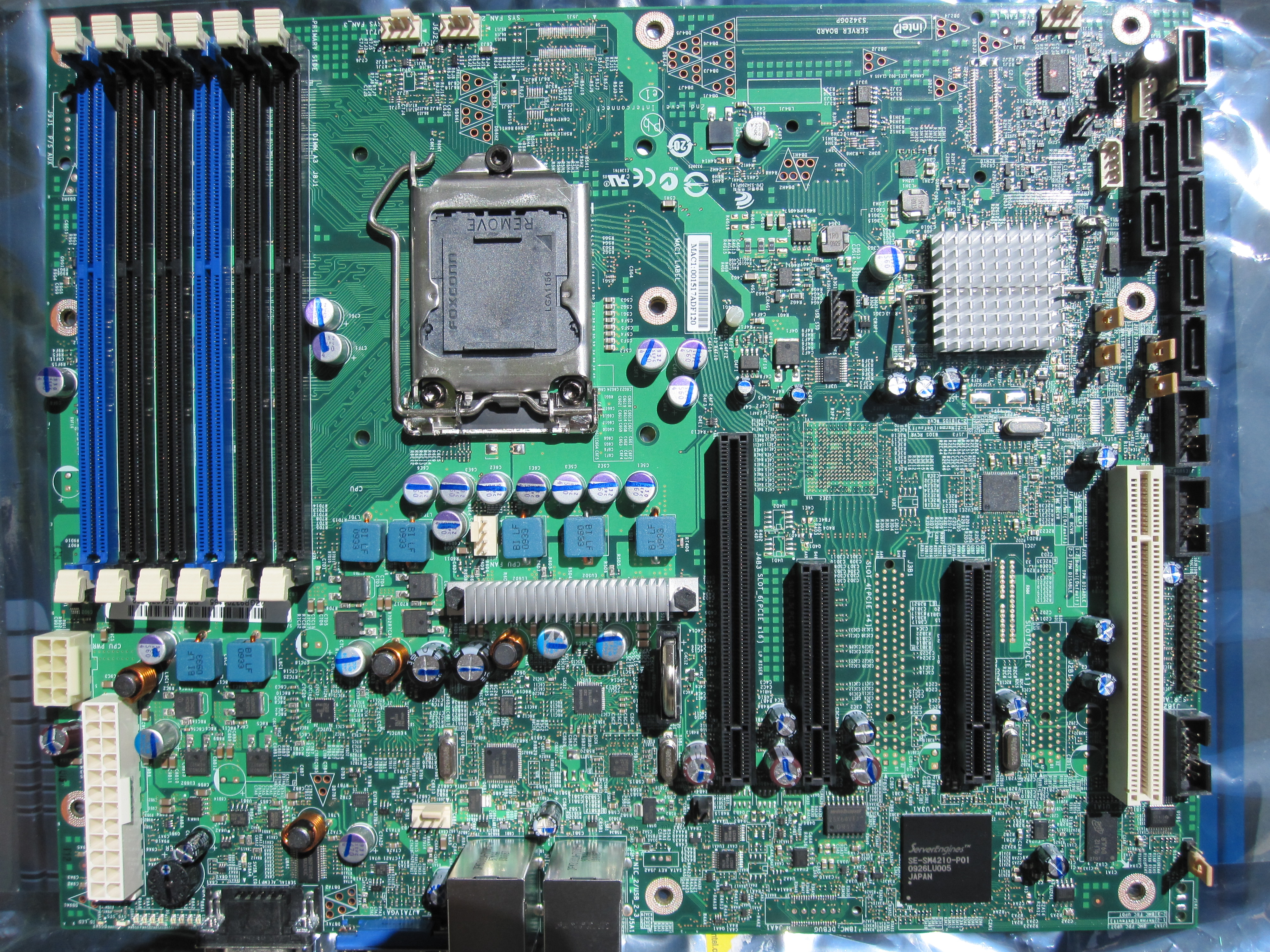
Intel’s 3400 chipset for its socket 1156 platform accepts CPU’s from the cheap Intel Pentium G6950 and Core i3-530 to the higher end Xeon X3430 to X3470 CPUs. Both Clarkdale and Lynnfield based CPU’s offer outstanding power consumption (for early 2010) at relatively low costs. After reviewing the Supermicro X8SIL-F, I purchased a competing (price wise) Intel motherboard to review, the Intel S3420GPLC. As I soon found, Intel also makes a good board, however it lacks some of the Supermicro’s features.
Read the full story
Posted in Motherboards
Posted on 01 June 2010. Tags: amd phenom, consumption figures, home server, i3-530, i5 750, Intel, intel pro, intel xeon, intel xeon x3440, maximum power consumption, mechanical disks, n330, Norco, offshoot, openfiler, picopsu, server v1, server v2, Supermicro, Supermicro x8sil-f, vail, virtual machines, x25, x25-v, x4, x8sil-f, xeon cpu
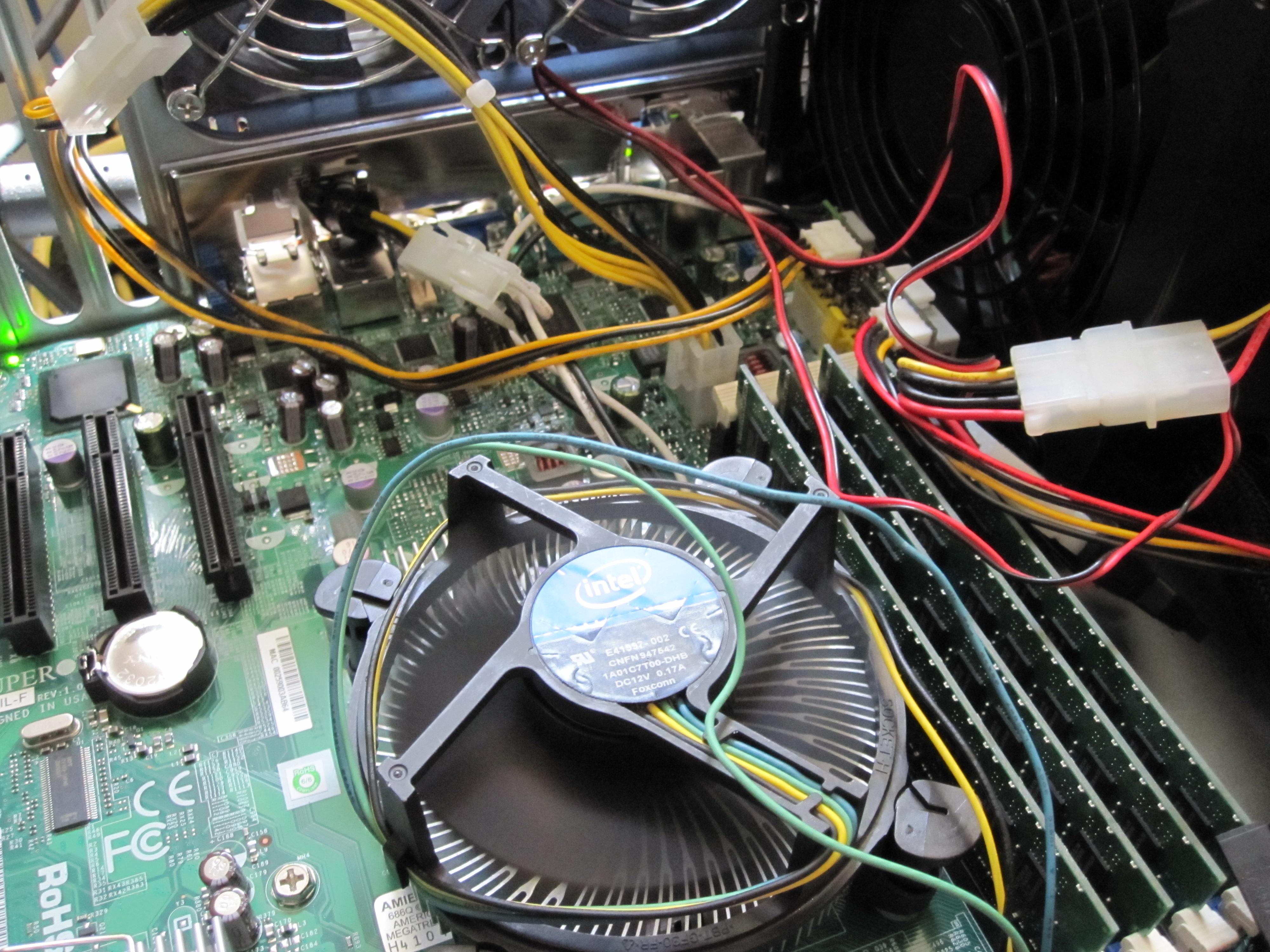
As a follow-on to the Supermicro X8SIL-F review, I had some interest in seeing power consumption figures for the CPU’s involved. I have already discussed the Intel Core i3-530′s low idle power consumption and relatively low maximum power consumption extensively. As I have a habit of doing, I decided to use an Intel Xeon X3340 in the new server for two reasons. First, I wanted to see a performance of the X3440 versus the other CPU’s I have tested for video encoding and transcoding on a Windows Home Server platform. Second, I wanted to have a server running Microsoft Hyper-V Server with Windows Home Server and Ubuntu 10.04 as guest operating systems running in Hyper-V virtual machines. In the end, I found that the Xeon X3440 provides a great feature set, relatively low power consumption, and performance all at a reasonable cost.
Posted in Server CPUs
Posted on 24 May 2010. Tags: 8u, adaptec, Areca, Core i3, Core i7, cpu intel, DDR3, Enclosure, expanders, gigabit switch, home server, host os, intel pro, main switch, Norco, rackspace, Seagate 7200.11, Server, server v2, stock fans, storage capacity, Supermicro, Supermicro x8sil-f, The Big WHS (30+ Drives), virtual machine, virtual machines, virtualization, WHS, Windows Home Server, x25, x8sil-f
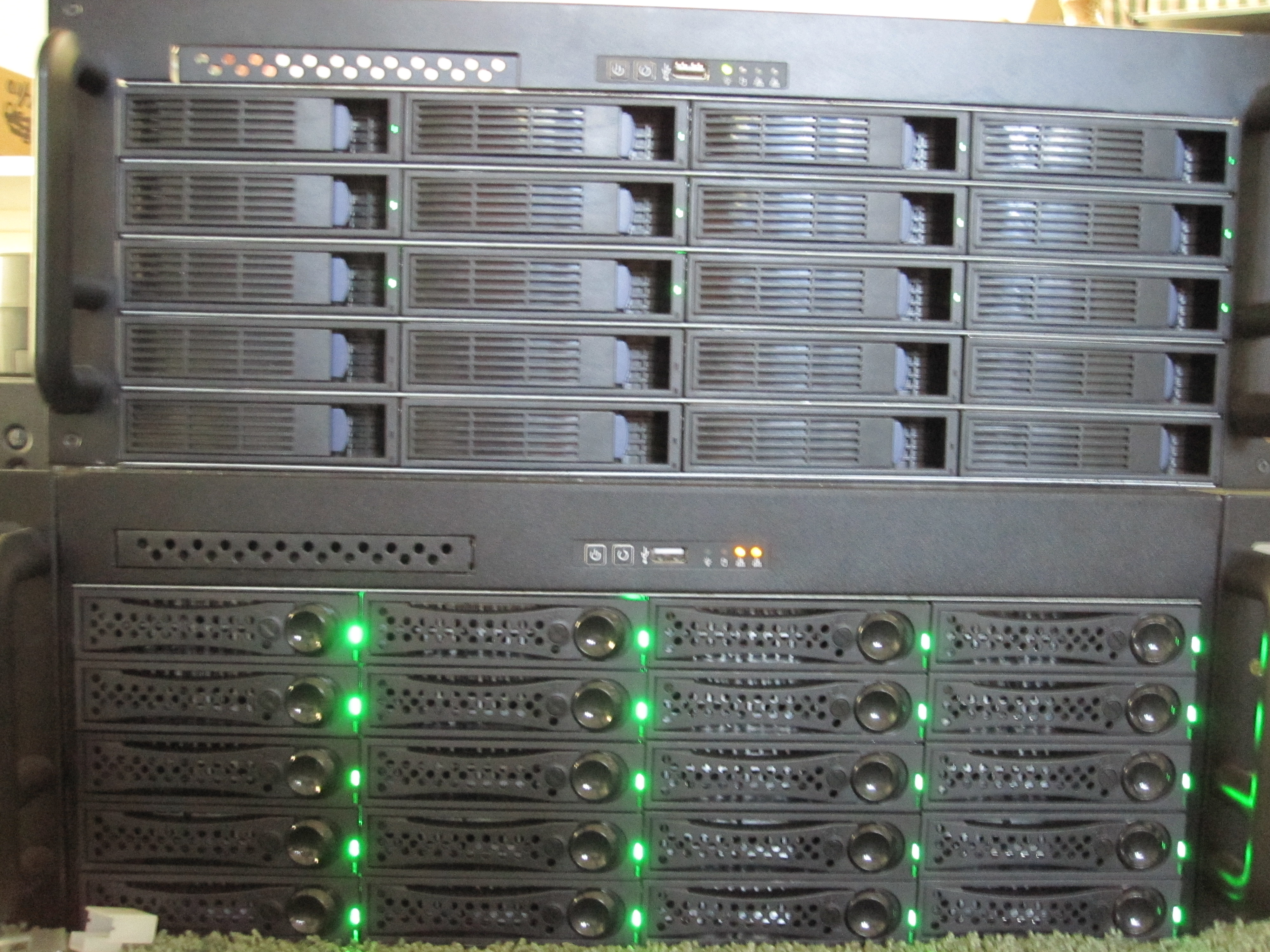
The Big WHS was originally supposed to house approximately 30TB of storage when the plans were first detailed on an Excel spreadsheet BOM in December 2009. This was a big upgrade to my first DIY Windows Home Server box that had well under 20TB. About five months later, the storage capacity has crested 60TB, with further room to expand. The Big WHS now spans two 4U Norco cases (using a total of 8U of rackspace and another 4U chassis is in the works) has over 60TB of storage, and requires well over a dozen ports on the gigabit switch.
Read the full story
Posted in The Big WHS
Posted on 20 May 2010. Tags: business storage, DDR3, dual nic, enormous benefit, eon zfs storage, expansion card, expansion slots, file server, flash drive, freenas, home server, home servers, htpc, intel xeon, internal usb header, motherboard, nics, Norco, openfiler, overclocking board, realtek nic, Review, server test, server v2, small business servers, storage drive, storage servers, Supermicro, Supermicro x8sil-f, test configuration, unraid, usb thumb drive, vail, virtual machine, WHS, Windows Home Server, windows home server v2 vail, x8sil-f, X8SIL-F v1.02
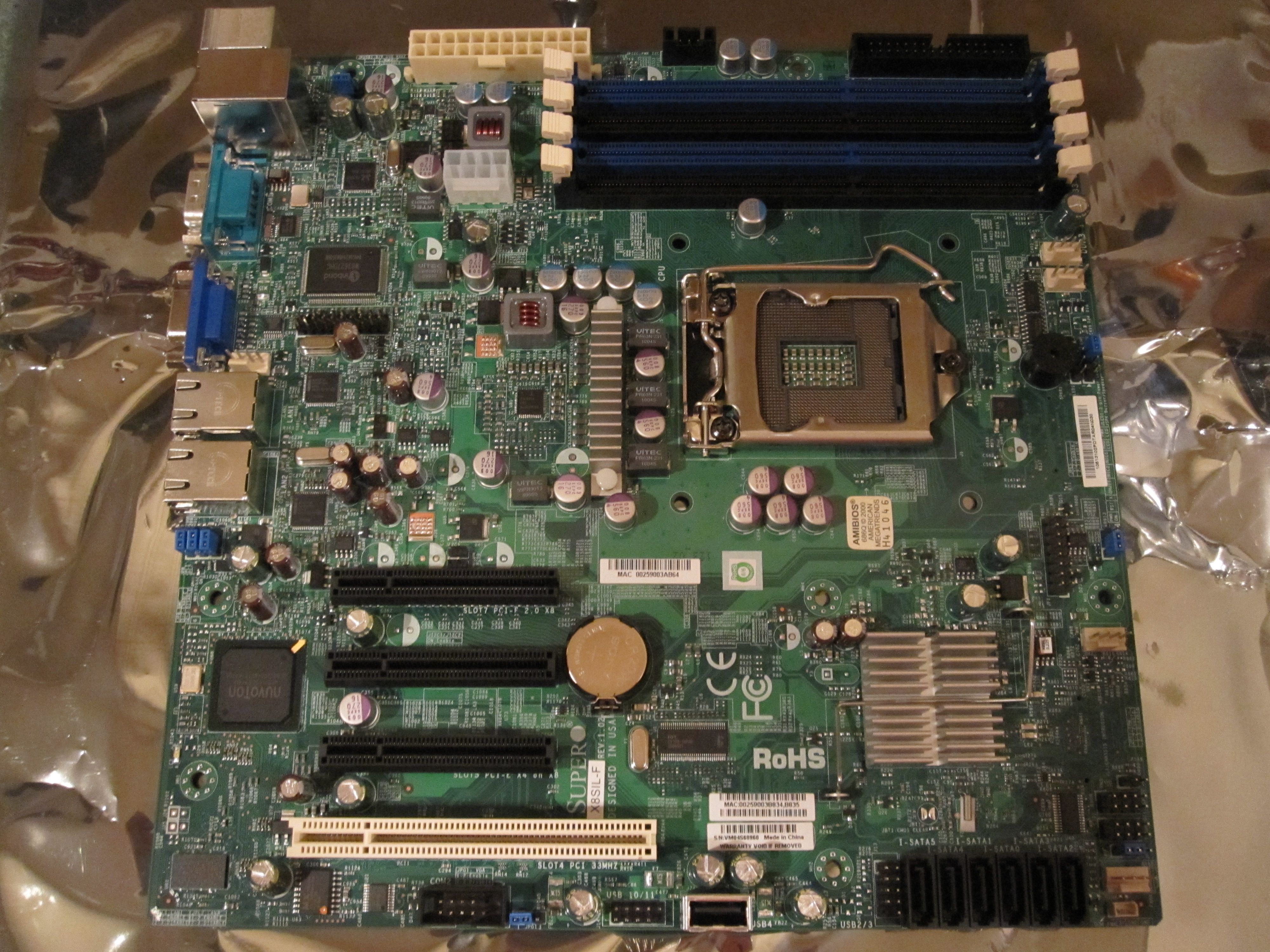
The Supermicro X8SIL-F motherboard is an excellent board for home and small business servers. When building a file server built upon Windows Home Server (V1 or V2 Vail) or another open source NAS project such as FreeNAS, Openfiler, EON ZFS storage, the Supermicro has a feature set that differentiates itself from both AMD and Intel based consumer-level motherboards. Compatibility with those operating systems and virtualization platforms such as Microsoft’s Hyper-V make the X8SIL-F a strong contender for a DIY storage or virtual machine server.
Read the full story
Posted in Motherboards
Posted on 03 May 2010. Tags: Areca, beep, bios update, dual intel, expansion cards, expansion slots, gigabit, google, google research, green ears, hitachi drives, home server, intel pro, lga, matx motherboard, network ports, server board, server v2, Supermicro, supermicro motherboard, Supermicro x8sil-f, x8, x8sil-f
Just as a quick note. I purchased a Supermicro X8SIL-F (mATX LGA 1156 server board with IPMI 2.0 and dual Intel gigabit NICs) last week, along with two 2TB Western Digital Green EARS drives using advanced format, and two Hitachi 2TB drives. First off, I was very excited about the X8SIL-F because it is a great mATX motherboard with IPMI 2.0, three PCIe x8 and one PCI slot with two onboard Intel NICs. My plan was to use those expansion slots for:
- PCIe #1: Areca ARC-1300
- PCIe #2: Intel Pro/1000 PT Dual
- PCIe #3: HP SAS Expander
- PCI #1: Intel Pro/1000 GT
That would give me well over 30 SATA ports (since there would be onboard SATA also) and five gigabit network ports (all Intel), and an option to expand to seven assuming I swapped the dual Intel NIC for a quad. I wanted to have a ZFS test box for FreeNAS/ OpenSolaris and for a physical or secondary Hyper-V installation of Windows Home Server v2 VAIL in the future. I had also ordered 4GB of ECC DDR3 1333 since I wanted lots of cache for ZFS.
Read the full story
Posted in Motherboards
Posted on 30 April 2010. Tags: adaptec, costly proposition, disk failure, home server, master boot record, parity, partitions, public preview, raid 0, raid 5 array, raid array, raid controllers, redundancy, Seagate, server v1, server v2, storage pool, storage pools, vail, western digital, WHS, Windows Home Server, windows home server v2
Windows Home Server v1 (WHS) was limited to using 2TB Master Boot Record (MBR) partitions in its storage pool, but the public preview of Windows Home Server V2 codename VAIL is not. This guide will show one how to use GPT Raid volumes passed through Windows Server 2008 R2 running Hyper-V into WHS V2 Codename VAIL. (That sounded way more complex than it actually is).
Read the full story
Posted in Windows Home Server
Posted on 29 April 2010. Tags: agility, conjecture, counterparts, default installation, disk space requirement, hard drives, home server, Norco, Raid 1, redundancy, rpc, SAS, server machines, server storage, server v2, SSD, system os, vail, vertex, whs v2, WHS V2 Vail, Windows Home Server, windows home server v2, windows home server vail, x25
Many Windows Home Server machines utilize a smaller OS disk (oftentimes in Raid 1 for redundancy) and then large SATA 3.5″ disks for storage. Common 2.5″ disks are laptop drives as well as SSDs. Another factor influencing their popularity in home-built WHS boxes is the fact that the
Norco RPC-4220 (a popular home server 4U rackmount enclosure) has the ability to house two 2.5″ hard drives in addition to 20 SAS or SATA drives. Smaller form factor drives tend to be of lower capacity than larger 3.5″ counterparts, so some users may be wondering with the new requirement of a 160GB Operating System (OS) disk in Windows Home Server (WHS) V2 Vail if it is possible to lower the OS disk space requirement.
Posted in Windows Home Server
Posted on 28 April 2010. Tags: amd cpus, amd phenom, black edition, consumption figures, core amd, cpu sockets, drives intel, dual core cpu, home server, imminent release, impending release, Norco, phenom II, phenom II x4 955, phenom II x4 955 be, phenom II x4 965, picopsu, power consumption, seagate momentus, server v2, test systems, WHS, x25, x4
After using one of the the lowest power AMD CPUs around, the Sempron 140 Sargas (single core) in a WHS, I decided to go to the other extreme and try a Phenom II X4 955 Black Edition. With the release of six core AMD CPU’s, and the existence of the Phenom II X4 965 Black Edition, the Phenom II X4 BE chip is not the highest end AMD CPU out there. On the other hand, WHS is currently based on the older 32-bit Windows Server 2003 kernel, so it runs on dual core CPU’s just fine. The impending release of Windows Home Server V2 VAIL means that 64-bit will be the new requirement and a bit more power will be needed for future WHS systems. A quad core is overkill but a six core CPU is basically a waste for WHS. Luckily, with the Phenom II X4 955 BE’s unlocked multiplier, we can emulate a Phenom II X4 965 BE through a very mild overclock, and some other AMD CPUs as well. The following is a quick review of what I encountered with the Phenom II X4 955 BE, and how I managed to get the Phenom II X4 955 to boot using the PicoPSU (to get comparable idle power consumption figures).

Phenom II X4 955 Boxed
Posted in Server CPUs
Posted on 26 April 2010. Tags: 1tb, Areca, case 2, codename, codename vail, codenamed, cpu intel, expanders, guest os, home server, host os, hyper-v, integration tools, intel pro, keyboard shortcuts, mouse support, Norco, public preview, server v2, test configuration, vail, vhd, virtual machine, virtualization, virtualized, vm, WHS, whs v2, windows home server v2, windows home server vail
If one browses this site they will quickly see that I am a fan of Hyper-V virtualization and also Windows Home Server. On April 26, 2010, Microsoft released the public preview of the long awaited Windows Home Server V2 codenamed VAIL. Of course, I did have a test system lying around, but the WHS V2 code base is supposed to be Windows Server 2008 R2 which is why it requires a 64-bit CPU. Now, I could have installed the VAIL preview onto a physical machine, but there are probably editors at 30 sites doing that right now. So how about something interesting, and more appropriate for software labeled beta and preview, a Hyper-V installation!
Read the full story
Posted in Hyper-V Virtualization, Operating Systems