

Supermicro is adding another motherboard to the burgeoning list of current LGA 2011 Intel Xeon E5 offerings with their X9SRL and X9SRL-F. The main difference between the Supermicro X9SRL-F motherboard and the X9SRL motherboard is that the Supermicro X9SRL-F has IPMI 2.0 remote management capabilities while the Supermicro X9SRL motherboard does not. This makes the Supermicro X9SRL motherboard slightly less expensive. Here’s the deal, the Supermicro X9SRL-F is an ATX motherboard with seven PCIe slots. The two physical x16 slots are PCIe x8 electrical so users looking to use x16 electrical cards such as GPUs or storage cards like the LSI 9202-16e may want to look at dual socket offerings. With that said, most cards are fine on a PCIe 3.0 x8 bus these days. The Supermicro X9SRL-F has tons of expansion options with a very small ATX footprint.
Most of the newer Intel Xeon E5 motherboards, even the Xeon E5-1600 series motherboards such as the ASUS P9X79 WS have run a bit larger. Being ATX size, there are many chassis and configuration options that open up. Supermicro also does a good job of keeping the space to the rear of the PCIe 3.0 slots free on the board. This means that SAS controllers and similar cards have space behind the slots.
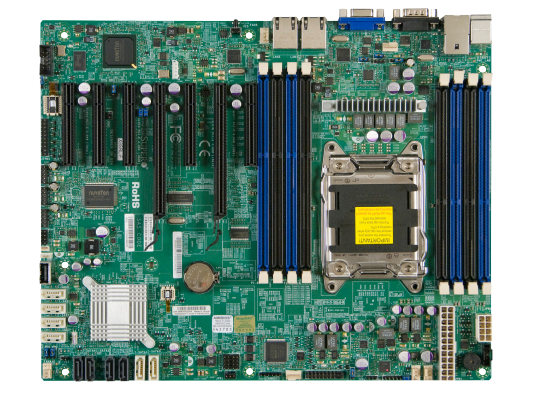
If one remembers my ordeal fitting the ASUS P9X79 WS into the Corsair Carbide 500R, having a smaller motherboard does make life easier as there are several smaller form factor workstation enclosures that cannot handle EATX or larger server or workstation motherboards.
Supermicro X9SRL-F Motherboard Specifications
Here is a quick look at the Supermicro X9SRL-F motherboard specifications which appear to be great for those using many PCIe 3.0 x8 devices in a UP Intel Xeon E5 server:
|
|||
| Form Factor | ATX | ||
| Dimensions | 12″ x 9.6″, (30.5cm x 24.4cm) | ||
| Processor/Cache | |||
| CPU | Intel Xeon processor E5-2600/E5-1600 family (up to 8 cores and up to 130W) | ||
| Single Socket R (LGA 2011) | |||
| System Memory | |||
| Memory Capacity | 8x 240-pin DDR3 DIMM sockets | ||
| Supports up to 256 GB DDR3 ECC Registered memory (RDIMM) | |||
| Supports up to 64 GB DDR3 ECC and non-ECC UDIMM | |||
| Memory Type | 1600/1333/1066MHz ECC DDR3 SDRAM 72-bit, 240-pin gold-plated DIMMs | ||
| DIMM Sizes | 32GB, 16GB, 8GB, 4GB, 2GB, 1GB | ||
| Memory Voltage | 1.5 V, 1.35 V | ||
| Error Detection (using ECC memory) | Corrects single-bit errors | ||
| Detects double-bit errors | |||
| On-Board Devices | |||
| Chipset | Intel C602 chipset | ||
| SATA | SATA3 (6Gbps) and SATA2 (3Gbps) | ||
| RAID 0, 1, 5, 10 support | |||
| IPMI | Support for Intelligent Platform Management Interface v.2.0 | ||
| IPMI 2.0 with virtual media over LAN and KVM-over-LAN support | |||
| Nuvoton WPCM450RA0BX | |||
| Network Controllers | Intel® 82574L Dual Port Gigabit Ethernet | ||
| Virtual Machine Device Queues reduce I/O overhead | |||
| Supports 10BASE-T, 100BASE-TX, and 1000BASE-T, RJ45 output | |||
| Video | Matrox G200eW 16MB DDR2 graphics | ||
| Input / Output | |||
| SATA | 2x SATA 3.0 ports (6Gbps) | ||
| 4x SATA 2.0 ports (3Gbps) | |||
| SCU | 4x SATA ports (3Gbps) via SCU | ||
| LAN | 2x RJ45 Gigabit Ethernet LAN ports | ||
| 1x RJ45 Dedicated IPMI LAN port | |||
| USB | 9x USB 2.0 ports total (2x rear + 6x via header + 1x Type A) | ||
| Video | 1x VGA port | ||
| Keyboard/Mouse | 2x PS/2 Keyboard/Mouse ports | ||
| Serial Port / Header | 1x serial port, 1 by headers | ||
| DOM | 1x DOM (Disk on Module) power connector | ||
| TPM | 1x TPM 1.2 20-pin header | ||
| Expansion Slots | |||
| PCI-Express | 2x PCI-E 3.0 x8 (in x16) slots | ||
| 2x PCI-E 3.0 x8 slots | |||
| 2x PCI-E 3.0 x4 (in x8) slots | |||
| 1x PCI-E 2.0 x4 (in x8) slot | |||
| System BIOS | |||
|
128Mb SPI Flash EEPROM with AMI BIOS | ||
| BIOS Features | Plug and Play (PnP) | ||
| APM 1.2 | |||
| DMI 2.3 | |||
| PCI 2.3 | |||
| ACPI 1.0 / 2.0 / 3.0 / 4.0 | |||
| USB Keyboard support | |||
| Hardware BIOS Virus protection | |||
| SMBIOS 2.7.1 | |||
| UEFI | |||
| RTC (Real Time Clock) Wakeup | |||
| Management | |||
| Software | IPMI (Intelligent Platform Management Interface) v1.5 / 2.0 with KVM support | ||
| SuperDoctor III | |||
| Watch Dog | |||
| NMI | |||
| Power Configurations | ACPI / APM Power Management | ||
| Keyboard Wakeup from Soft-Off | |||
| CPU Fan auto-off in sleep mode | |||
| Power-on mode for AC power recovery | |||
Supermicro X9SRL-F Motherboard Pricing
Price wise I did not see these on Newegg, but Amazon.com had the Supermicro X9SRL-F motherboard for around $325. At $325, one might want to look at dual socket motherboards with onboard devices already built-in to save some money, especially if you are looking to build a similar configuration through add-in cards. One of the big bonuses here is that the Supermicro X9SRL-F motherboard still uses a relatively small ATX form factor so it can be used in a variety of cases.

I’m looking at this motherboard for a home lab server but it’s not on either VMware’s HCL or Supermicro’s OS compatibility list for vSphere. I’m hoping that’s simply because it’s new? The X9SRW-F is listed as compatible and the only real difference looks to be the proprietary MB size, NIC model and some PCI 3 support.
Has anyone got one of these and tried to install ESXi v5 yet?
This board looks ABSOLUTELY killer.
I’ve got this running on ESXi v5… runs like a top!
Is (free) ESXi still limited to 32GB RAM at v5.1? I’m seriously looking at this board for home AV/lab server, with a major plus being the option to go 32 then later 64GB. But pretty sure I may have to get to grips with Xen to leave the door open!
Watch out for the LGA2011 Socket R and the Heatsinks you are planning to use. This LGA2011 socket has Narrow ILM screws, most LGA2011 cooling (or watercooling) solutions will NOT fit.
Check http://www.servethehome.com/narrow-ilm-square-ilm-lga2011-heatsink-differences/
Do you know if the PCI-e slots can support more than 25 watts of power? My storage cards need 50.
p.s. it is a joke that vendors can get away with putting x16 connectors on an x8 slot…. the proper way to do this is to use open-ended connectors like they do on the X9DR7-LN4F
Mark – that is something you would need to ask Supermicro. What cards are you using that take 50w? You might try the STH forums with that information to see if anyone has tried a similar setup.
Great Product. Terrible end user support
Pro
Good basic board – IPMI, SATA ports, PCI-e slots, 8 DIMMs…
Cons
1. This requires a small CPU cooler.
2. Supermicro customer support does not exist for end users. Not even a user forum.4
3. Only usb 2.0.
Thoughts
I have had issues getting this motherboard to work with a AX-860-i (Corsair) PSU. On power down the PC flicks on and off continuously until I unplug it. Corsair provided an RMA of the unit without question. I replaced the unit. Same problem. Out of desperation I used a Corsair TX650 PSU and I do not have these same issues. There is no way for me, an end user to report these types of things to Supermicro to request a BIOS update for controlling the digital PSU. According to Corsair, when they contacted Supermicro, their response is that I should use a Supermicro PSU.
Lesson learned. Corsair has great customer support. Supermicro doesn’t care unless you are an integrator. I wonder what company will get follow on business from me…
The board itself is a great server class motherboard. I would give it five stars. On the other hand, I give the company 0 stars.
Current Build:
Motherboard Supermicro x9srl-f
Processor Intel® Xeon® Processor E5-1650 v2
Intended Power Supply AX-860-i (Corsair) Current Power Supply Corsair TX650
Case 780T (Corsair)
Memory 32gb (4 * 8gb ecc modules.)
Video Card Asus GeForce GTX 960 – 2gb
Intel 730 SSD – 480 GB
JW